
F-150 vs RAM 1500: An Honest Truck Comparison for Ontario Buyers

By Navin Kotecha, The Car Doctor
Published
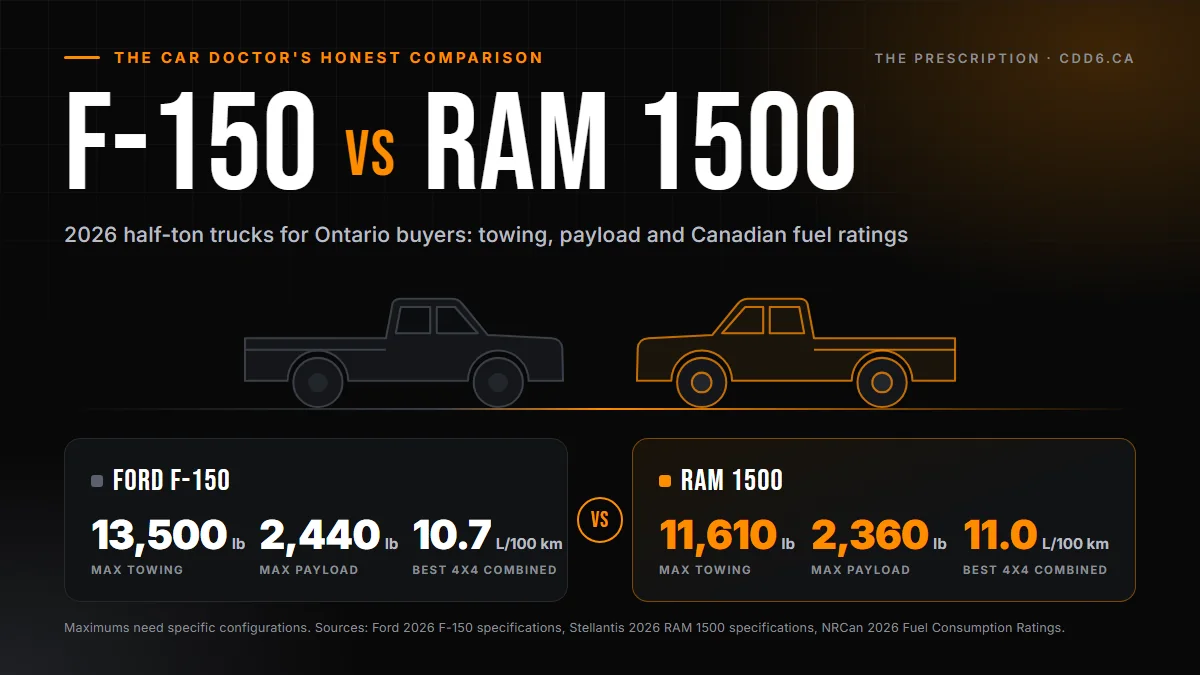
Full disclosure before anything else: I sell RAM trucks. Golden Mile Chrysler is a Chrysler, Dodge, Jeep and RAM store, so you would expect me to tell you the RAM 1500 wins every round. It does not, and pretending otherwise would waste your time. The Ford F-150 and the RAM 1500 are both excellent half-ton trucks. Each one is better at some things, and which one is worth your money depends on what you actually do with a truck in and around Toronto.
So this is the straight comparison, aspect by aspect, with the best and the worst of each. Every spec below comes from Ford's and Stellantis's own published 2026 figures, and the fuel numbers come from Natural Resources Canada, so they are in litres per 100 km, the way you will actually measure them at the pump. One thing you will not find here is a price. Prices, rates and incentives change every month and depend on the trim, so this guide answers "worth it" as value for your use, not as a sticker comparison. When you are ready to talk numbers on a RAM, the RAM 1500 page is where they live.
The short answer
If you tow right at the limit of what a half-ton can do, or you want a full hybrid with a big built-in generator, the F-150 has the edge on paper. If you want the smoothest ride on broken pavement, the segment's biggest available screen (by Ram's count), clever storage like RamBox and a 10-year powertrain warranty, the RAM 1500 is the one to look at. Most buyers sit somewhere in the middle, and for them the honest answer is a back-to-back test drive on the same road. Here are the key specs side by side before we go through them one at a time.
| Spec | Ford F-150 | RAM 1500 |
|---|---|---|
| Max towing | 13,500 lb (3.5L EcoBoost SuperCrew, Max Tow package) | 11,610 lb (3.0L Hurricane) |
| Max payload | 2,440 lb | 2,360 lb (3.6L Pentastar eTorque) |
| Engines | 2.7L and 3.5L EcoBoost V6, 5.0L V8, 3.5L PowerBoost hybrid; Raptor: 3.5L high-output, supercharged 5.2L V8 | 3.6L Pentastar V6 eTorque, 3.0L Hurricane inline-six (standard and high output), 5.7L HEMI V8 eTorque |
| Transmission | 10-speed automatic | 8-speed automatic |
| Rear suspension | Leaf springs (five-link coil on Raptor) | Five-link coil; available four-corner air |
| Largest screen | 12 in (as cited by Ram Canada) | 14.5 in Uconnect 5 (8.4 in standard) |
| Bed and tailgate | Pro Access tailgate; Pro Power Onboard up to 7.2 kW | RamBox bed storage; multifunction tailgate with bed step |
| Best combined, 4x4 | 10.7 L/100 km (PowerBoost hybrid) | 11.0 L/100 km (3.6L eTorque) |
| Powertrain warranty, Canada | Ask Ford for its terms in writing | 10 years or 160,000 km |
Source: Ford Canada and Ford's 2026 F-150 specifications; Stellantis, Stellantis Canada and Ram Canada; NRCan 2026 Fuel Consumption Ratings.
Capability: towing, payload and engines
F-150. Ford rates the 2026 F-150 at up to 13,500 lb (about 6,120 kg) of conventional towing and up to 2,440 lb (about 1,105 kg) of payload when properly equipped. That top towing figure needs a 3.5L EcoBoost SuperCrew with Ford's Max Tow/Haul package and Max Tow axle. The engine list is the widest in this fight: 2.7L EcoBoost V6, 3.5L EcoBoost V6, 5.0L V8, the 3.5L PowerBoost full hybrid, plus a high-output 3.5L for the Raptor and a supercharged 5.2L V8 for the Raptor R. All of them run a 10-speed automatic.
RAM 1500. Stellantis lists the 2026 RAM 1500 at up to 11,610 lb (about 5,265 kg) of towing with the 3.0L Hurricane twin-turbo inline-six (420 hp, 469 lb-ft) and up to 2,360 lb (about 1,070 kg) of payload with the 3.6L Pentastar V6 eTorque. In Canada the Pentastar is standard on Tradesman, Express, Big Horn and Warlock; the standard-output Hurricane comes on Sport, Rebel and Laramie; and the 540 hp high-output Hurricane powers Limited, Limited Longhorn, Tungsten and RHO. The 5.7L HEMI V8 with eTorque (395 hp, 410 lb-ft) is back for 2026, and in Canada it is ordered on nine Crew Cab 4x4 trims with the 5-foot-7 box, rated for up to 4,350 kg (9,590 lb) of towing. Every RAM 1500 uses an 8-speed automatic. The chart below puts the towing ratings side by side.
Maximum rated towing, 2026
Ford publishes one top figure for the F-150, for a 3.5L EcoBoost SuperCrew with the Max Tow package; other F-150 builds are rated lower. The HEMI figure is the Canadian rating for the Crew Cab 4x4 with the 5-foot-7 box; the other RAM figures are Stellantis's North American maximums per engine.
Source: Ford Canada and Ford's 2026 F-150 specifications; Stellantis and Stellantis Canada.
Best of the F-150: the highest published towing and payload numbers, and the most engine choices, including a true full hybrid. Worst of the F-150: those headline numbers belong to very specific builds, and many trucks are rated well below them. Best of the RAM 1500: the standard-output Hurricane makes big torque from a six-cylinder, and V8 loyalists can get a HEMI again. Worst of the RAM 1500: its maximum towing number is lower than Ford's, the Canadian HEMI comes in one cab and box configuration only, and the 540 hp Hurricane gives up towing and payload for performance. Payload tells the same story, engine by engine:
Maximum rated payload, 2026
Source: Ford Canada and Ford's 2026 F-150 specifications; Stellantis and Stellantis Canada.
Doctor's note: both makers say their maximums are not achieved together and drop with options, passengers and cargo. Before you hook up a trailer, read the payload label on the driver's door jamb of the exact truck you are buying. That sticker beats any brochure.
Ride and comfort
This is where the two trucks are built differently. The RAM 1500 uses a five-link rear suspension with coil springs, and offers an Active-Level four-corner air suspension that can raise and lower the truck. Ford's own 2026 spec sheet lists a leaf-spring rear on the F-150, with a five-link coil setup reserved for the Raptor.
Best of the RAM 1500: coils, and especially the air suspension, are designed for a settled ride with an empty bed, which is how most trucks in the GTA spend most of their time: commuting on the 401, crawling the DVP, bouncing over spring potholes and streetcar tracks downtown. Worst of the RAM 1500: air suspension is one more system to maintain over the long run. Best of the F-150: leaf springs are simple, proven and made for heavy loads. Worst of the F-150: an unladen leaf-sprung rear can feel busier over rough pavement. Don't take my word on ride. Drive both on the same broken road, with the bed empty, and decide for yourself.
If you want to see the two trucks driven and towing back to back before you come in, Edmunds ran exactly that test. It uses the previous model years, so treat it as a look at how each truck drives, and use the 2026 numbers on this page for the specs.

Interior and technology
RAM Canada lists an 8.4-inch Uconnect 5 touchscreen as standard and offers a 14.5-inch screen, which Ram compares with a 12-inch maximum on the F-150. Upper trims add a 12.3-inch digital cluster and heated and ventilated front seats. Ford answers with useful ideas of its own: an available Interior Work Surface, where the shifter stows and the centre console folds out into a flat desk, and BlueCruise hands-free highway driving on select trims, which Ford says works on 97% of controlled-access highways in the U.S. and Canada.
Best of the RAM 1500: the big screen and a cabin that leans toward comfort. Worst of the RAM 1500: the base screen is a lot smaller than the headline one, so check which trim you are really looking at. Best of the F-150: the fold-out work surface for anyone who runs a business from the cab, and hands-free highway driving for long 401 runs. Worst of the F-150: by Ram's comparison its largest screen is 12 inches, and BlueCruise is limited to certain trims.
Bed and tailgate
The RAM 1500 offers RamBox, storage bins built into the sides of the bed with LED lighting, and a multifunction tailgate with a centre bed step. The F-150 offers the Pro Access tailgate, which swings open 100 degrees and sits 19 inches closer to the bed than a regular tailgate, so you can reach the bed while a trailer is hitched. Ford also offers Pro Power Onboard with up to 7.2 kW of usable power from outlets in the bed.
Best of the RAM 1500: RamBox keeps tools, a jump pack or wet winter gear out of the cab. Worst of the RAM 1500: RamBox is an option, not standard. Best of the F-150: Pro Power Onboard turns the truck into a jobsite or cottage generator, and the Pro Access tailgate is genuinely handy when towing. Worst of the F-150: Ford presents the full 7.2 kW output with the hybrid, so check what your configuration actually gives you.
Fuel economy: the Canadian numbers
Here are the combined ratings for 2026 4x4 models, charted below, from the Natural Resources Canada fuel consumption ratings. F-150: 10.7 L/100 km for the PowerBoost hybrid, 11.8 for the 2.7L EcoBoost, 12.3 for the 3.5L EcoBoost and 12.8 for the 5.0L V8. RAM 1500: 11.0 L/100 km for the 3.6L Pentastar eTorque, 11.7 for the standard-output Hurricane, 13.3 for the HEMI eTorque and 13.8 for the high-output Hurricane.
Combined fuel consumption, 2026 4x4 models (lower is better)
Source: Natural Resources Canada, 2026 Fuel Consumption Ratings (dataset updated 2026-10-06).
Best of the F-150: the hybrid is the most efficient 4x4 in this comparison. Worst of the F-150: the V8 and the bigger EcoBoost use more. Best of the RAM 1500: the Pentastar eTorque is close behind Ford's hybrid, and the standard-output Hurricane beats both of Ford's 2.7L and 3.5L EcoBoost ratings while running on regular fuel. Worst of the RAM 1500: the HEMI and the high-output Hurricane are the thirstiest here, and NRCan lists the high-output Hurricane on premium. These are lab ratings. Winter driving, short trips and idling in traffic will push every one of these numbers up.
Winter, salt and Toronto parking
Both trucks come in 4x4. Ford uses an electronic shift-on-the-fly system on XL, STX and XLT and a two-speed automatic four-wheel-drive system on Lariat, King Ranch and Platinum. RAM offers an electronic shift-on-demand transfer case and, on some trims, an electronic locking rear axle, and every Canadian HEMI truck is 4x4. Honestly, in a Toronto winter the tires matter more than the badge. Put a proper set of winter tires on either truck and both will get you up a snowy side street.
On salt: Ford builds the F-150 body from aluminum alloy on a steel frame, and every truck's frame, brake lines and underbody take a beating from Ontario road salt. Whichever you buy, rinse the underside through the winter. On parking: a Crew Cab half-ton is a big vehicle. If you live in a condo with a tight underground garage or have a laneway garage, measure the space and the ramp clearance before you fall in love with either truck.
Ownership and warranty
The 2026 RAM 1500 in Canada is backed by a 10-year or 160,000 km limited powertrain warranty, according to Stellantis Canada. Ask Ford for its powertrain terms in writing and put the two side by side, because on a truck you plan to keep, coverage length is real money saved. Ram Canada also cites the RAM 1500 receiving the fewest reported problems in its segment in the J.D. Power 2026 U.S. Vehicle Dependability Study, which was based on 2023 models. That is a U.S. study of three-year-old trucks, so treat it as one data point, not a promise.
Something you won't read on a comparison site: both of these trucks come through our used lot. Golden Mile Chrysler's used inventory this year has included F-150s with 2.7L and 3.5L V6 engines, and RAM 1500s with the Hurricane six and the HEMI V8. If a nearly new truck makes more sense for you than a new one, have a look at our used cars and the used RAM 1500 page. And if you are torn between owning and leasing, read lease vs finance before you decide.
So which one is worth it?
Buy the F-150 if you tow heavy and often and want the highest rated capability, if a full hybrid and onboard generator power fit your work, or if hands-free highway driving matters to you. Buy the RAM 1500 if most of your driving is commuting and family duty on rough Toronto roads, if you want the bigger screen and a comfort-first cabin, if RamBox storage suits your life, or if the 10-year powertrain warranty tips your math. Either way, you are buying a good truck. Get the one that fits the life you actually live, not the one with the biggest number in the ad.
If the RAM side of this list sounds like you, start with the RAM 1500 page, browse the rest of the RAM lineup, or see how RAM 1500 financing works. Then call me. I will tell you straight which trim makes sense, and if a RAM is not the right truck for you, I will tell you that too.
F-150 vs RAM 1500: Common Questions
Can the F-150 tow more than the RAM 1500?
On paper, yes. Ford rates the 2026 F-150 at up to 13,500 lb of conventional towing with a specially equipped 3.5L EcoBoost SuperCrew, while Stellantis rates the 2026 RAM 1500 at up to 11,610 lb with the 3.0L Hurricane. Most trucks are not built to those maximums, so check the rating of the exact truck you are considering.
Which uses less fuel, the F-150 or the RAM 1500?
Among 2026 4x4 models in Natural Resources Canada's ratings, the F-150 PowerBoost hybrid is the most efficient at 10.7 L/100 km combined, with the RAM 1500 3.6L Pentastar eTorque next at 11.0. The RAM's standard-output Hurricane (11.7) rates better than the F-150's 2.7L (11.8) and 3.5L (12.3) EcoBoost engines.
Is the RAM 1500 more comfortable than the F-150?
The RAM 1500 uses coil springs at the rear and offers four-corner air suspension, while the F-150 uses leaf springs at the rear on most trims. Coils and air are designed for a smoother ride with an empty bed, but comfort is personal. Drive both on the same rough road before you decide.
Can you still get a HEMI V8 in a 2026 RAM 1500 in Canada?
Yes. The 5.7L HEMI V8 with eTorque returned for 2026. In Canada it is offered on nine Crew Cab trims with the 5-foot-7 box, always with 4x4, and is rated for up to 4,350 kg (9,590 lb) of towing.
Which truck is better for a Toronto winter?
Both offer capable 4x4 systems, and either will handle a Toronto winter well on proper winter tires, which matter more than the brand. Look at the 4x4 system on the specific trim, plan to rinse road salt off the underside, and measure your garage if you park underground.
Talk to the Car Doctor
Straight answers, no games, no runaround. The line is open.
437-371-5007