Types of Car Suspension Explained: Strut, Wishbone, Multi-Link, Solid Axle and Which Matters Most

By Navin Kotecha, The Car Doctor
Published
Car suspensions come in two families: independent, where each wheel moves on its own, and dependent (a solid axle), where the wheels on an axle are tied together. The layouts you will meet most are the MacPherson strut, double wishbone, multi-link, twist beam and solid axle. Which matters most depends on whether you commute, tow or go off-road.
Here is what each design does well, what it gives up, and how to weigh it. Air springs get their own guide.
What is the difference between independent and dependent suspension?
A solid axle uses one rigid housing across the vehicle to locate both wheels. It is strong, simple and long-lasting, which is why pickups, off-roaders and commercial vehicles still use it. The catch, as Car and Driver explains, is that a bump under one wheel also disturbs the wheel on the other side. When the axle also drives the wheels, its differential and shafts all add unsprung weight, and the ride suffers for it.
Independent suspension lets each wheel deal with the road by itself. Road & Track lists the payoff: tighter wheel control, lighter unsprung mass and more precise steering. That is why almost every new car, SUV and truck now has it at the front.
Every independent design does the same basic job: it has to manage five kinds of wheel movement. Those are bump (up), rebound (down), side to side, fore and aft, and camber, which is how far the tire leans relative to the road. Both evo and Road & Track frame it this way. What separates the designs is how many arms and links they use to get it done.

What are the main types of car suspension?
| Layout | Independent? | Good at | Gives up | Usually found |
|---|---|---|---|---|
| MacPherson strut | Yes | Compact, light and cheap to build; leaves room for front driveshafts | Weaker camber control in hard cornering | Front of most front-drive cars and crossovers |
| Double wishbone (A-arms) | Yes | Precise wheel control; keeps the tire flatter in corners | More parts, higher cost, needs more room | Sports and performance cars |
| Multi-link | Yes | Most tuning freedom; ride and handling can be tuned separately | Most complex; costs more than a strut | Rear of many cars, crossovers and SUVs |
| Twist (torsion) beam | Not fully | Cheap, compact, frees up cargo space | Not truly independent; stiffer bushings bring more impact harshness | Rear of economy cars |
| Solid (live) axle | No | Strength, durability, simplicity, off-road articulation | One wheel's bump upsets the other; heavy unsprung weight hurts ride | Pickups, off-roaders, commercial vehicles |
Source: Car and Driver; Road & Track on double wishbones and struts; Road & Track on multi-link; evo on double wishbones; evo on MacPherson struts; Hagerty; Road & Track on the Bronco.
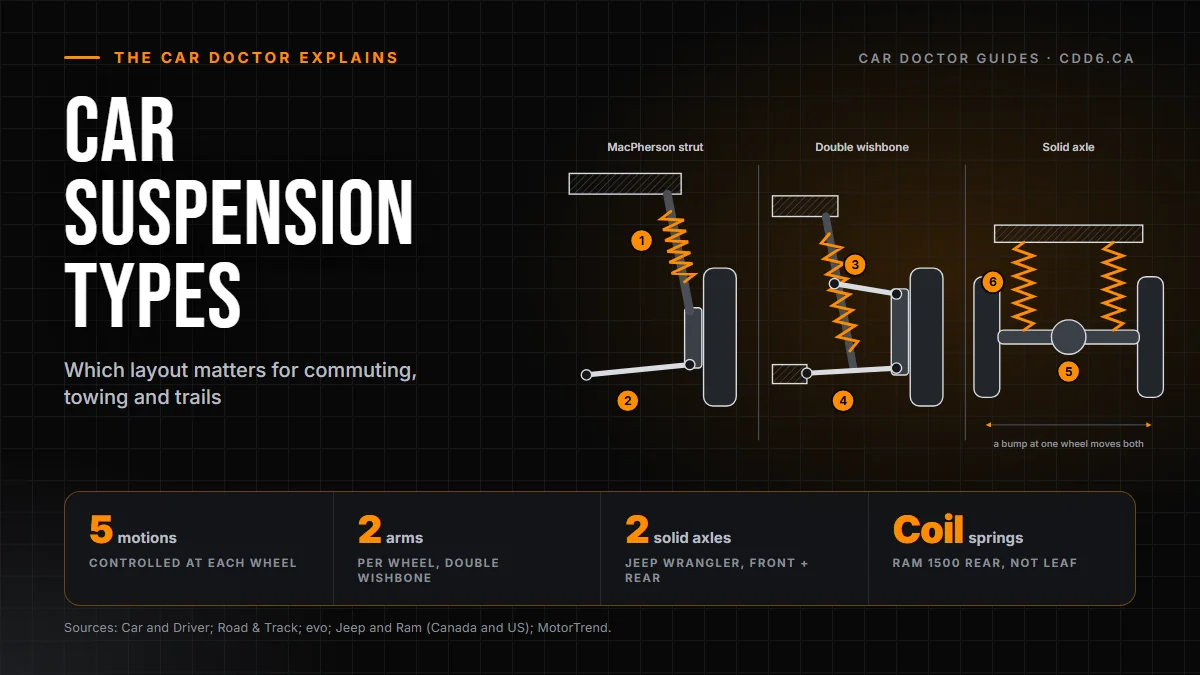
Three common layouts, seen from the front
- StrutA damper with a coil spring around it is the upper locating point, so there is no upper arm.
- Lower control armLocates the bottom of the wheel. Strut and arm together make a compact, light and low-cost layout.
- Upper arm (shorter)Making it shorter than the lower arm improves the tire's camber as the body rolls, for more grip.
- Lower arm (longer)With two arms, the wheel's motion and camber are controlled better than with a strut.
- Solid axle housingHolds both wheels, so a bump at one also moves the other. It is tough and simple, which is why off-roaders and pickups keep it.
- Coil springCarries the vehicle's weight, while the damper controls how the spring moves.
Strut and double wishbone are independent; the solid axle ties both wheels together. Simplified drawing; the layout differs between vehicles.
Source: Labels from caranddriver.com, roadandtrack.com, evo.co.uk, hagerty.com.
MacPherson strut
Earle MacPherson worked out this design at GM in the 1940s. The shock absorber, with a coil spring around it, doubles as the upper mount that locates the wheel, so there is no upper arm at all. That makes it narrow, light and inexpensive, and it leaves space for the driveshafts in a front-drive car. Hagerty notes that it needs a unibody for the top of the strut to bolt to, so it does not suit body-on-frame trucks. The compromise, per evo, is less camber control when you push hard through a corner.
Double wishbone
Two arms, one stacked over the other, hold the wheel. Engineers usually make the top arm shorter than the bottom one, which lets the outside tire lean in as the body rolls and keeps more rubber on the road. The downside is more parts and more space under the hood, so automakers tend to save it for vehicles where handling comes first.
Multi-link
Instead of two wishbones, a multi-link setup uses several separate links, including at least three that run side to side. Because each link has its own job, engineers can tune comfort and cornering with fewer trade-offs than any other layout. It costs more than a strut, but it sits low, which is why Road & Track says it suits crossovers and SUVs that need the cargo room.
Twist beam and solid axle
A twist beam joins two trailing arms with a cross member built to flex as the wheels move. It is cheap and compact, so the least expensive cars use it at the rear, but it is not truly independent. Off-roaders prize the solid axle for durability, flex and simplicity, and the current Jeep Wrangler still uses solid axles front and rear.
Coil, leaf or air: what actually holds the vehicle up?
The layout is only half the story; the spring is the other half. Most passenger vehicles ride on coil springs. Leaf springs are common on pickups and other vehicles built to carry heavy loads, according to Air Lift, a suspension maker.
The RAM 1500 breaks that pattern. Every 2026 RAM 1500 uses coil springs at the rear rather than the leaf springs found on its domestic rivals, which Car and Driver credits for its comfortable ride and Ram Canada calls class-exclusive. Select crew cab models can also be ordered with four-corner air suspension, which adjusts ride height and lowers the truck automatically to cut drag. See the current RAM 1500 page for this month's deal.
What are adaptive and magnetic dampers?
Springs carry the weight; dampers, or shocks, slow down how the spring moves so the car doesn't keep bouncing. Adaptive dampers can change that firmness while you drive. The best-known version is GM's Magnetic Ride Control. Its shocks are filled with fluid carrying iron particles, and electromagnetic coils change how thick that fluid is many times a second, so the damping adjusts to the road and to the driver. Popular Mechanics and MotorTrend both note that GM originated it and that brands such as Audi and Ferrari have used it since.
Which type of suspension matters most for you?
Which layout suits what
Most front ends
The MacPherson strut is the most popular front setup, common on front-drive cars.
Handling first
Double wishbone gives better camber control than a strut, at a higher cost.
Ride and space
Multi-link tunes ride and handling with fewer compromises and needs less height, which suits SUVs.
Trails
Off-roaders like solid axles for toughness and articulation; the Wrangler has them front and rear.
Towing and payload
A live rear axle usually carries higher payload and towing ratings than an independent rear.
There is no single best suspension, only the one that matches how you drive.
| How you drive | What to look for | Why |
|---|---|---|
| Commuting: city streets, the 401, the DVP | Independent at both ends; multi-link or double wishbone rear; adaptive dampers if offered | Each wheel handles its own bump, and multi-link lets engineers tune for comfort without giving up handling |
| Towing and hauling | A live rear axle or a rear setup rated for your load; self-levelling air suspension if available | Live axles have long been the payload and towing workhorse, and air springs keep the truck level with weight on the hitch |
| Off-road trails | Solid axles, or an independent front with a disconnecting stabilizer bar | Solid axles are durable and articulate well; most independent fronts offer less travel |
Source: Car and Driver on suspension types; Car and Driver on live axles vs independent rear; Road & Track on multi-link; Road & Track on the Bronco; Road & Track on off-roading with independent front suspension; Popular Mechanics on air suspension for towing. Guidance, not a ranking.
Commuting. For stop-and-go traffic and broken pavement you want independent suspension, and nearly every new vehicle has it up front. Test-drive on a rough street you know before you decide.
Towing and hauling. Car and Driver points out that a live rear axle is the traditional choice for payload and towing, and that an independent rear typically carries lower ratings than an otherwise equal live axle. Air suspension helps by keeping the truck level when the trailer tongue pushes the rear down. One caution from both MotorTrend and Air Lift: adding air helper springs does not raise the payload or towing rating on your door sticker. Always stay within the ratings for your exact truck.
Off-road. Independent suspension has a lot going for it on the trail, but Road & Track notes it is generally less stout than a live axle, and most designs give up some wheel travel. If rock crawling is the plan, the Wrangler's solid axles are the classic answer; our guide to Jeep Wrangler 4WD covers the 4x4 systems that go with them.
Car Suspension Types: Common Questions
What are the main types of car suspension?
The five layouts you will see most are the MacPherson strut, double wishbone, multi-link, twist beam and solid axle. The first three are independent, meaning each wheel moves on its own. A twist beam is only partly independent, and a solid axle ties both wheels on that axle together.
Is independent suspension better than a solid axle?
On pavement, usually yes: independent suspension gives better wheel control, less unsprung weight and more precise steering. A solid axle wins on strength, durability and simplicity, which is why it survives in pickups, work vehicles and serious off-roaders like the Jeep Wrangler.
What suspension does the Jeep Wrangler use?
The 2026 Jeep Wrangler uses solid axles at both the front and the rear, as Jeep, Car and Driver and MotorTrend all confirm. That layout trades some on-road refinement for durability and articulation on rough trails.
Does the RAM 1500 have leaf springs?
No. The 2026 RAM 1500 uses coil springs at the rear, where its domestic full-size rivals use leaf springs. Car and Driver credits the coils for the truck's comfortable ride. Select crew cab models can also be ordered with four-corner air suspension.
What is the best suspension for towing?
Look for a rear setup rated for your load, traditionally a live axle, and self-levelling air suspension if it is offered, since it keeps the truck level with weight on the hitch. Whatever the hardware, the limits are your truck's published payload and towing ratings; helper springs do not raise them.
What is a MacPherson strut?
It is a front suspension where the shock absorber, with a coil spring around it, also acts as the upper mount for the wheel, so there is no upper control arm. It is compact, light and cheap, which is why most front-drive cars use it, but it controls camber less well in hard cornering.
See this month's RAM 1500 deal: coil springs out back, air suspension available
Talk to the Car Doctor
Straight answers, no games, no runaround. The line is open.
437-524-1747