Window Tint in Ontario: What the Law Allows, and the Film Spec Worth Paying For

By Navin Kotecha, The Car Doctor
Published
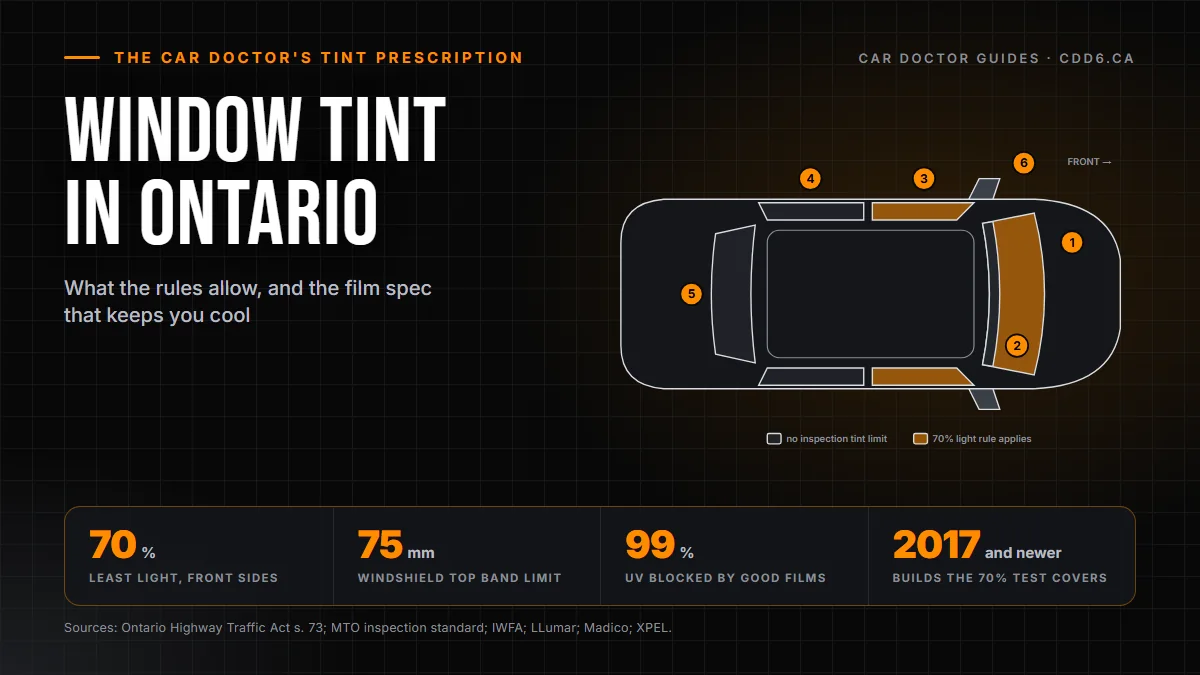
In Ontario, a vehicle built from January 1, 2017 onward fails its safety inspection if any aftermarket tint is on the windshield or if a front side window passes under 70 per cent of light. On the road, the Highway Traffic Act bans windshield and front side tint that substantially hides the interior. Rear windows are far less restricted.
Tint questions pile up on my line every July, after a few sunny crawls down the DVP. You can get a cooler cabin and less glare without a ticket or a failed safety, as long as you choose film by its numbers, not its darkness.
What does the Highway Traffic Act say about window tint?
The driving rule is section 73(3) of the Highway Traffic Act. In plain terms, you may not drive a vehicle whose windshield, or the window right beside the driver on either side, has been sprayed, filmed or coated with something coloured or reflective that makes the cabin substantially hard to see into from outside. Section 73(2) separately bans colour coatings on any window that block your view of the road.
Notice what is missing: the Act itself gives no percentage. The Ontario Association of Chiefs of Police called the law non-specific and hard to enforce in 2016 and asked the province to write a 70 per cent tint-meter test into section 73. The current text of the Act on e-Laws still contains no such test, and The Globe and Mail reported that it comes down to whether an officer can see inside.
Where does the 70 per cent rule come from?
From the safety inspection. When a used vehicle needs a Safety Standards Certificate to be registered or change hands, the inspection station follows the Ministry of Transportation's Passenger / Light-Duty Vehicle Inspection Standard, which Regulation 611 adopts. That standard is where the numbers are. MyChoice summarizes the same limits.
Which Ontario tint rule covers which window
- WindshieldOn vehicles built from 2017 on, any aftermarket tint fails the safety inspection; the standard also fails it below 70 per cent light transmittance.
- Top bandTint may not reach more than 75 mm down from the top or past the AS line marked on the glass.
- Front side windowsOn 2017 and newer builds, the windows beside the driver fail below 70 per cent light, and the Highway Traffic Act bars film that substantially hides the interior.
- Rear side windowsThe inspection standard sets no tint limit for these windows.
- Rear windowNo tint limit in the standard, as long as your mirrors give you a view behind.
- Side mirrorsThey are what allow darker rear glass under the Highway Traffic Act, s. 74.
Orange marks the glass the 70 per cent light rule covers; dark marks glass with no tint limit in the inspection standard. Simplified drawing; the layout differs between vehicles.
Source: Labels from ontario.ca, theglobeandmail.com, mychoice.ca.
| Window | Safety inspection (MTO standard) | On the road (Highway Traffic Act) |
|---|---|---|
| Windshield | Any aftermarket tint fails on vehicles built from January 1, 2017 onward. The standard also fails windshield light transmittance under 70 per cent, and a tint band that reaches more than 75 mm down from the top or past the AS line marked on the glass | Nothing coloured or reflective that makes the cabin substantially hard to see into (s. 73(3)) or blocks your view of the road (s. 73(2)) |
| Front side windows (beside the driver) | On vehicles built from January 1, 2017 onward, fails if under 70 per cent of light gets through | Same as the windshield: no material that substantially obscures the interior (s. 73(3)) |
| Rear side windows and rear window | The standard sets no tint limit for these windows | The rear window must give a clear view behind, unless mirrors give you that view instead (s. 74) |
Source: Highway Traffic Act, R.S.O. 1990, c. H.8, ss. 73 and 74; MTO Passenger / Light-Duty Vehicle Inspection Standard, windshield item 9(g), side windows item 10(d), rear window item 11; Regulation 611; MyChoice.
Two things to know about that table. First, the standard notes that factory tint is rated to let at least 70 per cent of light through, in line with the federal new-vehicle standard for the windshield and front side windows that the police chiefs' resolution describes. The glass your car came with already passes. Second, the test is on the window as a whole. Film goes on top of glass that is already slightly tinted, so the light that reaches you is less than the film's own rating. MyChoice makes the same point: the result depends on the glass and the film together.
What about a vehicle built before 2017? The standard's front side and windshield tint wording is tied to the January 1, 2017 build date, and it doesn't spell out a separate number for older vehicles. Section 73(3) applies to every vehicle on the road regardless of age. If you own an older car and plan to tint it, I'd ask a licensed inspection station before the film goes on.
What do VLT, IR rejection, TSER and UV mean?
Every reputable film comes with a spec sheet. These are the four numbers on it that matter, as defined by film makers Madico and Concord Window Film, and by the International Window Film Association.
Four numbers on a film spec sheet
VLT
The share of visible light that gets through. Higher means lighter film.
TSER
The share of total solar energy the film rejects; the broadest single heat measure.
IR rejection
Infrared is a main source of the heat you feel, but only part of the sun's energy.
UV
Quality films block up to 99 per cent of UV, even in light shades.
| Spec | What it measures | What to look for |
|---|---|---|
| VLT (visible light transmission) | The share of visible light that gets through. A higher number is a lighter film | For the front side windows of a 2017 or newer vehicle, a total of 70 per cent or more through glass and film combined |
| IR rejection | How much infrared the film blocks. Infrared is a big part of the heat you feel, but only part of the sun's total energy | Useful, but not the whole heat story. Don't compare films on this number alone |
| TSER (total solar energy rejected) | The share of all incoming solar energy kept out: ultraviolet, visible and infrared together | The fairest single number for comparing heat performance. Higher is cooler |
| UV rejection | How much ultraviolet the film blocks | 99 per cent, which reputable films of every shade offer |
Source: Madico and Concord Window Film terminology; International Window Film Association; XPEL; LLumar; 70 per cent limit from the MTO inspection standard.
One caution on spec sheets: the numbers come from a lab, not your car. Madico, for one, publishes figures measured on 6 mm clear glass and warns that results shift with the type of glass, and MyChoice notes the same about film on factory glass. Your factory glass is not lab glass, so treat the sheet as a way to compare films, not a promise about your car.
Ceramic, carbon or dyed: which window film is best?
The big lesson is that darkness and heat rejection are different things. A dyed film controls heat mostly by being dark. A ceramic film blocks infrared with tiny ceramic particles, so even a very light one can cut a lot of heat. That matters in Ontario, where the front side windows have to stay light.
| Film type | How it works | Heat rejection | Things to know |
|---|---|---|---|
| Dyed | A dye layer absorbs light and some heat | Rises with darkness; low in light shades | Surface-applied dye can fade or change colour over time; dye built into the film holds up better |
| Ceramic | Nano-ceramic particles or a non-metallic ceramic coating block infrared | The makers we checked rate it as their best heat rejection, and it holds up in light shades | The choice when the window must stay light, like an Ontario front side window |
| Carbon | Sold by some brands as a middle option | We could confirm figures from only one manufacturer, so we don't quote any | Compare it on its spec sheet like any other film, by TSER |
Source: Dyed: Madico, LLumar, Concord Window Film. Ceramic: Madico, LLumar, XPEL. Carbon: Madico only, so no figures are given.
Here is how big the gap can be, from two different makers' published specs. XPEL lists a 70 per cent VLT ceramic film that blocks 96 per cent of infrared, and Madico lists a ceramic film that lets 75 per cent of visible light through and still rejects 90 per cent of infrared. Madico's own dyed films, by comparison, reject about a quarter of the infrared, and the company says outright that dyed film is not meant for heat rejection.

The spec I'd recommend for Ontario
This is general guidance, not legal advice, and it assumes a vehicle built in 2017 or later:
Windshield: leave it alone. Any aftermarket tint fails the inspection on a 2017 or newer vehicle.
Front side windows: a light ceramic film, chosen so the glass and film together still measure 70 per cent or more. Ask the installer to meter the window after the film is on, and keep the reading with your receipt.
Rear side windows and back glass: go as dark as you like for privacy, but keep your mirrors in good working order, because the rear window rule leans on them. Ceramic here too if heat is the goal.
On every window: 99 per cent UV rejection, and compare films by TSER at the same VLT, not by how dark they look. Ask for the maker's spec sheet; a shop that can't produce one is telling you something.
Rules change, so check the current Highway Traffic Act and the inspection standard before you book. Shopping for a vehicle first? Browse our used cars or this month's deals, and ask how the factory glass is rated before you add anything to it.
Window Tint in Ontario: Common Questions
What is the legal tint limit in Ontario?
For vehicles built from January 1, 2017 onward, the MTO safety inspection standard fails front side windows that let through less than 70 per cent of light, and fails any aftermarket tint on the windshield. The Highway Traffic Act itself sets no percentage; it bans front tint that substantially obscures the interior.
Can I tint my windshield in Ontario?
Not on a vehicle built from January 1, 2017 onward: any aftermarket windshield tint fails the safety inspection. The inspection standard also fails a windshield tint band that reaches more than 75 mm down from the top or below the AS line marked on the glass.
Is 35 per cent tint legal on front windows in Ontario?
Not on a 2017 or newer vehicle at a safety inspection. A 35 per cent film lets through roughly half the light the 70 per cent test requires, before you even count the factory glass. On the road, police judge front tint by whether it substantially hides the interior.
How dark can rear windows be in Ontario?
The MTO inspection standard sets no tint limit for the rear side windows or the back glass. The Highway Traffic Act requires a clear view to the rear, but that can come from mirrors instead of the rear window, so keep your outside mirrors in good working order.
What does VLT mean on window tint?
VLT stands for visible light transmission: the percentage of visible light a film or window lets through. The higher the number, the lighter the tint. Ontario's 70 per cent inspection test is measured on the window as installed, glass and film together.
What is TSER and why does it matter?
TSER (total solar energy rejected) tells you how much of all the sun's energy a film keeps out, as a percentage, counting ultraviolet, visible light and infrared. It is the best single number for comparing how much heat two films block, especially two films of the same VLT.
Is ceramic tint worth it in Ontario?
If you want real heat control on the front side windows, yes. Those windows must stay light, and ceramic films block infrared without needing to be dark. Published specs from XPEL and Madico show light ceramic films rejecting 90 per cent or more of infrared.
Does window film block UV rays?
Yes. The International Window Film Association says quality films block up to 99 per cent of UV, and makers including LLumar, Madico and XPEL list 99 per cent for their films, including light shades. Check the spec sheet for the UV rejection figure.
Talk to the Car Doctor
Straight answers, no games, no runaround. The line is open.
437-524-1747