
Selling a Car in Ontario: The Complete Checklist, From UVIP to Plates to Payment

By Navin Kotecha, The Car Doctor
Published
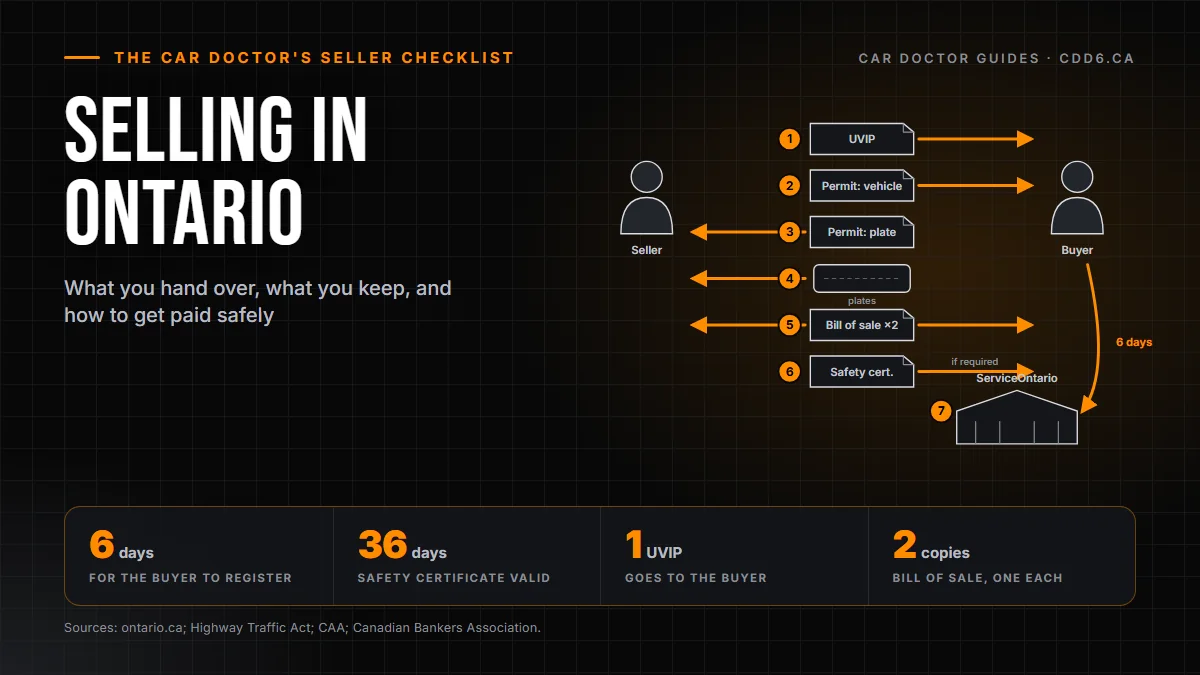
Selling privately in Ontario comes down to a handful of steps. Buy a Used Vehicle Information Package and give it to the buyer, sign the transfer on the back of the vehicle portion of your permit, write up a bill of sale, provide a safety certificate if you are selling it certified, take your plates off, then call your insurer.
The buyer then has six days to register the car in their name. Here is the full list, in order. Everything here is checked against ontario.ca and Ontario’s Highway Traffic Act.
The Ontario seller checklist at a glance
| Step | Who | Required? |
|---|---|---|
| Buy a Used Vehicle Information Package (UVIP) and give it to the buyer | Seller | Yes, under the Highway Traffic Act |
| Get a Safety Standards Certificate | Seller, if selling it certified; otherwise the buyer before plating | Needed before the car can be plated; valid 36 days |
| Fill in and sign a bill of sale | Seller and buyer | Yes; the UVIP has a bill of sale section |
| Complete and sign the Application for Transfer on the back of the vehicle portion of the permit, and give it to the buyer | Seller | Yes |
| Remove your licence plates and keep the plate portion of the permit | Seller | Yes |
| Register the vehicle at ServiceOntario | Buyer | Yes, within 6 days |
| Take the car off your insurance policy | Seller | Strongly advised |
| Remove your 407 ETR transponder and wipe your personal data | Seller | Strongly advised |
Source: From ontario.ca: buying or selling a used vehicle, Used Vehicle Information Package, Safety standards certificate, the Highway Traffic Act (sections 11 and 11.1), CAA, LegalLine and 407 ETR.
The private sale, step by step
Buy the UVIP
Get it from ServiceOntario before you list, and show it to buyers who ask.
Get a safety certificate if needed
Time it well: it is good for 36 days after the inspection.
Sign the bill of sale
Both names, the buyer's address, the date and the price. Keep matching copies.
Sign over the permit
Complete the Application for Transfer on the back of the vehicle portion and hand it over.
Take your plates
Remove them and keep the plate portion of the permit.
Get paid safely
Ask for a certified cheque and wait until your own bank says the funds have cleared.
Call your insurer
Have the car taken off your policy once it is sold.
Do I have to give the buyer a UVIP?
Yes. Under the Highway Traffic Act, anyone selling a used vehicle privately has to let buyers look at a valid Used Vehicle Information Package and must hand it over when the sale closes. You buy it from ServiceOntario. The buyer needs it to register the car.
Get it before you list. The package shows the vehicle’s details, its Ontario registration history and any liens registered against it. It also contains a bill of sale section you can fill in when you close. Selling to a family member? Ontario has a separate family transfer process with its own sworn statement, and the UVIP page lists transfers between family members as exempt.
Do I need a safety certificate to sell my car in Ontario?
Not to sell it, but someone needs one before the car goes back on the road. Ontario says a Safety Standards Certificate is required when a used vehicle is transferred to a new owner, other than a spouse. The buyer can buy and register the car without one, but cannot put plates on it until it passes. Certificates are issued by inspection centres licensed by the Ministry of Transportation.
Timing matters: a certificate is good for only 36 days from the inspection. Get it too early and it can lapse before the buyer registers. And it is not a warranty; it only shows the car met the minimum standard on the day it was inspected. If you sell the car without one, it is up to the buyer to get it certified; CAA suggests writing "as is" on the bill of sale in that case.
How to fill in the bill of sale and the ownership permit
Ontario wants a signed bill of sale that records who sold it (you), who bought it and where they live, the sale date and what was paid. Use the section in the UVIP or your own form, and make sure both of you keep a copy that matches.
Then turn over your ownership permit. It has two parts. On the back of the vehicle portion is the Application for Transfer: fill it in, sign it and give that portion to the buyer. The plate portion stays with you, because in Ontario the plates follow the owner, not the car. You will use them on your next vehicle.
Hand-over day: what goes to the buyer and what you keep
- Used Vehicle Information Package (UVIP)Goes to the buyer at the time of sale.
- Permit, vehicle portionFill in and sign the Application for Transfer on the back, then give it to the buyer.
- Permit, plate portionStays with you.
- Licence platesTake them off the car. They stay with you for your next vehicle.
- Bill of saleSigned, with both names, the buyer's address, the date and the price. Each of you keeps a matching copy.
- Safety Standards CertificateProvided by the seller when one is required. It is good for 36 days after the inspection.
- ServiceOntarioThe buyer registers the car there within 6 days.
Orange arrows show where each item ends up; the dashed one only applies when a certificate is required. Simplified drawing; the layout differs between vehicles.
Source: Ontario: Used Vehicle Information Package, Highway Traffic Act, Ontario FAQ on transferring a used vehicle, Ontario: Safety Standards Certificate and CAA South Central Ontario.
Do I keep my licence plates when I sell my car?
Yes. Section 11 of the Highway Traffic Act says that when you stop owning a vehicle, you take your plates off it and keep the plate portion of the permit. Do not let the buyer drive away on your plates. LegalLine warns that if the buyer has no insurance of their own and crashes on your plates, your insurer could end up paying for the damage.
The buyer has to register the car in their own name at ServiceOntario within six days of buying it. They bring the paperwork you gave them plus proof of insurance.

Insurance, your 407 transponder and your personal data
Call your insurance company once the car is sold and have it taken off your policy, or moved to the car you are replacing it with. CAA lists this as one of the last steps of the sale.
If you use the 407, take the transponder out of the windshield. 407 ETR says transponders belong to the company and that a personal transponder is meant only for the vehicle it is registered to, so it should not go with the car. Then sign in to your 407 ETR account and update it for your next vehicle, or return the transponder if you no longer need one.
Finally, wipe the car’s memory: paired phones, saved addresses, garage door codes and the connected-car app. I wrote a separate step-by-step guide on how to wipe your personal data from a car before you sell it. Empty the glovebox, trunk and bins too.
Getting the car ready: records, cleaning and photos
Gather your service receipts. CAA recommends showing them to buyers as proof the car has been looked after, along with the warranty booklet if any factory warranty is left. Get the car clean inside and out and in good running order before anyone sees it. Then shoot your listing photos in daylight, inside and out.
How do I get paid safely when selling a car privately?
Watch for the overpayment scam. A buyer sends a cheque or money order for more than your price and asks you to send back the difference. The Canadian Bankers Association says to refuse it and return the payment, never refund the extra from your own account. The cheque is fake, and when it bounces, you are on the hook for the full amount.
The bankers’ association suggests asking for a certified cheque rather than a regular one, and treating any cheque or money order as unconfirmed until your own bank tells you it has fully cleared. The Ombudsman for Banking Services and Investments reviewed a case where a seller spent the funds before a forged cheque was caught, and lost the money. Do not sign over the permit or hand over the keys until your bank confirms the payment.
For the meeting itself, pick a public, well-lit spot. A number of police services now offer camera-monitored parking spaces at their stations for exactly this, as Global News and NOW Toronto have reported; call your local division to ask what is available near you.
Rather skip all this? Trade it in
Not keen on listings, test drives and cheques? You can trade your car in at Golden Mile Chrysler on Eglinton Avenue East in Toronto and drive out in something else. Have a look at our used cars, or contact us and tell us what you are driving now.
Selling a Car in Ontario: Common Questions
What documents do I need to sell my car privately in Ontario?
A Used Vehicle Information Package (UVIP) for the buyer, your ownership permit with the Application for Transfer on the back of the vehicle portion completed and signed, and a signed bill of sale. If you are selling the car certified, you also hand over a Safety Standards Certificate. You keep your plates and the plate portion of the permit.
Is the seller required to provide a safety certificate in Ontario?
Not always. You can sell a car without one, and the buyer can register it without one, but it cannot be plated until it passes a safety inspection. Ontario requires a certificate when a used vehicle goes to a new owner other than a spouse. If you sell uncertified, CAA suggests noting "as is" on the bill of sale.
How long is a safety standards certificate valid in Ontario?
Thirty-six days, counted from the date of the inspection. If it runs out before the buyer registers the vehicle, a new inspection is needed. It is not a warranty: it only confirms the car met Ontario’s minimum safety standards on the day it was inspected.
How many days does the buyer have to register a used car in Ontario?
Six days. Under section 11 of the Highway Traffic Act, a new owner has to apply for a new permit within six days of buying the vehicle. The buyer registers at ServiceOntario and needs proof of insurance.
Do I keep my licence plates when I sell my car in Ontario?
Yes. In Ontario the plates belong to you, not the car. The Highway Traffic Act says to take your plates off when you stop owning the vehicle and keep the plate portion of the permit. You can register those plates to your next vehicle. Never let a buyer drive away on your plates.
What is the safest way to accept payment for a used car?
The Canadian Bankers Association suggests a certified cheque over a regular cheque, and waiting until your own bank confirms the funds have fully cleared before relying on them. Never refund an overpayment: return the payment instead. Meet in a public, well-lit place, ideally a camera-monitored exchange spot at a police station.
Talk to the Car Doctor
Straight answers, no games, no runaround. The line is open.
437-524-1747