
How to Read a VIN: Every Character Decoded, Plus Where to Find It in Canada

By Navin Kotecha, The Car Doctor
Published
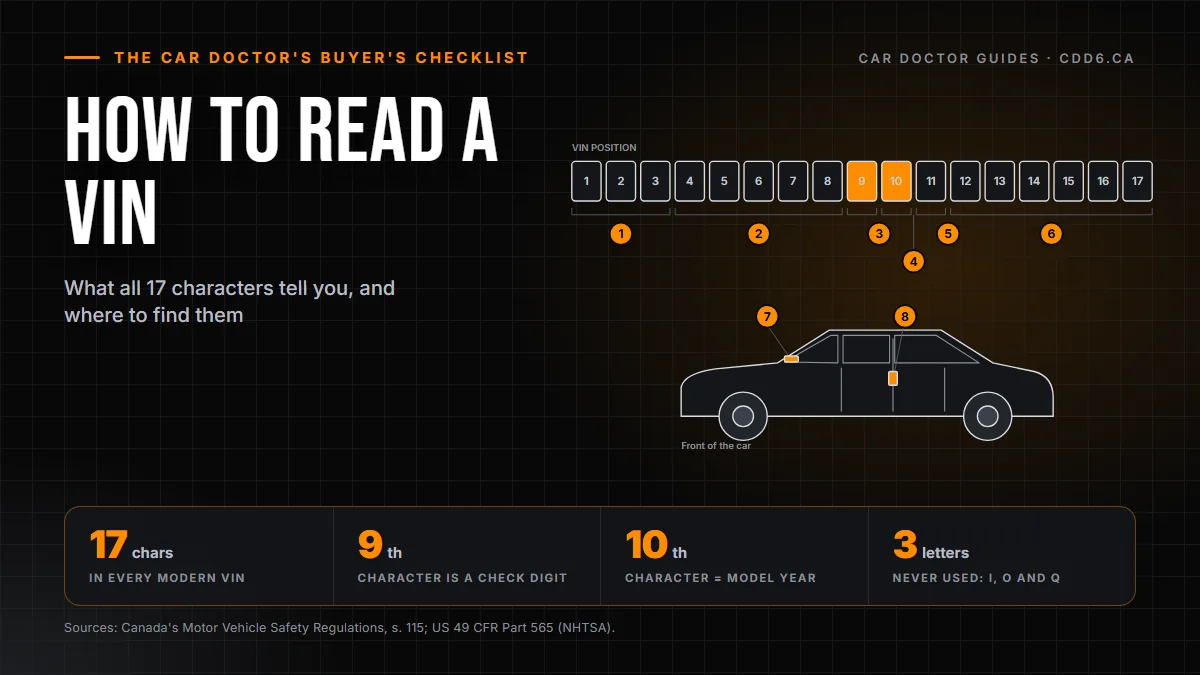
A VIN (vehicle identification number) is a 17-character code that belongs to one vehicle only. Read it in four chunks: characters 1 to 3 name the maker, 4 to 8 describe the vehicle, 9 is a check digit, and 10 to 17 give the model year, the assembly plant and the serial number. Here is how to read each part.
On any used vehicle, the VIN is the first thing I tell people to check: the history report, the recall check and the paperwork all run on it. And because Canadian and US federal rules spell out the same format, you read it the same way on a RAM 1500 as on a compact car.
What does each character of a VIN mean?
Canada's Motor Vehicle Safety Regulations (section 115) and the US rule, 49 CFR 565.15, lay out the same structure. A VIN uses the digits 0 to 9 and every capital letter except I, O and Q, which the rules leave out entirely. Every one of the 17 spaces must be filled.
What each part of a VIN means, and where to find it
- Positions 1 to 3Identify the manufacturer and the type of vehicle.
- Positions 4 to 8Describe the vehicle: line, series, body or cab type, engine and restraint systems.
- Position 9The check digit, a calculated character that catches copying mistakes.
- Position 10The model year code.
- Position 11The assembly plant. Makers set these codes, and not all of them are public.
- Positions 12 to 17The sequential production number.
- Dashboard plateInside the car next to the left windshield pillar, readable through the windshield from outside.
- Driver's door openingThe compliance label on the door edge or pillar shows the VIN and the month and year the vehicle was built.
Positions 9 and 10 are shaded because they are the two most buyers check first. Simplified drawing; the layout differs between vehicles.
Source: Motor Vehicle Safety Regulations (Canada) and 49 CFR 565.15; VIN location from the same regulations and 49 CFR 565.13; door label from 49 CFR 567.4.
| Position | What it is | What it tells you |
|---|---|---|
| 1 to 3 | Manufacturer identifier | The maker and the type of vehicle. Low-volume makers put a 9 in position 3 and finish their code in positions 12 to 14 |
| 4 to 8 | Vehicle descriptor | Details the maker chooses to encode, such as line, series, body or cab type, engine and restraint systems. On cars and light trucks, position 7 is always a letter |
| 9 | Check digit | A number from 0 to 9, or the letter X, calculated from the other 16 characters to catch typing errors |
| 10 | Model year | A letter or number that stands for the model year (table below) |
| 11 | Plant | The factory that built the vehicle; each maker sets its own codes |
| 12 to 17 | Serial number | The production sequence number, given out in order as vehicles are built |
Source: Canada: Motor Vehicle Safety Regulations, C.R.C., c. 1038, s. 115; US: 49 CFR 565.13 and 565.15.
The first character usually tells you the country of final assembly: 2 means Canada, 3 means Mexico, and 1, 4 or 5 mean the United States, according to Consumer Reports and AutoTrader.ca. Treat that as a hint, not proof: both publications point to the label in the driver's door opening as the more reliable way to see where a vehicle was put together.
How do I tell the model year from a VIN?
Look at the 10th character and match it to the table. The codes skip I, O and Q like the rest of the VIN, and they also skip U, Z and the number 0. Thirty codes cover 30 model years, and then the same characters come around again. To know which cycle you are looking at on a car or light truck, check position 7. A number there points to the 1980 to 2009 cycle; a letter points to 2010 to 2039.
| Code | Model year | Code | Model year |
|---|---|---|---|
| A | 2010 | S | 2025 |
| B | 2011 | T | 2026 |
| C | 2012 | V | 2027 |
| D | 2013 | W | 2028 |
| E | 2014 | X | 2029 |
| F | 2015 | Y | 2030 |
| G | 2016 | 1 | 2031 |
| H | 2017 | 2 | 2032 |
| J | 2018 | 3 | 2033 |
| K | 2019 | 4 | 2034 |
| L | 2020 | 5 | 2035 |
| M | 2021 | 6 | 2036 |
| N | 2022 | 7 | 2037 |
| P | 2023 | 8 | 2038 |
| R | 2024 | 9 | 2039 |
Source: Table II of Canada's Motor Vehicle Safety Regulations, s. 115 and Table VII of 49 CFR 565.15; the two tables match code for code. The position 7 rule for telling cycles apart is the note to Table VII.
Keep in mind this is the model year, not the date the vehicle was built. The build month and year are printed on the compliance label in the driver's door opening.

What is the check digit for?
The 9th character is a built-in error check. The maker turns every other character into a number (letters have set values), multiplies each by a weight that depends on its position, adds the results and divides by 11. The remainder becomes the check digit, and a remainder of 10 is written as X. The US rule describes its job plainly: it confirms the VIN was copied correctly. Get one character wrong on a form and the sum will usually no longer produce the same check digit. You will never need to work it out by hand.
Where is the VIN on a car in Canada?
Look in three places, and make sure they all match:
Four places the VIN should match
Dashboard
Through the windshield, low on the driver's side.
Driver's door
On the label at the door edge or pillar, with the build month and year.
Ownership
The Ontario vehicle permit lists the VIN.
Pink slip
Your insurance liability slip carries it too.
The dashboard, through the windshield. On cars, SUVs, vans and light trucks, Canadian and US rules require the VIN inside the vehicle where you can read it through the glass from outside, standing by the driver's side windshield pillar, in characters at least 4 mm tall. CARFAX Canada describes it as a black plate just below the windshield on the driver's side.
The driver's door opening. Open the driver's door and look at the edge of the door or the pillar it latches to. The compliance label there must show the VIN and the month and year the vehicle was built, under both Canadian regulations (section 6) and the US rule 49 CFR 567.4.
Your paperwork. In Ontario, the vehicle permit (the ownership) lists the VIN, as the Ontario government explains. Your insurance papers carry it too, as AutoTrader.ca notes, and Co-operators advises comparing the number on the dash or door against both the pink slip and the ownership.
How can I decode a VIN for free?
The NHTSA VIN Decoder is a public tool run by the US safety regulator. It decodes a VIN against the patterns automakers report to NHTSA (the vPIC catalogue), and it does not handle model years before 1981. Because the data comes from the maker's filings, check anything that matters against the labels on the vehicle itself.
For recalls, Canada now has its own route. Under rules that came into force on January 1, 2025, Transport Canada requires designated automakers to offer a lookup on their own websites where you type in the 17-character VIN and see which recalls apply, with full compliance due by mid-2026, as The Car Guide also reported. Transport Canada's own Motor Vehicle Safety Recalls Database stays available too.
How do I check a used vehicle's history in Ontario?
Two reports, both run on the VIN, cover most of what you need.
| Detail | Used Vehicle Information Package (UVIP) | CARFAX Canada report |
|---|---|---|
| Who offers it | The Ontario government (ServiceOntario) | CARFAX Canada, a private company |
| What it shows | Ontario ownership history, past odometer readings and lien information, plus basic vehicle details | Reported accidents and collisions, and lien information, among other records reported to CARFAX Canada |
| When it is required | A private seller must give one to the buyer under the Highway Traffic Act; OMVIC-registered dealers don't have to | Never required; OMVIC suggests getting one on any used vehicle |
| How to get it | Online from the Ontario government or in person at ServiceOntario, using the VIN or plate number | From carfax.ca, using the VIN |
| Limits | Registration history is Ontario only | Only as complete as what has been reported to CARFAX Canada |
Source: Ontario.ca: Used vehicle information package; Ontario.ca: Buy or sell a used vehicle; OMVIC: Shopping for a vehicle; CARFAX Canada.
Even when you buy from a registered dealer, OMVIC suggests picking up a UVIP. Buying privately? Walk around the vehicle and compare the VIN on it with the one on the ownership yourself; both the Ontario government and Co-operators tell you to make that check.
A history report only knows what someone reported, so it never replaces a proper inspection and a test drive. If you are shopping now, browse our used cars and ask for the VIN on anything you like; we'll walk you through what it says. Prefer something new with a warranty? See this month's deals.
Reading a VIN: Common Questions
How many characters are in a VIN?
Seventeen. Canada's Motor Vehicle Safety Regulations and the matching US rule both set the VIN at 17 characters, made of the digits 0 to 9 and capital letters, with every space filled. The free NHTSA decoder handles model years from 1981 onward.
Why are the letters I, O and Q never in a VIN?
Both the Canadian and US rules leave those three letters off the list of allowed characters. So if a VIN someone sends you contains an I, O or Q, it has been copied wrong. Go and read the plate on the dashboard yourself before you run any report.
Which character of the VIN shows the model year?
The 10th. For example, S is 2025, T is 2026 and V is 2027. The codes repeat every 30 years, so on a car or light truck check the 7th character too: a letter there means the 2010 to 2039 cycle, a number means 1980 to 2009.
Does the VIN tell me where my car was built?
Partly. The 11th character is the assembly plant, but the rules leave the plant codes to each maker. The first character usually points to the country of final assembly, with 2 for Canada and 3 for Mexico. For a firmer answer, read the label in the driver's door opening.
Where is the VIN on my car?
On the dashboard, readable through the windshield from outside on the driver's side, and on the compliance label in the driver's door opening. In Ontario it is also printed on your vehicle permit (ownership), and your insurer records it for your pink liability card. All of these should match.
Is there a free VIN decoder?
Yes. NHTSA's public VIN Decoder at vpic.nhtsa.dot.gov decodes model years from 1981 onward, using data the automakers report to the US regulator. For recalls on a vehicle sold in Canada, use the VIN lookup that Transport Canada now requires on automakers' websites, or Transport Canada's recalls database.
What is a UVIP and do I need one?
The Used Vehicle Information Package is the Ontario government's report on a used vehicle, covering its Ontario ownership history, past odometer readings and liens. In a private sale the seller must hand one to the buyer. OMVIC-registered dealers are exempt, though OMVIC still suggests buyers get one.
Is a CARFAX Canada report the same as a UVIP?
No. The UVIP comes from the Ontario government and covers Ontario ownership, odometer and lien records. A CARFAX Canada report is a private product that looks for reported accidents and collisions as well as liens. They overlap on liens, and getting both gives you the fuller picture.
Browse used cars at Golden Mile Chrysler and ask for the VIN
Talk to the Car Doctor
Straight answers, no games, no runaround. The line is open.
437-524-1747