
Types of Gasoline in Canada: What 87, 89 and 91 Mean, Where Ethanol Fits and How Gas Is Made

By Navin Kotecha, The Car Doctor
Published
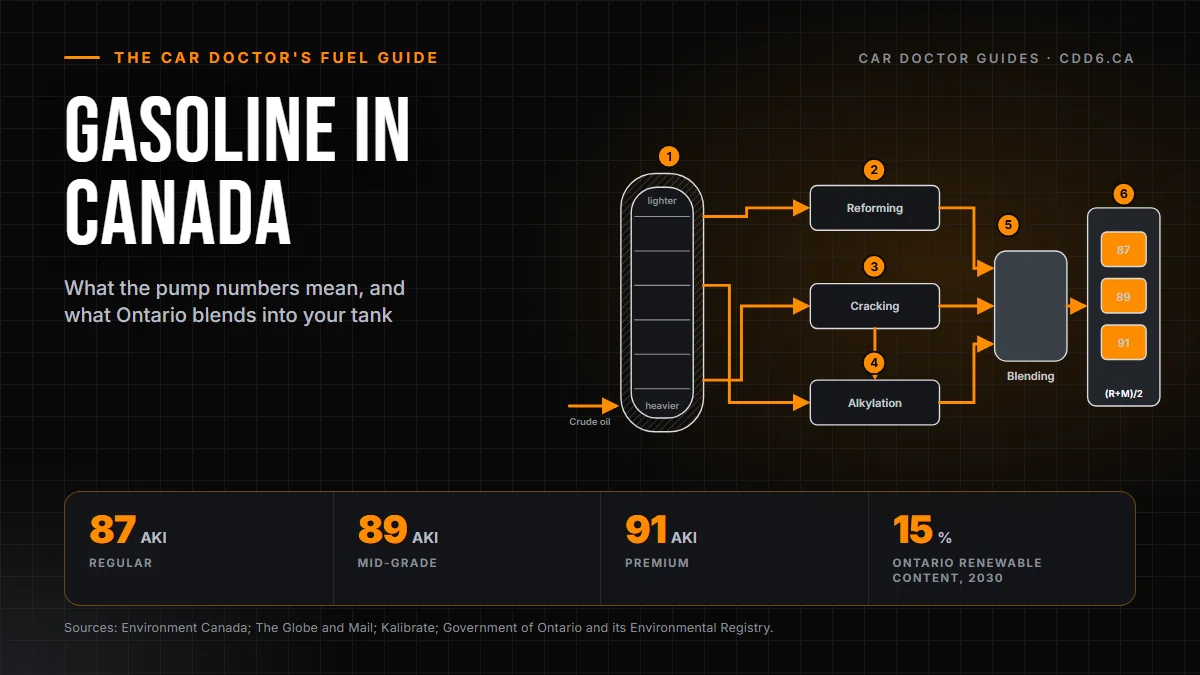
Canada sells three main types of gasoline: regular at 87 octane, mid-grade at 89 and premium at 91, and some stations add a super premium at 93 or more. The number is a measure of how well the fuel resists knocking, not how much energy it holds. Your owner's manual tells you which one your engine needs. Below: what octane means, when premium matters, the ethanol in Ontario gas, and how crude becomes gasoline.
What do 87, 89 and 91 mean on a Canadian pump?
The number on the button is the anti-knock index, or AKI. It is worked out by averaging two lab ratings, research octane (RON) and motor octane (MON), which is why you sometimes see it written as (R+M)/2. A 2015 Environment Canada presentation on Canadian fuel quality explains that pumps here show the minimum AKI for each grade, set by a Canadian General Standards Board standard, and the U.S. Energy Information Administration describes the same averaging method for American pumps.
| Grade | Minimum octane (AKI) | Who it is for |
|---|---|---|
| Regular | 87 | The large majority of engines; the grade most vehicles are designed around |
| Mid-grade | 89 | Engines whose manual calls for 89; usually mixed at the station from regular and premium |
| Premium | 91 | Engines whose manual requires or recommends premium, typically high-compression or high-performance designs |
| Super premium | 93 or higher | Sold at some stations; only worth it if your manual asks for it |
Source: Environment Canada presentation on Canadian fuel quality, 2015; The Globe and Mail, March 2022; Kalibrate.
A detail most drivers never hear: according to the same Environment Canada presentation, most refiners make only 87 and 91, and the 89 at the pump is blended from those two at the station. The Globe and Mail describes mid-grade the same way.
Does higher octane mean more power?
No. Octane tells you how stable the fuel is under heat and pressure, meaning how well it holds off lighting by itself before the spark plug fires. When fuel ignites early you get knock, or pinging, which puts extra stress on engine parts. Higher-octane gas needs more heat to ignite, so engines that squeeze the mixture hard can run it safely. The EIA and The Globe and Mail both explain it this way.
In an engine built for 87, premium does nothing useful. A Centennial College automotive professor told The Globe and Mail in 2018 that octane has no bearing on making more power, and the paper's 2022 follow-up reached the same conclusion for cars designed for regular.

When is premium gas required, and when is it only recommended?
Read the fuel section of your owner's manual and look at the exact word it uses. If premium is required, buy premium every time: the engine was designed around it. If premium is only recommended, the expert in the 2022 Globe and Mail article says regular usually works fine, and the 2018 piece notes that most cars that mention premium only recommend it rather than require it. A vice-president of the Canadian Fuels Association told the paper that the manual comes first.
How much ethanol is in gas in Ontario?
Ethanol is the main renewable ingredient blended into Canadian gasoline, and it also raises octane, as the Environment Canada presentation notes; the U.S. Department of Energy lists pure ethanol at a pump octane of 110. In Ontario, the Cleaner Transportation Fuels regulation (O. Reg. 663/20) sets how much renewable content fuel suppliers must blend into gasoline, and the requirement steps up through 2030.
| Years | Renewable content in gasoline |
|---|---|
| 2020 to 2024 | 10 per cent |
| 2025 to 2027 | 11 per cent |
| 2028 to 2029 | 13 per cent |
| 2030 onward | 15 per cent |
Source: Government of Ontario, Cleaner transportation fuels; Environmental Registry of Ontario, notice 025-0669; Bioenergy International, November 2020.
Renewable content Ontario requires in gasoline
The requirement is on what fuel suppliers blend into the gasoline they sell.
Source: Government of Ontario; Environmental Registry of Ontario.
The province also sets a climate test for that content: before 2030 it must produce 45 per cent less greenhouse gas than fossil gasoline over its life cycle, according to ontario.ca. The Environmental Registry records the 2020 decision behind the climb, which takes gasoline to a 15 per cent requirement by 2030.
One trade-off is energy. Per the U.S. Department of Energy's fuel properties table, a gallon of pure ethanol holds about two-thirds of the energy of a gallon of gasoline, and The Globe and Mail notes that ethanol's lower energy density is why high-ethanol blends cut mileage.
What is E85, and can my car use it?
E85, also called flex fuel, is a high-ethanol blend meant only for flexible-fuel vehicles. Sources describe the range a little differently: the U.S. Department of Energy puts it at 51 to 83 per cent ethanol depending on region and season, while The Globe and Mail reports that in Canada it can be up to 85 per cent. Both say it delivers fewer kilometres per litre than gasoline. Never put it in a vehicle that is not built for it; your owner's manual says whether yours is.
Where does diesel fit in?
Diesel is a separate fuel for a different kind of engine. A diesel engine has no spark plugs: it squeezes air until it is hot enough to light the fuel when it is injected, as the U.S. Department of Energy and Jalopnik explain. Diesel is rated by cetane rather than octane, and it packs roughly 10 to 15 per cent more energy into the same volume than gasoline, per fueleconomy.gov and the DOE fuel properties table. Ontario requires 4 per cent renewable content in diesel. For the full comparison, read how a diesel engine works vs a gasoline engine.
How is gasoline made from crude oil?
Refining comes down to separating, converting and treating, as the EIA lays out and Penn State's fuels course teaches in more detail. In plain terms:
From crude oil to the three grades at the pump
- DistillationHeated crude separates by boiling point, with the lighter fractions rising to the top of the column.
- ReformingTurns low-value naphtha into higher-octane gasoline components.
- CrackingHeat, pressure and catalysts break heavy molecules into lighter ones.
- AlkylationJoins small molecules left over from cracking into high-octane components.
- BlendingThe streams are blended into finished gasoline that meets octane and vapour pressure limits, which in Canada change by zone and season.
- Pump gradesRegular 87, mid-grade 89 and premium 91, each shown as the (R+M)/2 anti-knock index. Mid-grade is usually mixed at the station from regular and premium.
The orange lines are product moving through the refinery. Simplified drawing; the layout differs between vehicles.
Source: Refining steps from the U.S. EIA and Penn State EGEE 439; grades and octane index from Environment Canada, the EIA and The Globe and Mail.
| Step | What happens |
|---|---|
| Distillation | Crude is heated and fed into a tall column, where it splits into fractions by boiling point: light products rise to the top, heavy ones stay low |
| Cracking | Heat, pressure and catalysts break heavy, long molecules into lighter ones that can go into gasoline |
| Reforming | Low-value naphtha is rearranged into branched and ring-shaped molecules with a higher octane rating |
| Alkylation | Small leftover molecules from cracking are joined into high-octane gasoline components |
| Treating and blending | Streams are cleaned up, then mixed to hit the octane and vapour pressure each grade and season needs |
Source: U.S. Energy Information Administration, Refining crude oil; Penn State, EGEE 439, Refining of petroleum into fuels; vapour pressure by zone and season from the Environment Canada presentation.
Gas in Canada in five points
87, 89, 91
Regular, mid-grade and premium, shown on the pump as the minimum anti-knock index.
Octane is not power
It measures how well fuel resists igniting on its own (knock), not how much energy it holds.
Required or recommended
If your manual requires premium, use it. If it only recommends premium, regular usually works.
Ethanol in the blend
Ontario requires renewable content in gasoline, rising to 15 percent from 2030.
E85 is not for every car
Only flexible-fuel vehicles can use it, and it gives lower fuel economy.
The Car Doctor's bottom line
Buy the grade your manual asks for, no higher. If it says regular, premium is money you are pouring into the 401 for nothing. If it says premium required, don't skimp. Looking at a truck? The RAM 1500 page has this month's deal, and every CDD6 deal comes with the lifetime oil change*, a gas card and two years of free tire storage.
Gasoline in Canada: Common Questions
What octane is regular gas in Canada?
Regular is 87 on the anti-knock index, the average of the research and motor octane numbers. Mid-grade is 89, premium is 91, and some stations sell a super premium at 93 or higher. The number shown on the pump is the minimum for that grade under the Canadian standard.
Is premium gas worth it if my car takes regular?
No. Octane measures resistance to knock, not energy or power, so an engine designed for 87 gains nothing useful from 91. Automotive experts quoted by The Globe and Mail in 2018 and 2022 gave the same answer. Follow your owner's manual.
What happens if I put regular in a car that requires premium?
An engine that requires premium is built to run at pressures where lower-octane fuel can ignite too early and knock, which stresses engine parts. If your manual says premium is required, use it. If it only says recommended, experts quoted by The Globe and Mail say regular usually works fine.
How much ethanol is in gasoline in Ontario?
Ontario's Cleaner Transportation Fuels regulation requires fuel suppliers to blend 11 per cent renewable content into gasoline from 2025, rising to 13 per cent in 2028 and 15 per cent from 2030. It was 10 per cent from 2020 to 2024.
Is mid-grade gas a separate fuel?
Usually not. A 2015 Environment Canada presentation says most refiners produce only 87 and 91 octane, and the 89 is made by blending those two at the station. The Globe and Mail describes mid-grade the same way.
Can I use E85 in my car?
Only if it is a flexible-fuel vehicle. E85 is a high-ethanol blend, up to 85 per cent ethanol in Canada, and it gives fewer kilometres per litre than gasoline because ethanol carries less energy. Your owner's manual will tell you whether your vehicle is built for it.
Does gasoline with ethanol have less energy?
Yes, a little. Pure ethanol holds about two-thirds of the energy of gasoline per gallon on U.S. Department of Energy figures, so blends with more ethanol deliver somewhat fewer kilometres per litre.
Talk to the Car Doctor
Straight answers, no games, no runaround. The line is open.
437-524-1747