
How to Convert MPG to L/100 km and km/L: Formulas, Tables and Examples

By Navin Kotecha, The Car Doctor
Published
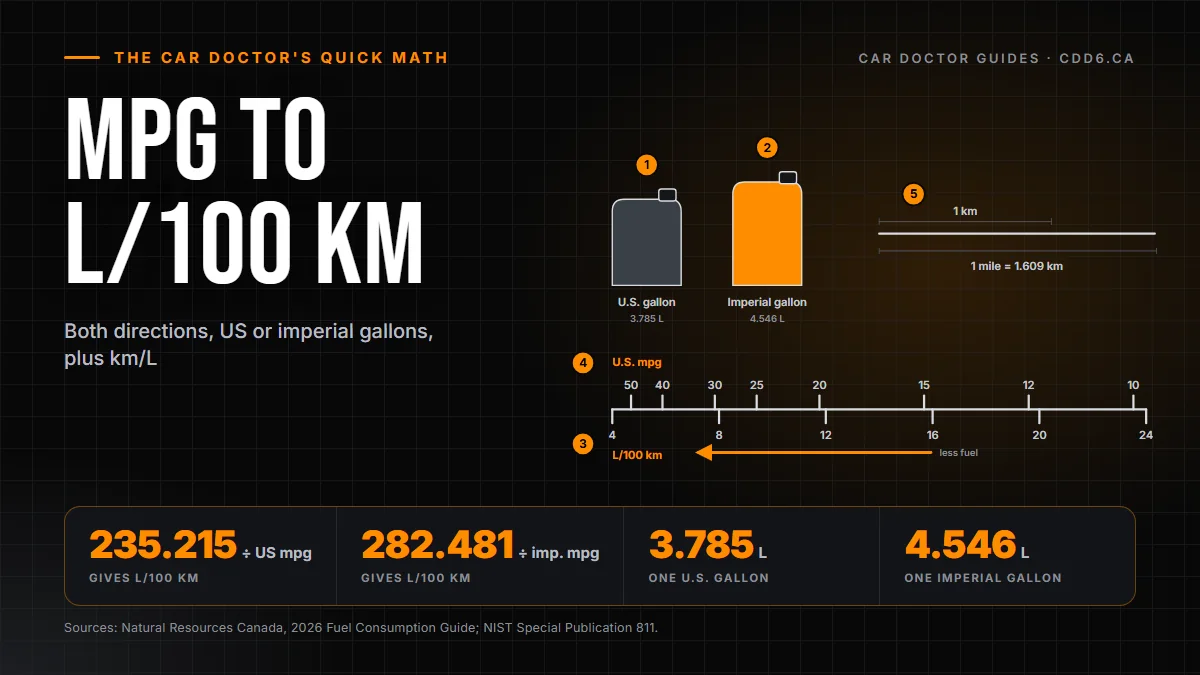
To turn miles per gallon into litres per 100 km, divide 235.215 by the US mpg figure. If the number is in imperial mpg, as older Canadian and UK figures are, divide 282.481 instead. For km/L, multiply US mpg by 0.425. In L/100 km, a smaller number means the vehicle burns less fuel.
I get this question a lot from people cross-shopping a truck they saw reviewed in an American magazine against the Canadian numbers here in Toronto. The American review quotes mpg, Natural Resources Canada quotes L/100 km, and the two numbers run in opposite directions. Here is how to line them up properly.
The four numbers to remember
235.215
Divide it by U.S. mpg to get L/100 km, or by L/100 km to get U.S. mpg.
282.481
The same trick for imperial mpg.
1.2 times
An imperial gallon holds about 20 percent more than a U.S. gallon.
Lower is better
With L/100 km a smaller number means less fuel; with mpg a bigger number does.
What are the exact conversion formulas?
Every factor comes from two definitions: the length of a mile and the size of a gallon. A mile is 1.609344 km. A U.S. gallon is about 3.785 litres, while an imperial gallon, the one Canada's Weights and Measures Act defines, is 4.54609 litres. Divide 100 by those numbers in the right order and you get the constants below. NIST lists the US factors to more decimal places, and the Natural Resources Canada 2026 Fuel Consumption Guide prints both rounded to 235.21 and 282.48.
| You have | You want | Do this |
|---|---|---|
| US mpg | L/100 km | 235.215 ÷ US mpg |
| L/100 km | US mpg | 235.215 ÷ L/100 km |
| Imperial mpg | L/100 km | 282.481 ÷ imperial mpg |
| L/100 km | Imperial mpg | 282.481 ÷ L/100 km |
| US mpg | km/L | US mpg × 0.425144 |
| km/L | L/100 km | 100 ÷ km/L |
| US mpg | Imperial mpg | US mpg × 1.20095 |
Source: Factors from NIST Special Publication 811, Appendix B.9 (US mpg to L/100 km: 235.215; US mpg to km/L: 0.4251437; U.S. gallon 3.785412 L; imperial gallon 4.54609 L; mile 1.609344 km) and the Natural Resources Canada 2026 Fuel Consumption Guide (235.21 and 282.48). The imperial factor is 100 × 4.54609 ÷ 1.609344 = 282.481; the imperial-to-US ratio is 4.54609 ÷ 3.785412 = 1.20095.
US gallon or imperial gallon: which mpg do you have?
This is where most conversions go wrong. The imperial gallon holds roughly 20 per cent more than the U.S. one, so the same vehicle shows a bigger mpg number in imperial units. NIST labels the 4.54609-litre gallon as the Canadian and U.K. gallon, and Britain's Vehicle Certification Agency still works out its mpg figures with imperial gallons. Natural Resources Canada's guide follows the same habit: it writes plain "mpg" for imperial and "mpg (U.S.)" for the American version.
A quick rule: a figure from an American source such as a US review or the US government is U.S. mpg. A figure from a British source, or an older Canadian brochure, is probably imperial. If you are not sure, convert it both ways; if one answer looks wildly off from the L/100 km rating, you have your answer.
Why the gallon matters, and how the two scales line up
- U.S. gallonAbout 3.785 litres.
- Imperial gallonHolds 4.546 litres, about 1.2 times a U.S. gallon. It is the gallon behind older Canadian mpg figures.
- L/100 km scaleLitres used to drive 100 km. Lower is better.
- U.S. mpg scaleEach mark sits where 235.215 divided by that mpg falls on the litre scale, so the marks bunch up as mpg rises.
- Mile and kilometreOne mile is 1.609344 km.
Jug heights are in proportion to volume; the scale positions are calculated from the formula. Simplified drawing; the layout differs between vehicles.
Source: Conversion factors from NIST Special Publication 811 and Natural Resources Canada; imperial gallon from the Weights and Measures Act.
MPG to L/100 km conversion table
| US mpg | L/100 km | km/L | Imperial mpg |
|---|---|---|---|
| 15 | 15.7 | 6.4 | 18.0 |
| 20 | 11.8 | 8.5 | 24.0 |
| 25 | 9.4 | 10.6 | 30.0 |
| 30 | 7.8 | 12.8 | 36.0 |
| 35 | 6.7 | 14.9 | 42.0 |
| 40 | 5.9 | 17.0 | 48.0 |
| 50 | 4.7 | 21.3 | 60.0 |
Source: Calculated with L/100 km = 235.215 ÷ US mpg, km/L = US mpg × 0.425144 and imperial mpg = US mpg × 1.20095, factors from NIST SP 811 and the Natural Resources Canada 2026 Fuel Consumption Guide. Rounded to one decimal.
L/100 km to mpg conversion table
| L/100 km | US mpg | Imperial mpg | km/L |
|---|---|---|---|
| 5.0 | 47.0 | 56.5 | 20.0 |
| 6.0 | 39.2 | 47.1 | 16.7 |
| 7.0 | 33.6 | 40.4 | 14.3 |
| 8.0 | 29.4 | 35.3 | 12.5 |
| 9.0 | 26.1 | 31.4 | 11.1 |
| 10.0 | 23.5 | 28.2 | 10.0 |
| 12.0 | 19.6 | 23.5 | 8.3 |
| 14.0 | 16.8 | 20.2 | 7.1 |
| 16.0 | 14.7 | 17.7 | 6.3 |
Source: Calculated with US mpg = 235.215 ÷ L/100 km, imperial mpg = 282.481 ÷ L/100 km and km/L = 100 ÷ L/100 km, factors from NIST SP 811 and the Natural Resources Canada 2026 Fuel Consumption Guide, whose own rounded table agrees. Rounded to one decimal.
Worked examples
A US review says 25 mpg. 235.215 ÷ 25 = 9.41, so call it 9.4 L/100 km. That is the number to hold up against a Canadian rating.
A British car magazine says 40 mpg. That is imperial, so 282.481 ÷ 40 = 7.06, or about 7.1 L/100 km. Had you used the US factor by mistake, you would have got 5.9, and the car would look a lot thriftier than it is.
Your dash reads 8.0 L/100 km and a buddy in Buffalo asks what that is in mpg. 235.215 ÷ 8 = 29.4 US mpg. For a friend in the UK, 282.481 ÷ 8 = 35.3 imperial mpg.
A spec sheet from overseas says 12 km/L. 100 ÷ 12 = 8.3 L/100 km. To go from km/L to US mpg, divide by 0.425144: 12 ÷ 0.425144 = 28.2 US mpg.
Why is lower L/100 km better?
Mpg and km/L measure distance per unit of fuel, so higher is better. L/100 km flips it around and measures the fuel needed for a fixed distance, so lower is better. Natural Resources Canada makes the same point at the front of its guide. Because one is the inverse of the other, the scale is not even. The chart below shows how much fuel 100 km takes at different US mpg figures.
Fuel used per 100 km at different US mpg figures (lower is better)
Going from 15 to 20 mpg saves about 3.9 litres every 100 km. Going from 40 to 45 mpg saves about 0.65 litres. The gains at the thirsty end are far bigger than the mpg gap suggests.
Source: Calculated with L/100 km = 235.215 ÷ US mpg (NIST SP 811; Natural Resources Canada 2026 Fuel Consumption Guide).
That is why L/100 km is the more honest unit when you are thinking about your fuel bill. If you commute up the DVP and along the 401 every day, the litres you burn per 100 km map straight onto what goes into the tank.

Comparing trucks and SUVs the right way
When you compare vehicles, convert everything to L/100 km first, and compare like with like: city against city, highway against highway, combined against combined. If you are weighing full-size pickups, our F-150 vs RAM 1500 comparison does the side-by-side for you, and the Jeep Wrangler engines page covers the powertrains on offer in the Wrangler.
Ready to look at real vehicles? Every CDD6 deal at Golden Mile Chrysler comes with the lifetime oil change*, a gas card and two years of free tire storage. See this month's current deals, or browse our used cars if pre-owned fits your plan better.
MPG and L/100 km: Common Questions
How do I convert mpg to L/100 km?
Divide 235.215 by the US mpg figure. For 25 US mpg, that is 9.4 L/100 km. If the mpg figure uses imperial gallons, as British figures do, divide 282.481 by it instead. Natural Resources Canada uses the same formulas, rounded to 235.21 and 282.48.
How do I convert L/100 km to mpg?
It is the same division the other way round. Divide 235.215 by the L/100 km figure for US mpg, or 282.481 for imperial mpg. A vehicle using 8.0 L/100 km gets about 29.4 US mpg, or about 35.3 imperial mpg.
What is 30 mpg in L/100 km?
If it is 30 US mpg, it works out to 7.8 L/100 km (235.215 ÷ 30). If it is 30 imperial mpg, it is 9.4 L/100 km (282.481 ÷ 30). That gap of 1.6 litres is why you need to know which gallon a figure uses before converting.
Why is a UK mpg figure higher than a US one for the same car?
Because the imperial gallon used in the UK is bigger. It holds 4.54609 litres, against roughly 3.785 litres for a U.S. gallon, so a car travels about 20 per cent farther on an imperial gallon. Same fuel use, larger mpg number.
How do I convert km/L to L/100 km?
Divide 100 by the km/L figure. A vehicle that goes 12 km on a litre uses 100 ÷ 12 = 8.3 L/100 km. To go from US mpg to km/L, multiply by 0.425144, so 30 US mpg is about 12.8 km/L.
Is a lower L/100 km number better?
Yes. L/100 km tells you how many litres a vehicle burns to cover 100 km, so a smaller number means less fuel. Mpg and km/L are the other way round, where a bigger number is better. Natural Resources Canada points this out in its Fuel Consumption Guide.
Does Canada use mpg or L/100 km?
Natural Resources Canada publishes its official fuel consumption ratings in L/100 km. Where Canadian sources quote mpg, the gallon is the imperial one, which Canada's Weights and Measures Act defines as 4.54609 litres, so convert with 282.481 rather than 235.215.
Talk to the Car Doctor
Straight answers, no games, no runaround. The line is open.
437-524-1747