
How a Diesel Engine Works vs a Gasoline Engine: Ignition, Torque, Fuel Economy, DEF and Winter Starts

By Navin Kotecha, The Car Doctor
Published
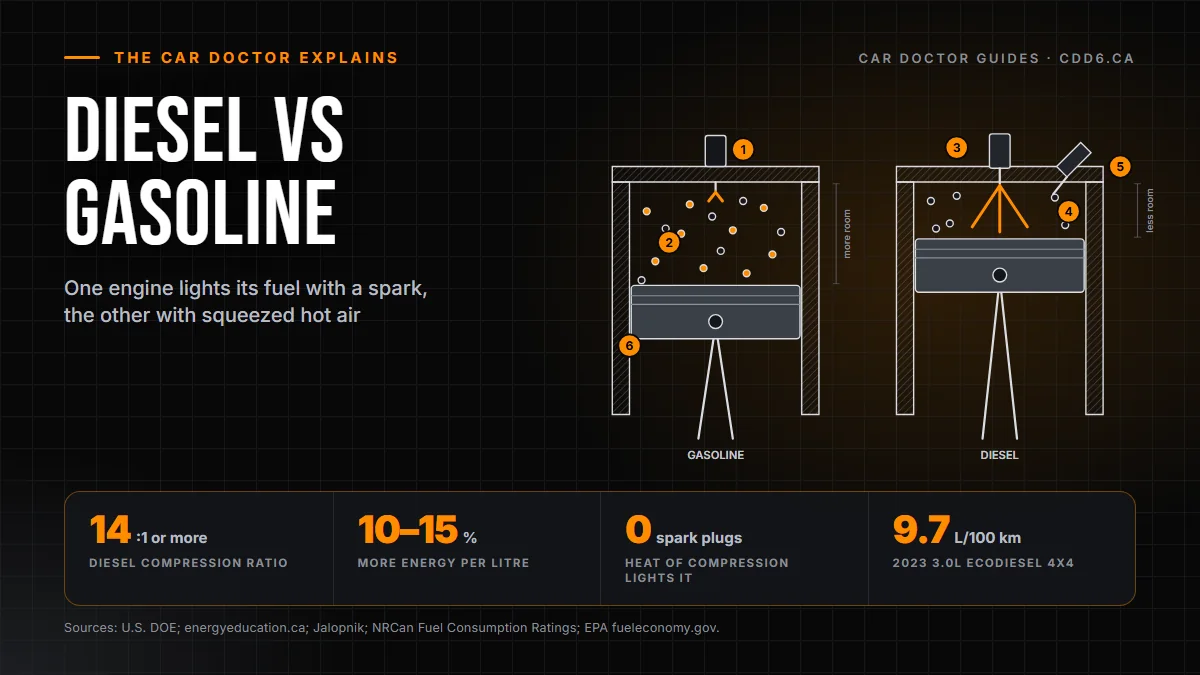
The short answer: a gasoline engine mixes fuel with air and fires it with a spark plug. A diesel engine has no spark plugs. It squeezes air so hard that the air gets hot enough to ignite the diesel the moment it is injected. That higher compression is why diesels make strong low-end torque and use less fuel, and also why they need glow plugs and extra exhaust hardware.
What is the difference between spark ignition and compression ignition?
Both are internal combustion engines with pistons, and both burn fuel to push those pistons down. The difference is how the fire starts. In a gasoline engine, fuel and air are combined in the cylinder or intake and a timed spark from the plug lights the mix. In a diesel, the piston compresses air alone, and fuel sprayed into that hot air lights by itself. The U.S. Department of Energy describes both systems this way, as do energyeducation.ca at the University of Calgary and Jalopnik.
Spark ignition and compression ignition, side by side
- Spark plugA gasoline engine lights its air-fuel mixture with a spark.
- Air-fuel mixtureGasoline engines squeeze the mixture less, because squeezing it too hard would make it ignite early and knock.
- Fuel injectorA diesel has no spark plug: fuel is injected into air that the piston has already squeezed and heated.
- Hot, squeezed airDiesels compress air about 14:1 or more, and that heat is what lights the fuel.
- Glow plugHeats the combustion area to help a cold diesel start.
- PistonBoth are internal combustion engines; the piston does the squeezing in each.
Both cylinders are drawn at the top of the compression stroke. Simplified drawing; the layout differs between vehicles.
Source: U.S. DOE on diesel and gasoline vehicles; energyeducation.ca; Jalopnik; glow plugs from fueleconomy.gov and energyeducation.ca.
| Feature | Gasoline engine | Diesel engine |
|---|---|---|
| How the fuel lights | Spark plug fires the air and fuel mix | Fuel ignites on contact with air heated by compression |
| Compression ratio | Lower, held down to avoid knock | Much higher, roughly 14 to 1 or more |
| Fuel rating | Octane number | Cetane number |
| Energy in the fuel | Baseline | About 10 to 15 per cent more per litre |
| Torque | Less at low engine speed for its size | More low-end torque for its size |
| Cold starts | Spark does the work | Glow plugs heat the chamber when cold |
Source: U.S. DOE, how diesel vehicles work and how gasoline vehicles work; energyeducation.ca, Diesel engine and Diesel vs gasoline engine; Jalopnik, January 2026; fueleconomy.gov; DOE fuel properties.

Why do diesels use higher compression?
Squeezing air heats it, and a diesel needs a lot of heat to light its fuel without a spark. energyeducation.ca says the air in a diesel cylinder is compressed to somewhere around one-fourteenth to one-twenty-fifth of its starting volume, and Jalopnik puts diesel ratios at 14 to 1 or higher. A gasoline engine cannot go that far: squeeze a gasoline and air mix too hard and it lights before the spark, which is engine knock. That is also why high-compression gasoline engines call for higher-octane fuel; our guide to types of gasoline in Canada explains octane.
Why do diesels have more torque and better fuel economy?
Two reasons. First, higher compression extracts more work from each drop of fuel, so diesels tend to be more efficient, as energyeducation.ca and Jalopnik both explain. Second, the fuel itself is denser in energy: diesel holds roughly 10 to 15 per cent more energy than the same volume of gasoline, per fueleconomy.gov and the DOE's fuel properties table. The same fueleconomy.gov page and energyeducation.ca note that diesels produce more torque at low engine speed than gasoline engines of similar size.
Here is a real Canadian example. The 2023 RAM 1500 4x4 was the last model year sold with the 3.0-litre EcoDiesel: RAM ended production of the diesel 1500 in January 2023, as The Drive and Kelley Blue Book reported. Natural Resources Canada's official ratings let you compare it with the gas engines in the same truck.
| Engine | City | Highway | Combined |
|---|---|---|---|
| 3.0L EcoDiesel V6 (diesel) | 11.1 L/100 km | 8.0 L/100 km | 9.7 L/100 km |
| 3.6L V6 eTorque (gasoline) | 12.1 L/100 km | 9.7 L/100 km | 11.0 L/100 km |
| 5.7L V8 eTorque (gasoline) | 13.5 L/100 km | 10.5 L/100 km | 12.1 L/100 km |
Source: Natural Resources Canada, 2015–2024 Fuel Consumption Ratings (Open Government Portal). The U.S. EPA ranks the same three engines in the same order on fueleconomy.gov: 24, 21 and 19 mpg combined. Ratings, not real-world results; your consumption will vary.
2023 RAM 1500 4x4 combined fuel consumption by engine (lower is better)
Lower is better. Part of the diesel's edge comes from its fuel holding more energy per litre.
Source: Natural Resources Canada Fuel Consumption Ratings; order confirmed by fueleconomy.gov.
How do diesels start on a cold Canadian morning?
Cold is where compression ignition works against you. A cold diesel is harder to start than a cold gas engine, as energyeducation.ca points out. The fix is the glow plug, an electrically heated element in the combustion area that helps the fuel catch when the engine is cold. Stellantis lists glow plugs for reliable cold-weather starts in its 2026 Ram Chassis Cab Canadian press kit. For winter specifics on your truck, including any block heater advice, follow the owner's manual.
What are DEF, SCR and the diesel particulate filter?
Before cleanup, diesel exhaust still carries relatively high levels of soot and nitrogen oxides (NOx), fueleconomy.gov notes. Modern diesels meet emission rules with a chain of parts the gas engine does not need.
| Part | What it does | What it means for you |
|---|---|---|
| Diesel particulate filter (DPF) | Traps soot in a porous filter, then burns it off during regeneration | Regeneration happens on its own when the exhaust is hot enough; some systems need you to follow a prompt. See your manual |
| Diesel oxidation catalyst (DOC) | A catalyst in the exhaust that reduces emissions | Part of the same aftertreatment chain |
| Diesel exhaust fluid (DEF) | A urea and water solution sprayed into the exhaust | Lives in its own tank with its own filler; keep it topped up |
| Selective catalytic reduction (SCR) | Uses the DEF to turn NOx into nitrogen and water | Needs DEF in the tank to do its job |
Source: U.S. DOE, how diesel vehicles work; U.S. EPA, Diesel Particulate Filter technical bulletin; DieselNet, Diesel particulate filters; Cummins, DEF and SCR bulletin; U.S. EPA, verified clean diesel technologies.
On the DPF, the EPA bulletin explains the two kinds of regeneration: passive, when the exhaust is already hot enough to burn the soot, and active, which may need extra heat or fuel, or the driver's help. DieselNet describes the same split. On DEF, Cummins and the DOE agree it is a urea solution in water that the SCR system uses to break NOx down into harmless nitrogen and water vapour. Keep the DEF tank topped up, and check your owner's manual for the warnings your truck gives and the fluid spec it needs.
Does RAM offer a diesel in Canada?
In the heavy-duty trucks, yes. Stellantis Canada's 2027 Ram Heavy Duty press kit lists the 6.7-litre Cummins HO Turbo Diesel inline-six at 430 horsepower, and Mopar Insiders reported the same high-output Cummins as an option on the 2026 Ram 2500 Warlock and Black Express in Canada. The half-ton RAM 1500 lost its diesel in January 2023, and our F-150 vs RAM 1500 comparison covers its engines. For the whole lineup, see RAM.
Diesel vs gasoline in five points
Spark vs squeeze
Gasoline uses a spark plug; a diesel lights its fuel with the heat of compressed air.
14:1 or more
Diesels run much higher compression, which helps make them more efficient.
More energy per litre
Diesel fuel holds roughly 10 to 15 percent more energy by volume than gasoline.
Cold starts
Glow plugs warm the combustion area so a cold diesel can start.
DEF and a filter
Modern diesels carry a DEF tank and a particulate filter; gasoline vehicles have neither.
Diesel or gas: the Car Doctor's take
If you tow heavy or rack up long highway kilometres on the 401, a diesel's torque and range earn their keep. If you mostly do short runs around the city, a gas engine is simpler to live with: no DEF to top up and no particulate filter to keep happy. Whatever you drive, every CDD6 deal includes the lifetime oil change*, a gas card and two years of free tire storage.
Diesel vs Gasoline Engines: Common Questions
Does a diesel engine have spark plugs?
No. A diesel compresses air until it is hot enough to ignite the fuel as soon as it is injected, which is called compression ignition. Gasoline engines use spark plugs. Diesels do have glow plugs, but those only heat the combustion area to help a cold engine start.
Why are diesel engines more fuel-efficient than gas engines?
They run much higher compression, which gets more work out of the fuel, and diesel fuel carries roughly 10 to 15 per cent more energy per litre than gasoline. On Natural Resources Canada's ratings, the 2023 RAM 1500 4x4 EcoDiesel was rated 9.7 L/100 km combined against 11.0 for the 3.6-litre gas V6.
Why do diesels have more torque?
Diesels make more torque at low engine speed than gasoline engines of a similar size, according to fueleconomy.gov and energyeducation.ca. Torque is the twisting force that gets a heavy load rolling, so on a diesel that pull comes in earlier in the rev range. Your truck's spec sheet gives the exact figures.
What is diesel exhaust fluid (DEF)?
DEF is a solution of urea in purified water, stored in its own tank. The exhaust system sprays it into the exhaust stream, where the selective catalytic reduction (SCR) catalyst uses it to turn nitrogen oxides into nitrogen and water. Refill it with fluid that meets the spec in your manual.
What does a diesel particulate filter do?
It traps soot from the exhaust in a porous filter, then burns that soot off in a process called regeneration. Passive regeneration happens when the exhaust is hot enough; active regeneration may add heat or need the driver's help. Follow your owner's manual if a regeneration message appears.
Are diesels hard to start in a Canadian winter?
Cold diesels are harder to start than cold gas engines because compression ignition needs hot air. Glow plugs heat the combustion area so the fuel lights when the engine is cold. Check your owner's manual for the cold-weather advice that applies to your truck.
Can I buy a diesel RAM 1500 in Canada?
RAM ended production of the RAM 1500 EcoDiesel in January 2023, so the 2023 model year was the last one. For diesel power, Stellantis Canada lists the 6.7-litre Cummins HO Turbo Diesel for the 2027 Ram Heavy Duty trucks.
Talk to the Car Doctor
Straight answers, no games, no runaround. The line is open.
437-524-1747