
What Is a Catalytic Converter? How It Works, Warning Signs and Why Thieves Want It

By Navin Kotecha, The Car Doctor
Published
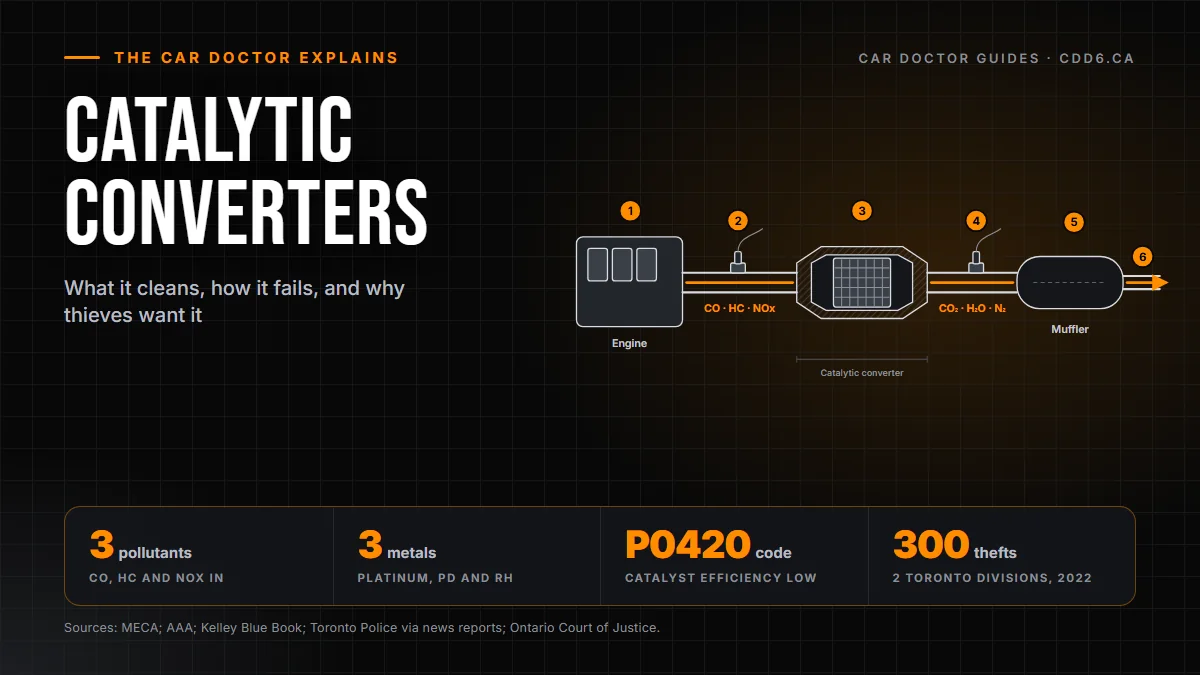
A catalytic converter is the part of your exhaust, between the engine and the muffler, that cleans up exhaust gas before it leaves the tailpipe. A modern three-way converter uses platinum, palladium and rhodium to turn carbon monoxide, unburned hydrocarbons and nitrogen oxides into carbon dioxide, water vapour and nitrogen.
Most drivers never think about it until one of two things happens: the check engine light comes on with a code like P0420, or they start the car one morning and it sounds like a race car. Here is what the part does, how to tell when it is in trouble, and what to do about it in Toronto.
What does a catalytic converter do?
Burning gasoline leaves three troublemakers in the exhaust: carbon monoxide (CO), hydrocarbons (HC) and nitrogen oxides (NOx). Inside the converter, a coating of precious metal sets off chemical reactions that change those gases into much less harmful ones. The Manufacturers of Emission Controls Association (MECA) and AAA agree on what comes out the other end: mostly carbon dioxide, water and nitrogen.
Where the converter sits and what it changes
- EngineSends out exhaust carrying carbon monoxide (CO), hydrocarbons (HC) and nitrogen oxides (NOx).
- Upstream oxygen sensorReads the exhaust before it enters the converter.
- Catalytic converterIts core carries platinum, palladium and rhodium, which turn the three pollutants mainly into carbon dioxide, water and nitrogen.
- Downstream oxygen sensorReads the exhaust after the converter. When its reading looks too much like the upstream one, the computer can set P0420.
- MufflerComes after the converter in the exhaust line.
- TailpipeWhere the cleaned-up exhaust leaves the car.
The orange line is the exhaust flowing from the engine to the tailpipe. Simplified drawing; the layout differs between vehicles.
Source: Layout and chemistry from MECA, AAA and Cars.com; oxygen sensor comparison from the P0420 sources cited below.
| Goes in | Comes out mainly as |
|---|---|
| Carbon monoxide (CO) and hydrocarbons (HC) | Carbon dioxide (CO2) and water (H2O) |
| Nitrogen oxides (NOx) | Nitrogen (N2) |
Source: Manufacturers of Emission Controls Association, The Catalytic Converter: Technology for Clean Air; AAA, What Does a Catalytic Converter Do?
Why is it called three-way?
Because it handles all three pollutant groups at once. Early converters were two-way: they only dealt with CO and HC. The three-way design added control of NOx, and it is the type most gasoline vehicles on the road carry today, as both MECA and AAA explain.
Which precious metals are inside?
Platinum, palladium and rhodium, according to MECA. Those metals are valuable, which is the whole reason converters get stolen: The Globe and Mail and TD Insurance both name the same three metals as the prize.

What are the signs of a failing catalytic converter?
When a converter fails, it is often because something else killed it. RepairPal and Cars.com both name engine misfires, oil burning in the engine and coolant leaking into the exhaust as common causes. Unburned fuel can overheat the converter, and oil can clog it, which AAA also warns about. That is why a misfire deserves quick attention: drive on it long enough and a small repair can turn into a big one.
| What you notice | What it can mean | Confirmed by |
|---|---|---|
| Check engine light, often with code P0420 | The converter is not cleaning the exhaust as well as it should, or a sensor, leak or misfire is fooling the test | Kelley Blue Book; RepairPal |
| Rotten egg (sulphur) smell from the exhaust | A converter that is not working properly | Kelley Blue Book; Cars.com |
| Sluggish acceleration or loss of power | A converter that is clogged or damaged and restricting the exhaust | Kelley Blue Book; RepairPal; Cars.com |
| Sudden loud roar when you start the engine | The converter may have been cut out and stolen | AAA; The Globe and Mail |
Source: Kelley Blue Book, P0420; RepairPal, P0420; Cars.com, common catalytic converter problems; AAA; The Globe and Mail.
What does code P0420 mean?
P0420 stands for catalyst system efficiency below threshold, bank 1. Your engine computer reads one oxygen sensor ahead of the converter and one after it. A healthy converter smooths out the oxygen readings, so the rear sensor should look much calmer than the front one. When the two start to look alike, the computer decides the converter is not doing enough, sets the code and turns on the light. Kelley Blue Book and RepairPal both explain the test this way.
A P0420 does not automatically mean a new converter. Both sources name a worn converter as the usual culprit, but they also list a faulty oxygen sensor, an exhaust leak or a misfire as things that can set the code. Have the whole system diagnosed before anyone sells you parts.
Why do catalytic converters get stolen in Toronto?
It comes back to the metals. A thief can cut a converter out from under a vehicle in a few minutes, according to The Globe and Mail and TD Insurance. Trucks, SUVs and other tall vehicles sit higher off the ground, which makes the job easier, and both sources flag them as frequent targets.
Toronto has seen its share. In spring 2023, Toronto Police said two of its west-end divisions, 22 and 23, saw about 300 converter thefts in 2022, as reported by Guide Auto and Motorious. That is two divisions in one year, not the whole city.
How to make yours harder to steal
No device makes a converter theft-proof, but you can slow a thief down. Both TD Insurance and The Globe and Mail suggest a protective shield or clamp around the converter, and engraving your VIN on it so a stolen part can be traced back to your vehicle. If yours does get taken, report it to police and call your insurer.
Does insurance cover a stolen catalytic converter?
Generally yes, as long as your policy carries one of the optional coverages TD Insurance names: all perils, comprehensive or specified perils. The Globe and Mail adds two checks: make sure your comprehensive coverage does not exclude converter theft, and that your deductible is not set too high. Read your own policy, or call your broker, before you need it.
Can I just remove it? Not in Ontario
Some people think a missing or dead converter can simply be swapped for a straight pipe. In Ontario that is tampering. The province has told drivers not to remove or tamper with any emissions equipment, according to an archived Ontario government page, and the Ontario Court of Justice set fine schedule lists tampering with a vehicle's emissions system as an offence under section 75.1(2) of the Highway Traffic Act. The right fix is a proper replacement converter.
Since converters usually fail because of an engine problem, staying on top of service is the cheapest protection you have. Every CDD6 deal at Golden Mile Chrysler comes with the lifetime oil change*, a gas card and two years of free tire storage. Shopping pre-owned? Browse our used cars, or get in touch with any question for The Car Doctor.
Know the signs
Check engine light
Often with code P0420, catalyst efficiency below threshold.
Sluggish acceleration
A restricted converter can rob the engine of power.
Suddenly much louder
A missing converter makes the exhaust far louder, a sign it may have been stolen.
Make it harder to steal
A shield or clamp slows a thief down, and an engraved VIN makes the part traceable.
Catalytic Converters: Common Questions
What does a catalytic converter do?
It cleans up exhaust gas before it leaves the tailpipe. A modern three-way converter uses platinum, palladium and rhodium to change carbon monoxide, unburned hydrocarbons and nitrogen oxides into carbon dioxide, water and nitrogen. It sits in the exhaust between the engine and the muffler.
What are the symptoms of a bad catalytic converter?
The most common is a check engine light, often with code P0420. Others include a rotten egg smell from the exhaust and sluggish acceleration or a loss of power if the converter is clogged. Many of these can also come from sensors or misfires, so get it diagnosed.
What does P0420 mean?
P0420 means catalyst system efficiency below threshold on bank 1. The engine computer compares oxygen sensors in front of and behind the converter, and sets the code when the rear reading looks too much like the front. A worn converter is the usual cause, but sensors, leaks and misfires can trigger it too.
Can I keep driving with a P0420 code?
The car may feel normal, but Kelley Blue Book warns that driving on it can cause further damage to the converter, and RepairPal notes the underlying cause, often a misfire or a leak, needs fixing too. Book a diagnosis soon rather than waiting for it to get worse.
Why are catalytic converters stolen?
For the platinum, palladium and rhodium inside them. A thief can cut one out in a few minutes. Trucks, SUVs and other tall vehicles are frequent targets because their extra ground clearance makes the converter easier to reach, according to TD Insurance and The Globe and Mail.
How do I know if my catalytic converter was stolen?
The giveaway is noise. Without its converter, the exhaust gets far louder than normal, and you will usually notice it the moment you start the engine or step on the gas. If you suspect theft, have the car checked, then report it to police and to your insurer.
Is it illegal to remove a catalytic converter in Ontario?
Yes, removing it counts as tampering. Ontario tells drivers not to remove or tamper with emissions equipment, and tampering with a vehicle's emissions system is an offence under section 75.1(2) of the Highway Traffic Act. A failed or stolen converter should be replaced, not deleted.
Does car insurance cover catalytic converter theft?
Usually, provided your policy includes all perils, comprehensive or specified perils protection, according to TD Insurance. The Globe and Mail suggests checking your policy for any converter theft exclusion and making sure your deductible is not too high before you ever need to file a claim.
Talk to the Car Doctor
Straight answers, no games, no runaround. The line is open.
437-524-1747