
4x4 vs AWD in Snow: What Each One Helps With, and What Only Tires Can Do

By Navin Kotecha, The Car Doctor
Published
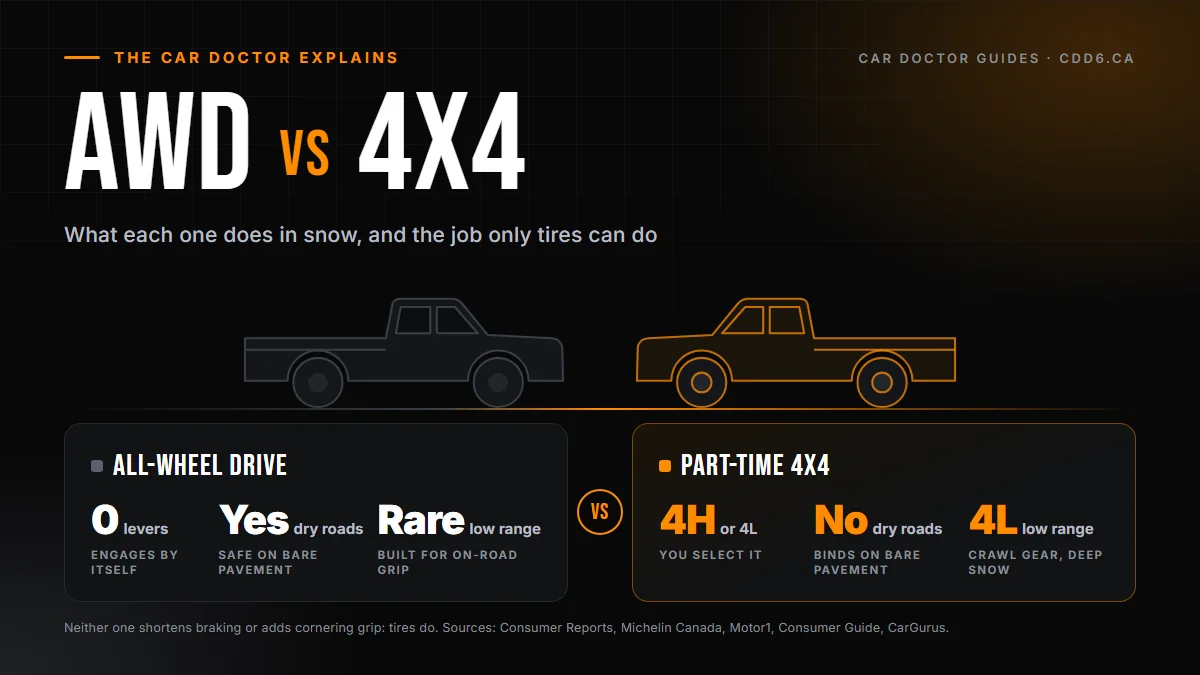
Short answer: all-wheel drive and 4x4 help you get moving on snow. Neither one helps you stop or steer. Braking and cornering come down to the four patches of rubber touching the road, so a set of winter tires does more for you on a slippery GTA morning than the badge on the tailgate.
That does not make the drivetrain useless. It decides whether you can climb out of a slushy side street, up a steep driveway or along an unplowed cottage road. Below, I sort out front-wheel drive, rear-wheel drive, AWD, part-time 4x4 and full-time 4WD, explain 4-Hi and 4-Lo, and match each one to the kind of winter driving you actually do.
What is the difference between AWD, 4x4, FWD and RWD?
The real difference is how power gets split between the front and rear axles, and whether the front and rear wheels are allowed to turn at different speeds. That second point decides whether a system is safe to leave on when the pavement is bare.
| Setup | How power is sent | Who switches it on | OK on dry pavement? | Low range? |
|---|---|---|---|---|
| Front-wheel drive (FWD) | Front wheels only; the engine's weight sits over them | Always on | Yes | No |
| Rear-wheel drive (RWD) | Rear wheels only, under the lighter end of the vehicle | Always on | Yes | No |
| All-wheel drive (AWD) | Both axles, either all the time or added automatically when a wheel slips; a centre differential or clutch lets front and rear turn at different speeds | The vehicle, with no lever or button | Yes | Rare; found mainly on off-road-focused SUVs |
| Part-time 4x4 | Usually the rear wheels in 2H; 4H and 4L lock the front and rear driveshafts to the same speed through a transfer case | The driver, with a lever, knob or button | No: only in 2H | Yes, 4L |
| Full-time or Auto 4WD | All four wheels, with hardware that allows some front-to-rear slip | Always on, or an Auto setting | Yes, in the full-time or Auto mode | Usually, 4L |
Source: Motor1, Consumer Guide, CarGurus Canada, NAPA and Capital One. Check your owner's manual for the system in your own vehicle.
Not sure which one you have? A useful tell: if the owner's manual warns you not to use four-wheel drive on dry pavement, it is a part-time 4x4. If there is no lever or switch at all, it is almost certainly AWD.
What do AWD and 4x4 actually help with in snow?
Getting going. When two driven wheels start to spin, a system that can send power to the other two finds grip that a two-wheel-drive car leaves on the table. Consumer Reports found that this is where AWD earns its keep: pulling away from a stop and climbing a snowy, uphill driveway. Michelin Canada and CarGurus Canada say the same.
A 4x4 goes further in deep, unplowed snow and off-road, where its low range and locked axles help most. For ordinary winter roads, Michelin puts a 4x4 roughly level with AWD, and Motor1 calls AWD the better everyday choice for light snow and rain.
Who does which job on a snowy road
Going: drivetrain and tires
AWD and 4x4 help you pull away and climb when two wheels alone would spin. Good tires help here too.
Stopping: tires only
Driving all four wheels adds nothing to braking. Stopping distance depends on the grip your tires have.
Turning: tires only
Cornering grip comes from the tires as well. An AWD vehicle on the wrong tires can still slide straight on in a bend.
The fix: four winter tires
Fit a full matching set, AWD and 4x4 included. Look for the three-peak mountain snowflake on the sidewall.
Why don't AWD and 4x4 help you stop or turn?
Because the drivetrain only decides where engine power goes. Slowing down and changing direction both depend on how hard the tires can hold the road, and sending power to more wheels does not change that. Consumer Reports' snow testing found AWD did not help with braking or with some cornering situations, and Motor1 sums it up: braking is decided mostly by the tires, not the drivetrain.
That is why the tire matters more than the drivetrain in most winter driving. Michelin says a front-wheel-drive car on dedicated winter tires will often stop and corner better than an AWD vehicle on all-seasons, and Motor1 agrees. AutoTrader.ca makes a related point: a two-wheel-drive car on tires with plenty of tread does better than an AWD car on worn ones. Winter tires use a rubber that stays flexible below about 7°C and a tread designed for snow and ice; the three-peak mountain snowflake guide explains what the symbol certifies, and types of tires covers all-weather versus winter.

One more trap: confidence. Consumer Reports warns that drivers who expect AWD to carry them through a storm or a sharp bend risk a crash or getting stranded, and AutoTrader.ca lists the belief that AWD makes you invincible among the classic winter myths. AWD gets you up to speed sooner. It does not shorten the distance you need to stop.
When should you use 4-Hi and 4-Lo?
On a part-time 4x4, 2H is where the lever lives for normal driving on clear roads. Switch to 4H (4-Hi) when the road surface turns slippery or loose: packed snow, ice, slush or gravel at normal driving speeds. Go back to 2H once you are on bare pavement again.
4L (4-Lo) adds an extra gear set in the transfer case that multiplies torque, so the vehicle creeps forward with plenty of pulling power. Use it at crawling speed only: deep snow, a steep unplowed grade, sand, rough trails or pulling a heavy load out of a tight spot. It is not a highway gear. The shift procedure and speed limits vary from one vehicle to the next, so follow your manual. Wrangler owners: our Jeep Wrangler 4WD guide walks through the transfer-case lever position by position.
Why shouldn't you drive a part-time 4x4 on dry pavement?
In a turn, all four tires follow curves of different lengths, so the front and rear axles need to turn at slightly different speeds. AWD and full-time 4WD have a differential or clutch that allows this. A part-time 4x4 in 4H or 4L does not: it ties the front and rear driveshafts together so they spin at the same rate.
On snow, gravel or ice the tires can slip a little and the difference sorts itself out. On dry asphalt they cannot, so the strain winds up in the driveline instead. It shows up as heavy, awkward handling in tight turns. Do it often and it wears the tires and can damage the driveline, as Consumer Guide, Motor1 and CarGurus Canada all warn. Running in 4WD also burns more fuel. The habit that matters on Toronto's patchy winter roads: once the streets are bare again, go back to 2H.
Some trucks and SUVs add a full-time or Auto 4WD mode built to stay engaged on dry roads, as well as the usual part-time 4H. If yours has one, that is the mode to leave on for patchy winter roads. The manual tells you which settings are safe on pavement.
Is front-wheel drive or rear-wheel drive better in snow?
On the same all-season tires, front-wheel drive usually has the edge. The engine sits over the front wheels, and that weight presses the driven tires into the road. Rear-wheel drive pushes from the lighter end, so the rear tires break loose more easily and the back can slide out. A pickup in 2H is a rear-drive vehicle too. Both Consumer Reports and Capital One's car guide make this point, and both add that traction control and stability control help a two-wheel-drive vehicle, up to a point.
Sources part ways once both cars have proper winter tires. In a Tyre Reviews snow test covered by Motor1, a rear-drive car and a front-drive car on identical winter tires finished very close, with the rear-drive car slightly ahead. That is one test of two specific cars, not a rule, but it points the same way as everything else here: the tires matter more than which wheels are driven.
Which drivetrain do you need for a GTA winter?
Start from where you drive, not from the spec sheet. Whatever the answer, fit four winter tires first; our winter tire dates for Toronto say when to book the swap.
| Your winter | What helps most | Drivetrain that fits |
|---|---|---|
| City streets, the 401 and the DVP; salted roads, slush, mostly bare pavement | Four winter tires, gentle inputs and following distance | Any. FWD or AWD on winter tires covers it |
| Steep driveway, hilly side streets, a street that gets plowed last | Grip to pull away and climb | AWD, or a 4x4 with an Auto mode or 4H |
| Cottage country on weekends: unplowed lanes, deep snow, steep grades | Pulling power at crawling speed, plus winter tires | Part-time or full-time 4x4 with low range |
| Towing a trailer, launching on a snowy ramp, trails | Low range and a strong driveline | 4x4 with 4L, ideally on a truck or SUV built to tow |
Source: Drivetrain roles from Motor1, Consumer Guide, Michelin Canada and Consumer Reports; the GTA situations are examples, not test results.
If your winters include trails as well as snow, the hardware under the truck matters too: types of car suspension explains why off-roaders keep solid axles, and air suspension explained covers trucks that can lift for rough ground. Shopping for a 4x4? Start with the Jeep Wrangler and RAM 1500 pages, then call me: I will tell you which 4x4 system the truck you are looking at has, and how to use it.
4x4 vs AWD in Snow: Common Questions
Is AWD or 4x4 better in snow?
For everyday plowed and salted roads, AWD is the easier choice: it works by itself and is safe on bare pavement. A 4x4 is better in deep, unplowed snow and off-road, where low range and locked axles help most. Neither one helps you stop or turn, so put winter tires on either.
Do I need winter tires if I have AWD or 4x4?
Yes. AWD and 4x4 help you get moving, but braking and cornering depend on the tires. A front-wheel-drive car on winter tires will often stop and corner better than an AWD vehicle on all-season tires. Fit a matching set of four.
Can I leave my 4x4 in 4H all winter?
Only if the manual says that mode is safe on dry pavement, as a full-time or Auto 4WD setting is. A part-time 4x4 in 4H locks the front and rear axles together, which strains the driveline on bare roads. Switch back to 2H once the pavement is clear.
When should I use 4-Lo?
At crawling speed, when you need maximum pulling power: deep snow, a steep unplowed grade, sand, rough trails or freeing a stuck vehicle. 4-Lo is not for normal road speeds, and the way you shift into it varies by vehicle, so follow your manual.
Is front-wheel drive good in snow?
On plowed city roads with winter tires, yes. The engine's weight over the driven wheels helps traction, and traction and stability control help further. Where it struggles is deep snow or a steep, slippery hill, where AWD or 4x4 can pull away when front-wheel drive alone would spin.
This Month's Deals at Golden Mile Chrysler
November 2026 · All-in weekly finance pricing — tap a deal for full details.
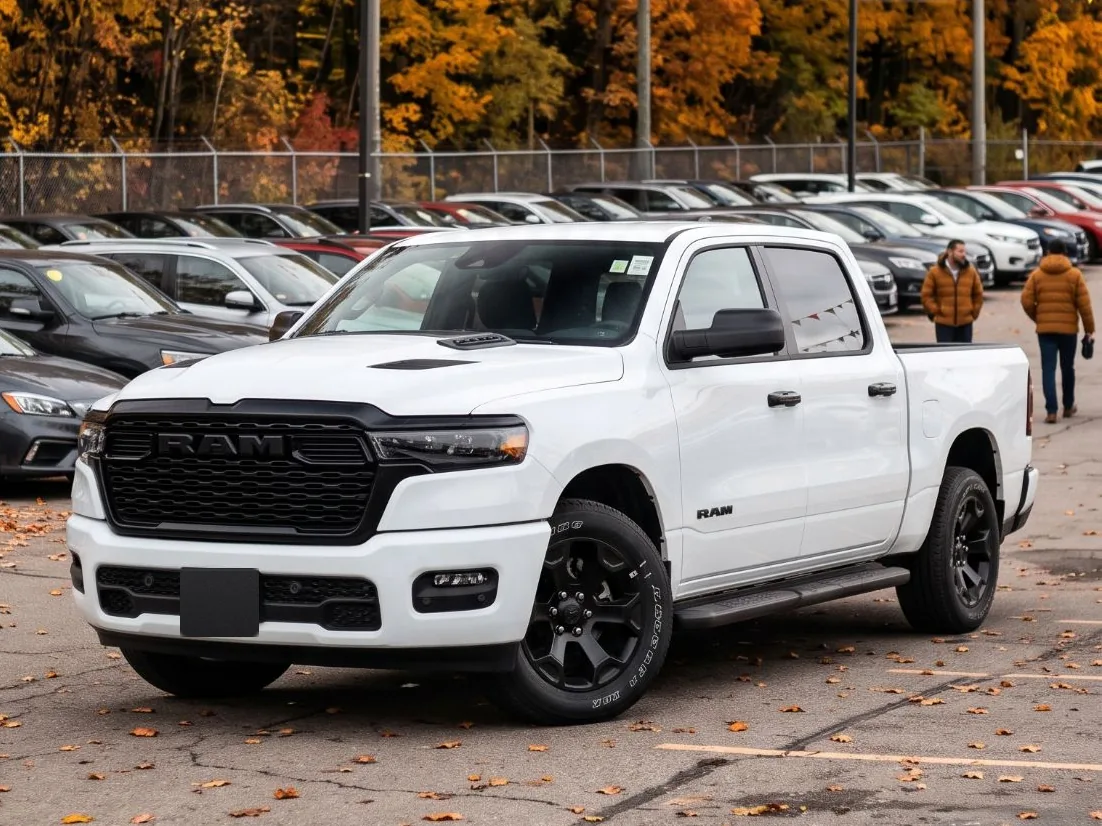
2026 RAM 1500 Black Express 4x4 Crew Cab

2026 Jeep Wrangler Sport S 4-Door 4x4
A note on this month's offers. The CDD6 program is running finance offers only for November 2026 — there are no advertised lease specials in this cycle. Leasing remains available on everything Golden Mile Chrysler stocks; the terms are simply quoted directly rather than advertised as a special. Call 437-524-1747 and we will price it either way so you can compare.
Advertised weekly prices are all-in (freight, PDI, admin & OMVIC fees included); only HST and licensing are extra. On approved credit (OAC). Not all lessees or buyers will qualify — see dealer for eligibility. Vehicles subject to prior sale; see each deal page for full disclosure. E.&O.E. Call 437-524-1747.
See all of this month's deals Black Friday Used Car Sale: on until November 30, 2026 →
Talk to the Car Doctor
Straight answers, no games, no runaround. The line is open.
437-524-1747