
When to Switch to Winter Tires in Toronto: The Dates, the Insurance Discount and the Rules

By Navin Kotecha, The Car Doctor
Published
Every fall the same question comes in on my line: when should I put the winter tires on? Here is the straight answer for Toronto. Book the swap for the last weekend of October, and take them off on the first weekend after April 15. That puts them on before the city's average temperature drops below 7°C, before the earliest insurance deadline, and keeps them on long enough for every insurer's discount. Below are the dates for each winter to 2031, the data behind them, and the rules that trip people up.
The weekend to book, every winter to 2031
The Tire and Rubber Association of Canada says to change over as soon as the temperature consistently dips below 7°C. Below that, the softer rubber in a winter tire grips better than an all-season. Nobody can forecast a Tuesday in November three years from now, so the table uses the long-term average instead: the weekend just before Toronto normally crosses 7°C, which is also the weekend before the earliest insurer deadline of November 1. The take-off weekend is the first one after April 15, the latest date any insurer below asks you to keep them on.
| Winter | Put them on | Take them off | Why these dates |
|---|---|---|---|
| 2026–27 | Oct 31–Nov 1 (if you missed it, do it now) | Apr 17–18, 2027 | Toronto's average falls below 7°C between Oct 29 and Nov 5 and climbs back above it around Apr 11 to 15 |
| 2027–28 | Oct 30–31, 2027 | Apr 22–23, 2028 | Same averages; Apr 15, 2028 is a Saturday, so the next weekend keeps every discount window covered |
| 2028–29 | Oct 28–29, 2028 | Apr 21–22, 2029 | On before Nov 1, the earliest insurer install-by date |
| 2029–30 | Oct 27–28, 2029 | Apr 20–21, 2030 | On before Nov 1, the earliest insurer install-by date |
| 2030–31 | Oct 26–27, 2030 | Apr 19–20, 2031 | On before Nov 1, the earliest insurer install-by date |
| 2031–32 | Oct 25–26, 2031 | Apr 17–18, 2032 | On before Nov 1, the earliest insurer install-by date |
Source: Weekends worked out from Environment and Climate Change Canada Climate Normals, 1981–2010 monthly mean daily temperature for Toronto (downtown) and Toronto Pearson, interpolated between mid-month values; the 7°C guidance from the Tire and Rubber Association of Canada; insurer dates from the table below. Averages, not a forecast: if a cold snap comes early, switch early.
Live up north of the 401 or out by the airport? Lean early. On the long-term averages, Pearson drops below 7°C about a week before downtown Toronto does.
What the Toronto weather data actually shows
These are Environment Canada's long-term averages for the two Toronto stations. October is still above 7°C on average, November is well below it, and the city does not get back above 7°C until April. Snow follows the cold: Pearson averages a few centimetres in November, then about a quarter of a metre a month from December to February.
| Month | Downtown, mean daily temp | Pearson, mean daily temp | Pearson, average snowfall |
|---|---|---|---|
| October | 10.7°C | 9.5°C | 0.4 cm |
| November | 4.9°C | 3.7°C | 7.5 cm |
| December | −0.5°C | −2.2°C | 24.9 cm |
| January | −3.7°C | −5.5°C | 29.5 cm |
| February | −2.6°C | −4.5°C | 24.0 cm |
| March | 1.4°C | 0.1°C | 17.7 cm |
| April | 7.9°C | 7.1°C | 4.5 cm |
Source: Environment and Climate Change Canada, Canadian Climate Normals 1981–2010, stations TORONTO (6158350) and TORONTO LESTER B. PEARSON INT'L A (6158733).
Average snowfall at Toronto Pearson by month
March still averages more snow than November. Taking winter tires off in March is how people end up on all-seasons in the last storm of the year.
Source: Environment and Climate Change Canada, Canadian Climate Normals 1981–2010, Toronto Pearson (6158733).
The insurance discount: the dates that matter
Since 2016, Ontario has required insurers to offer a winter tire discount, and it is the only province that does. The amount is up to 5 per cent, and each insurer sets its own number and its own dates, so the only dates that count are the ones in your policy. Here is the range insurers use, and two examples confirmed by more than one source.
| What insurers set | Range or example | Confirmed by |
|---|---|---|
| Discount | Up to 5 per cent; insurers reviewed offered 2 to 5 per cent | The Globe and Mail; rates.ca |
| Winter tires on by | November 1 at the earliest, December 1 at the latest | The Globe and Mail (6 of 11 insurers by Nov 1, 2 by Dec 1); Scrivens; Sonnet |
| Keep them on until | March 31 at the earliest, April 15 at the latest | The Globe and Mail; Scrivens; rates.ca |
| Example: CAA Insurance | On by November 20, keep on until April 15, 5 per cent | The Globe and Mail; rates.ca |
| Example: Intact | On by December 1, keep on until March 31 | The Globe and Mail; Scrivens |
Source: The Globe and Mail, November 18, 2025; rates.ca; Scrivens, updated November 5, 2026; Sonnet. Insurers change these terms; check your own policy.
Two things people miss. First, the discount is a promise: the Insurance Bureau of Canada told The Globe and Mail that if you say you have winter tires and you don't, you have technically broken the contract, and some insurers ask for proof, so keep the receipts for the tires and the install. Second, all-weather tires are a grey area. Many insurers do not count all-weather tires left on all year, but CAA has said its discount applies to them. If you run all-weathers, ask your insurer before you count on the discount.
Why bother: what winter tires actually do

Research from the Traffic Injury Research Foundation found stopping distances with winter tires as much as 30 per cent shorter than with all-seasons, as both the Tire and Rubber Association of Canada and The Globe and Mail report. Look for the three-peak mountain snowflake on the sidewall: Transport Canada's rules require a tire with that symbol to pass a traction test on packed snow. Most drivers are already on board: in the association's 2025 survey, 80 per cent of Canadian drivers said they use winter tires.
Put on four, never two. The association is blunt that anything less than four winter tires compromises safety, and Co-operators gives the same advice: grip that differs front to back makes the car unstable on snow and ice. If you are choosing a family vehicle for winter, our minivan comparison covers which vans offer all-wheel drive.
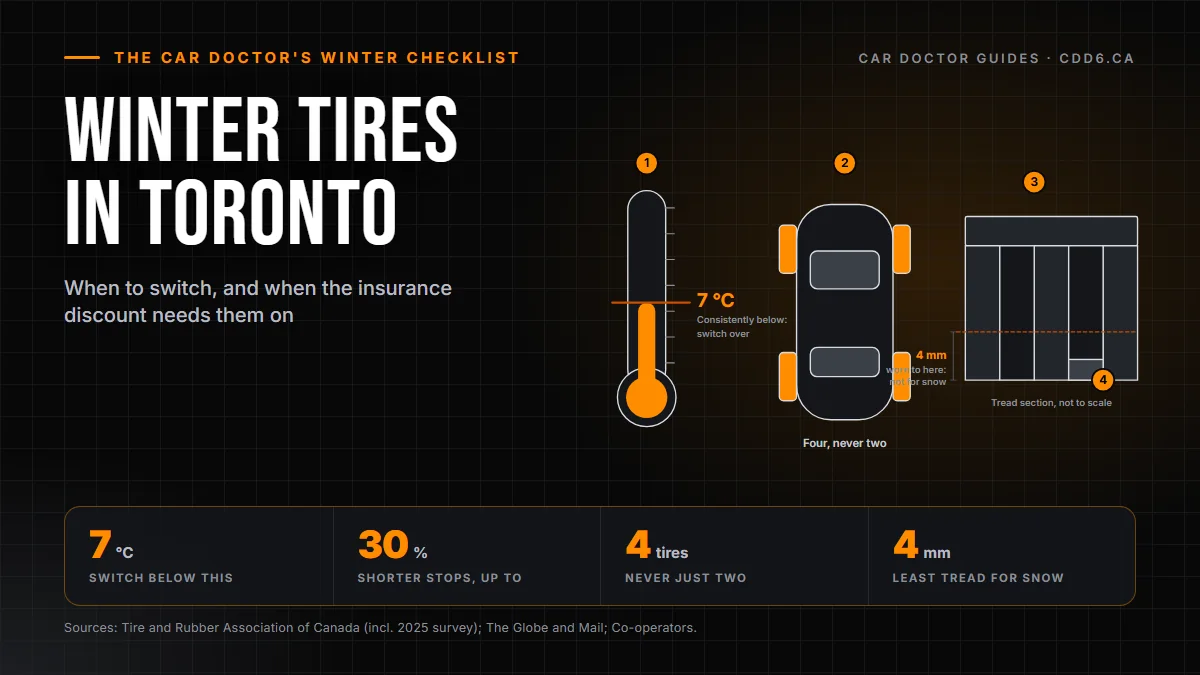
Three checks before the snow
- Below 7 °CChange over once the temperature consistently dips below 7 °C, the Tire and Rubber Association of Canada advises.
- All four wheelsFit four winter tires. Fewer than four compromises safety, because the grip ends up different front to back.
- At least 4 mmCo-operators says winter tires worn below 4 mm should not be used on snow-covered roads.
- Wear indicatorReplace any tire whose tread has worn flush with its wear indicators.
The thermometer marks the switch point; the tread section shows where 4 mm sits above the bottom of a groove. Simplified drawing; the layout differs between vehicles.
Source: Tire and Rubber Association of Canada, Co-operators and the Ontario government
The rules: mandatory, studs and wear
Winter tires are not mandatory in Ontario. Quebec is the province that requires them: the SAAQ requires winter tires on Quebec-registered vehicles from December 1 to March 15. Studded tires are a no for most of us: the Ontario government allows them on vehicles registered in Northern Ontario, and not in Southern Ontario unless you are visiting from out of province or live in the North.
Check your tread every fall when the tires come out of storage. Co-operators says winter tires worn below 4 mm (5/32 inch) should not be used on snow-covered roads, and to replace any tire whose tread is flush with its wear indicators. Cold weather lowers tire pressure, the Ontario government notes, so check it at least once a month through the winter.
The winter tire checklist
Switch at 7 °C
Book the change once the temperature stays below 7 °C, not on the first snowfall.
Four, never two
Different grip front to back makes the car unstable on snow and ice.
Ask about the discount
Ontario insurers must offer a winter tire discount; ask yours which dates the tires must be on.
Check pressure monthly
Cold weather lowers tire pressure, so check it at least once a month through the winter.
Where to keep them: two years of free storage
No garage, a condo locker the size of a closet, or no wish to haul four tires up from the basement twice a year? Every CDD6 deal at Golden Mile Chrysler comes with two years of free tire storage, along with the lifetime oil change* and a gas card. We store your set, and when you come in for the swap your other set is waiting. If you are shopping for a vehicle this fall, ask about it when you call; it is part of every current deal. Shopping pre-owned? Browse our used cars and ask what comes with the one you like.
Driving a Wrangler with bigger tires, or thinking of upsizing for winter? Read Jeep Wrangler tire sizes first; it lists the factory tire sizes by trim.
Winter Tires in Toronto: Common Questions
What is the best date to put winter tires on in Toronto in 2026?
The last weekend of October, October 31 to November 1, 2026. Toronto's average daily temperature drops below 7°C between October 29 at Pearson and November 5 downtown (Environment Canada climate normals), and the earliest insurer deadline is November 1. If you missed it, put them on now: other insurers set their deadline later in November or on December 1. Check yours.
When should I put winter tires on in 2027, 2028 and later years?
Book the last weekend of October each year: October 30 to 31, 2027; October 28 to 29, 2028; October 27 to 28, 2029; October 26 to 27, 2030; and October 25 to 26, 2031. These are based on long-term averages, so if a cold snap arrives early, switch early.
When can I take winter tires off in Toronto?
The first weekend after April 15, for example April 17 to 18, 2027. Toronto climbs back above 7°C around April 11 to 15 on average, and CAA Insurance, for one, wants winter tires kept on until April 15 for its discount. Pearson still averages more snow in March than in November, so do not pull them early.
How much is the winter tire insurance discount in Ontario?
Up to 5 per cent. Ontario has required insurers to offer a discount since 2016, but each insurer sets the amount. In The Globe and Mail's 2025 review of 11 insurers, discounts ranged from 2 to 5 per cent; CAA Insurance offers 5 per cent.
Do all-weather tires qualify for the insurance discount?
It depends on the insurer. Many do not count all-weather tires that stay on all year, while CAA has said its discount applies to them. Ask your insurer before you buy.
Are winter tires mandatory in Ontario?
No. Ontario does not require winter tires, but it requires insurers to offer a discount for them. Quebec makes them mandatory from December 1 to March 15.
Can I use studded tires in Toronto?
Not if your vehicle is registered in Southern Ontario. The Ontario government allows studded tires on vehicles registered in Northern Ontario, and for visitors from out of province.
Do I need four winter tires or just two?
Four. The Tire and Rubber Association of Canada and Co-operators both say to fit winter tires in a set of four, because different grip front and rear makes the car unstable on snow and ice.
How do I know my winter tires are worn out?
Below 4 mm (5/32 inch) of tread, winter tires should not be used on snow-covered roads, according to Co-operators, and any tire worn flush with its wear indicators needs replacing.
Talk to the Car Doctor
Straight answers, no games, no runaround. The line is open.
437-524-1747