
What Should Your Tire Pressure Be? How to Find It, Check It and Keep It Right

By Navin Kotecha, The Car Doctor
Published
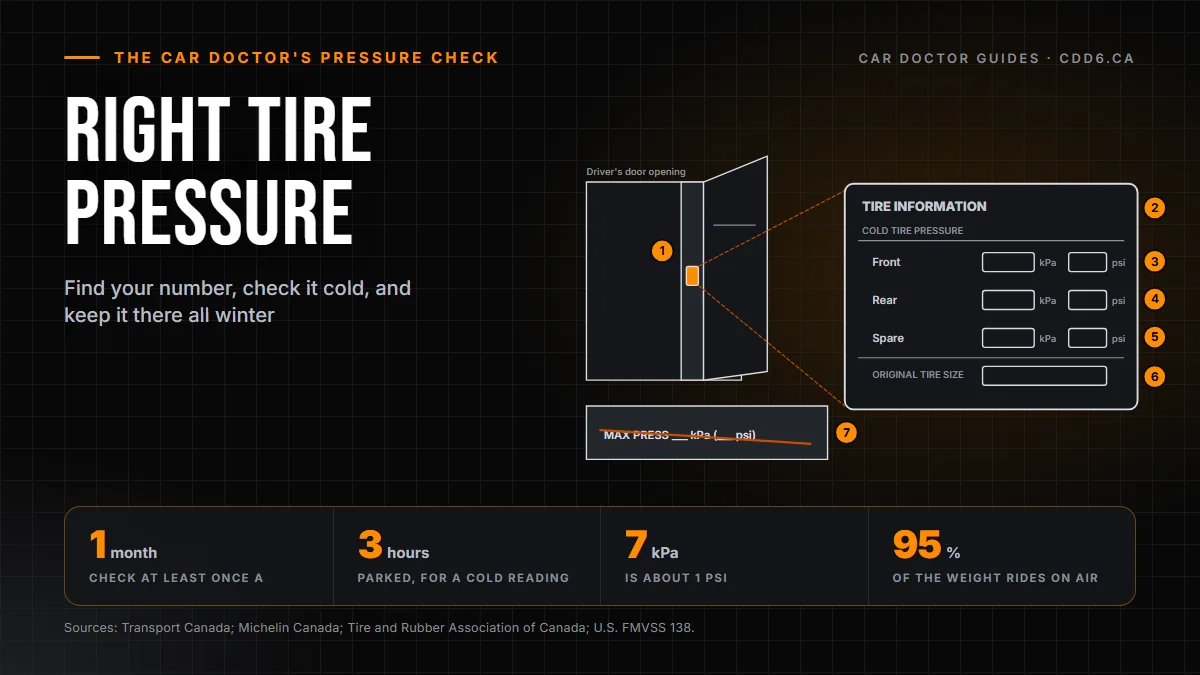
Your correct tire pressure is the number on the tire information label in the driver's door frame, or in your owner's manual. It is not the number moulded into the tire. Set it with the tires cold, check it at least once a month, and add air as Toronto gets colder, because cooler air means lower pressure.
Tire pressure is the cheapest maintenance there is, and the easiest to get wrong. Here is where the right number lives, how to read it in psi or kPa, and what the tire pressure warning light on your dash is trying to tell you.
Where do I find the right tire pressure for my car?
Open the driver's door and look at the edge of the door or the pillar it closes against. That label lists the vehicle maker's cold pressures for the front tires, the rear tires and the spare, plus the original tire size. No label? The owner's manual has the same figures.
Where your number is, and where it is not
- Door labelThe tire information label sits on the driver's door edge or the pillar the door closes against.
- Cold tire pressureEvery figure is a cold pressure: check after the car has been parked at least three hours.
- FrontThe front pressure has its own line, in kPa with psi beside it.
- RearThe rear can differ from the front, so read both lines.
- SpareThe spare has a pressure too. Check it when you check the others.
- Original tire sizeThe label also lists the size the vehicle left the factory on.
- Sidewall maximumThe maximum on the tire is the pressure for its maximum load, not the one to set. Never go over it.
The boxes are left blank because every vehicle's label has its own numbers. Simplified drawing; the layout differs between vehicles.
Source: Transport Canada, Tire and Rubber Association of Canada, Michelin Canada and U.S. FMVSS (Cornell LII)
| Number | Where it is | What it means | Use it to fill your tires? |
|---|---|---|---|
| Recommended cold pressure | Label on the driver's door edge or door pillar, or the owner's manual | The pressure the vehicle maker chose for your vehicle, front, rear and spare | Yes |
| Maximum pressure | Moulded into the tire's sidewall | The pressure the tire needs to carry its maximum rated load | No. Never go above it, either |
Source: Transport Canada, Inflating your tires and TP 2823; Tire and Rubber Association of Canada, Tire Basics; Michelin Canada; label contents per U.S. FMVSS 110.
Front and rear numbers are listed separately for a reason, so check both. And if you want to know what the rest of the sidewall says, our guide on how to read tire size decodes every code on it.
Is tire pressure in psi or kPa?
You will see both. Transport Canada writes pressures in kPa with psi beside them, while tire makers such as Michelin talk in psi. One psi is about 6.9 kPa, which Transport Canada rounds to 7. If your label gives one unit and the air machine shows the other, use this chart.
| psi | kPa (rounded) |
|---|---|
| 30 | 207 |
| 32 | 221 |
| 33 | 228 |
| 35 | 241 |
| 36 | 248 |
| 38 | 262 |
| 40 | 276 |
Source: Converted at 1 psi = 6.894757 kPa, the factor published by NIST; Transport Canada uses about 7 kPa per psi. Your own label's number always wins.
Why should you check tire pressure when the tires are cold?
The number on your label is a cold-tire figure; the U.S. label rule (FMVSS 110) calls it the recommended cold inflation pressure. So measure before a run down the DVP, not after. Transport Canada and Michelin Canada both define cold the same way: the vehicle has sat for at least three hours, or you check before you set out. First thing in the morning, in the driveway or the condo garage, is ideal.

Buy your own gauge and keep it in the glovebox. Both sources say a personal gauge is generally more trustworthy than the one built into a gas station air hose.
How much does cold weather lower tire pressure?
Roughly 1 psi (about 7 kPa) for every 5°C the air cools. That is Transport Canada's figure and the one in Michelin's winter checklist; Michelin's tire pressure page uses 6°C, so treat it as a rule of thumb. On top of that, tires slowly lose air through the rubber even with no puncture. The Ontario government also lists falling tire pressure among its cold-weather warnings.
| Drop in air temperature | Approximate loss | Toronto example |
|---|---|---|
| 10°C | About 2 psi (12 to 14 kPa) | A 15°C afternoon to a 5°C morning |
| 20°C | 3 to 4 psi (23 to 28 kPa) | Set in a 20°C garage, driven on a 0°C day |
| 30°C | 5 to 6 psi (34 to 41 kPa) | Set at 20°C in early fall, parked outside at minus 10°C |
Source: Estimates from the rule of thumb of about 1 psi per 5°C (Transport Canada; Michelin Canada, winter preparation) to 1 psi per 6°C (Michelin Canada, tire pressure). Actual loss varies by tire and vehicle.
So a set of tires that was spot on when you swapped to winters can be well short by January without a single nail in it. That is the case for the monthly check, and for topping up through the winter. If your swap is still ahead of you, our guide to winter tires in Toronto has the dates.
What happens if your tires are underinflated?
According to Transport Canada and the Tire and Rubber Association of Canada, the air inside the tire carries about 95 per cent of the vehicle's weight, so pressure is doing most of the work. Run low and the sidewalls flex more, which raises rolling resistance, burns more fuel, wears the tread faster and builds heat. Transport Canada warns that heat can end in a sudden tire failure, and U.S. federal rules (49 CFR 575.104) list underinflation among the causes of dangerous heat build-up. Too much air is not the fix either: fill to the label, not past it.
What does the tire pressure warning light mean?
The tire pressure warning light belongs to the tire pressure monitoring system, or TPMS. How it behaves tells you what is wrong. Your owner's manual has the exact details for your vehicle.
| What you see | What it usually means | What to do |
|---|---|---|
| Light comes on and stays on | One or more tires is well below the label pressure. U.S. rules require the warning by the time a tire is 25 per cent low | Check all four with a gauge when you can and fill to the label |
| Light flashes for about a minute or longer at start-up, then stays on | A fault in the monitoring system itself | Check pressures by hand and have the system serviced |
Source: U.S. FMVSS 138, 49 CFR 571.138 (warning at 25 per cent below placard; malfunction signal flashes 60 to 90 seconds, then stays lit); Michelin Canada (warning at 25 per cent low); RAM 2500/3500 owner's manual, Mopar (fault light flashes 75 seconds, then stays on).
Do not treat the light as your pressure check. A quarter low is a lot of missing air, and Transport Canada and the tire association both point out that some systems only speak up once a tire is badly underinflated. The U.S. rule even requires owner's manuals to say the TPMS does not replace regular tire care.
How often should you check tire pressure?
At least once a month, plus before any long drive, and do not skip the spare. That is the advice from Transport Canada and Michelin Canada, and it matches the statement U.S. rules require in every owner's manual. Make it a habit you tie to something you already do, like the first fill-up of the month.
Check your tire pressure in five steps
Find your number
Read the cold pressure on the driver's door label or in the owner's manual.
Start cold
Check after the car has sat for at least three hours, or before you drive.
Use your own gauge
A personal gauge is generally more accurate than the one on a gas station hose.
Do all four, and the spare
Front and rear can have different numbers, and the spare loses air too.
Repeat every month
At least once a month and before a long drive, because cold weather lowers the pressure.
Shopping for your next vehicle? Every CDD6 deal at Golden Mile Chrysler comes with the lifetime oil change*, two years of free tire storage and a gas card. Browse this month's lease deals or our used cars.
Tire Pressure: Common Questions
What should my tire pressure be?
Whatever the tire information label in your driver's door frame says, or your owner's manual if there is no label. It lists cold pressures for the front, rear and spare, chosen by the vehicle maker. Do not use the maximum pressure printed on the tire.
Should I fill my tires to the psi on the sidewall?
No. The sidewall number is the maximum pressure, the amount the tire needs to carry its top rated load. Transport Canada, the Tire and Rubber Association of Canada and Michelin all point you to the door label instead. Never inflate above the sidewall maximum.
How do I convert psi to kPa?
Multiply psi by about 6.9. For example, 35 psi is about 241 kPa and 36 psi is about 248 kPa. Transport Canada rounds it to 7 kPa per psi, which is close enough for a quick check at the air machine.
Does cold weather lower tire pressure?
Yes. Transport Canada puts it at about 1 psi (7 kPa) for every 5°C drop in air temperature, and Michelin gives 5 to 6°C. A tire set in a warm fall garage can be several psi low by a January morning in Toronto, so check monthly through the winter.
What does it mean when the tire pressure light flashes?
A light that flashes at start-up and then stays on usually signals a fault in the monitoring system, not low pressure. U.S. rules set that flash at 60 to 90 seconds, and one RAM owner's manual describes 75 seconds. Check your tires with a gauge and have the system serviced.
How often should I check my tire pressure?
At least once a month and before a long trip, including the spare. Check when the tires are cold, meaning the vehicle has been parked for at least three hours or you have not driven yet, and use your own gauge rather than the gas station's.
Is it bad to drive with low tire pressure?
Yes. An underinflated tire flexes more, which wastes fuel, wears the tread faster and builds heat. Transport Canada warns that the heat can lead to sudden tire failure. If the TPMS light comes on, check and fill your tires as soon as you safely can.
See this month's deals, with the lifetime oil change and free tire storage
Talk to the Car Doctor
Straight answers, no games, no runaround. The line is open.
437-524-1747