
How Wheel Locks Work, and Are They Worth It on Your Car or Truck?

By Navin Kotecha, The Car Doctor
Published
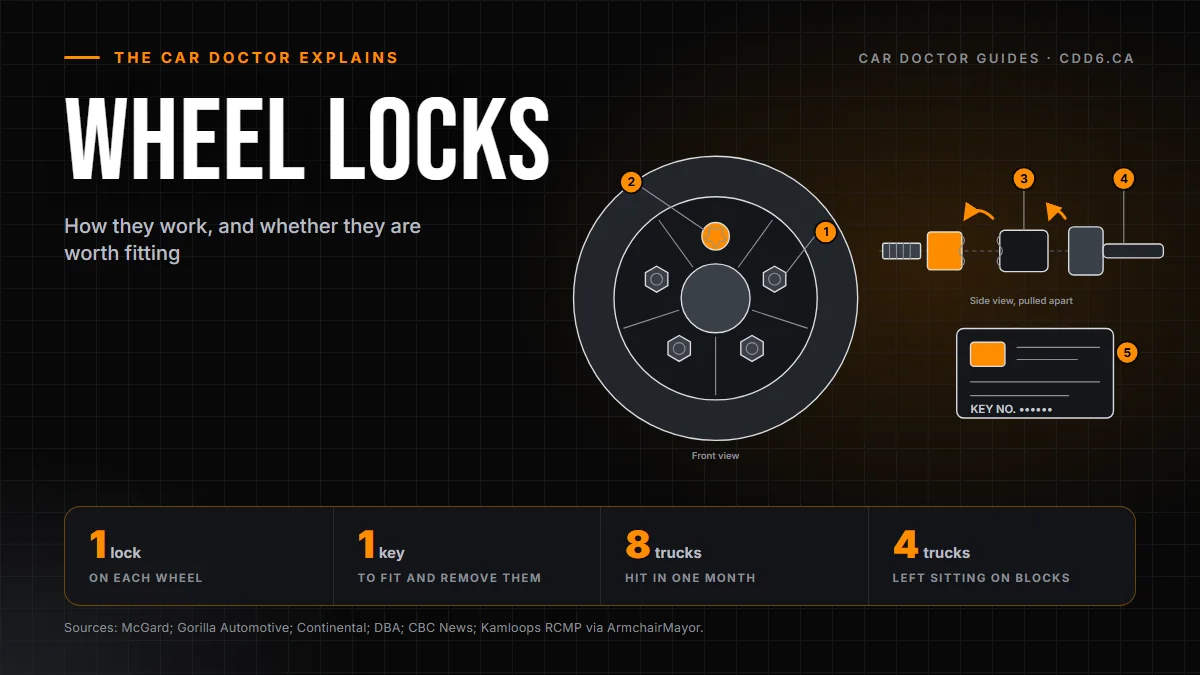
A wheel lock swaps one regular lug nut or bolt on each wheel for one with a patterned head. A normal socket can't grip it; only its matching key, which sits between the lock and your wrench, can turn it. Worth it? For most drivers, yes. Police recommend them, but they slow a determined thief rather than stop one.
How does a wheel lock work?
Think of it as a lug nut with a combination. It clamps the wheel to the hub like the others, but its head carries a groove pattern instead of a plain hex. The key is a small adapter cut with the mirror of that pattern. You slip it over the lock, line up the patterns, and put your lug wrench or torque wrench on the key. Without it, the tools in a regular trunk kit have nothing to bite on.
You only need one per wheel. McGard, one of the big lock makers, recommends a single lock on each wheel, and a typical Gorilla Automotive kit comes with four locks and one key. Each set also comes with a card or sticker showing a registration number. Hang on to it: that number is how you get a replacement key.
How a wheel lock and its key fit together
- Ordinary lug nutA regular socket or lug wrench turns it.
- Wheel lockIt takes the place of one lug nut and has a patterned head that an ordinary socket cannot grip. A typical kit fits one per wheel.
- KeyIts pattern matches the lock. Set it over the lock and turn until the two patterns engage.
- Lug wrenchIt turns the key, and the key turns the lock.
- Registration cardThe number on it is what McGard and Gorilla ask for before they will supply a replacement key.
The side view pulls the parts apart so you can see the order they go together in. Simplified drawing; the layout differs between vehicles.
Source: McGard, McGard replacement keys, Gorilla Automotive and Gorilla replacement keys.
What do wheel locks stop, and what can't they stop?
Wheel locks are aimed at the quick grab. When thieves took the tires off eight trucks in one month in Kamloops, B.C., the RCMP put out a list of prevention tips, and one was a lock on every wheel, because without the key the lug nuts become very hard to get off (CBC News; ArmchairMayor). After a run of wheel thefts in Prince George, RCMP there also urged owners to buy them (Prince George Citizen).
Now the limits. Very hard is not impossible, and McGard's own warranty says its locks carry no promise of being theft proof. In both B.C. cases, police said these were organized crews, not opportunists. Pickups come up again and again in these reports. In Kamloops most of the stolen sets were stock Ford truck tires, and police quoted by Global News named pickups and SUVs as the usual targets. A lock makes your vehicle a slower job than the one parked beside it. That is the real value.
What else protects your wheels?
The Kamloops RCMP list is a good checklist, because the lock is only one item on it. The Insurance Bureau of Canada gives similar parking advice for vehicle theft in general: use a garage if you can, and a well-lit spot if you can't (IBC).
| Police tip | Why it helps | The Car Doctor's note |
|---|---|---|
| Keep it in a garage when you can | Out of sight is out of reach | Best option, if your condo or house has the space |
| Fit an alarm with wheel sensors | Raises the alarm when the vehicle is lifted or a wheel is worked on | Ask before buying whether it suits your vehicle |
| Park where there is traffic and lighting | Thieves want time and darkness | On the street, pick the spot under the light |
| Turn your wheels when you park | A turned wheel tucks into the wheel well and is harder to pull off | Costs nothing; make it a habit |
| Put a wheel lock on each wheel | The lug nuts can't be removed without the key | Cheap insurance against the quick grab |
Source: Kamloops RCMP release as reported by CBC News and ArmchairMayor, January 2017; parking advice also from the Insurance Bureau of Canada.
Does insurance cover stolen wheels and tires?
Check before you need it. In Ontario, theft is handled by the optional coverages for your own vehicle, not by collision coverage, and deductibles and exclusions apply. Ask your broker which of these you carry, what the deductible is, and whether aftermarket rims are covered.
| Coverage | Does it respond to theft? | Notes |
|---|---|---|
| Collision or upset | No | Covers hitting something or rolling over |
| Specified perils | Yes | Theft or attempted theft is one of the listed perils |
| Comprehensive | Yes | Includes the specified perils, plus vandalism and more |
| All perils | Yes | Combines collision and comprehensive |
Source: Financial Services Regulatory Authority of Ontario; Insurance Bureau of Canada. Summaries only: deductibles and exclusions apply, and your policy wording decides.
How do I look after the key?
Keep the key in the vehicle. The glovebox or the bin with the jack and spare is where a roadside crew or a shop will look for it. A key sitting on your kitchen counter does nothing for a flat on the 401.
Record the code somewhere else. Take a photo of the registration card or sticker and keep it on your phone. Both McGard and Gorilla ask for that number before they will supply a matching replacement key.
Tell the tire shop. When you drop the vehicle off for a swap, tell them where the key is and ask for it back where you keep it.
Torque it to spec, by hand. McGard says to tighten each lock to the torque in your owner's manual, ideally with a torque wrench, and not to install locks with an impact gun, which can overtighten them. DBA gives the same advice for wheel nuts in general: finish by hand with a torque wrench. Then have the torque checked after a short drive; the guidance we found ranges from about 40 km (McGard says 25 miles) to roughly 80 km (DBA), with Continental at about 50 km.
Swapping to winter tires soon? Our winter tire guide has the best weekend to book in Toronto.
Fitting a wheel lock the right way
Engage the key
Put the key over the lock and turn it until the patterns lock together.
Start it by hand
Skip the impact gun. It can overtighten the lock.
Torque it to spec
Finish with a torque wrench set to the figure in your owner's manual.
Re-check after a short drive
Check the torque again after roughly 40 to 80 km, depending on whose advice you follow.
File the card
Keep the registration card safe. Its number is what you need to order a replacement key.

What if I lose the wheel lock key?
Don't panic, and don't go at the lock with a hammer. Start with the code.
| Your situation | First step |
|---|---|
| You have the McGard registration card or sticker | Order a replacement key from McGard with the registration number; it sells replacement keys direct |
| You have a Gorilla lock set | Order a replacement key using the key registration number on the silver sticker that came with the set |
| The locks came with the vehicle | Call the dealership that sold it and ask whether they can help or have the code on file |
| You can't find the code anywhere | Search the glovebox and owner's paperwork, then call the lock maker or your dealer |
Source: McGard FAQ and McGard replacement parts ordering; Gorilla Automotive replacement keys.
Some new vehicles leave the lot with a lock set already on. McGard supplies factory wheel locks to automakers, and Gorilla sells sets made for dealers to fit on factory aluminum wheels. If you bought new or used and never noticed a key, look in the glovebox and the spare tire area before your next tire appointment.
So, are wheel locks worth it?
If you drive a pickup or SUV on factory alloys, or you park on the street or in a big open lot, a set is an easy call. Police keep recommending them, and the main thing they ask of you is keeping track of the key. Just treat them as one layer: park smart, keep the key and the code in separate places, and check your insurance. Running bigger rubber on a Wrangler? Our Jeep Wrangler tire sizes page lists the factory sizes by trim.
Shopping for your next vehicle? Every CDD6 deal at Golden Mile Chrysler comes with two years of free tire storage, so your off-season set sits with us instead of in a condo locker, along with the lifetime oil change* and a gas card.
Wheel Locks: Common Questions
What is a wheel lock?
A wheel lock is a lug nut or lug bolt with a patterned head that takes the place of one regular fastener on each wheel. It can only be turned with its matching key, an adapter that sits between the lock and your wrench, so a thief with an ordinary socket can't remove that wheel quickly.
How many wheel locks do I need?
One per wheel. McGard recommends a single lock on each wheel, and a typical four-wheel kit, such as Gorilla's, includes four locks and one key. The other lug nuts on each wheel stay as they are.
Can thieves still steal wheels with locks on?
It's possible. McGard says its locks carry no promise of being theft proof, and Canadian police have described wheel thieves as organized rather than opportunistic. Locks make the job slower and harder, which is often enough to send a thief to an easier vehicle, so combine them with good parking.
Where should I keep my wheel lock key?
In the vehicle, in the glovebox or with the jack and spare, so a roadside crew or tire shop can find it. Keep a photo of the registration code on your phone, separate from the key, so you can order a replacement if the key goes missing.
What do I do if I lose my wheel lock key?
Find the registration number that came with the set; McGard and Gorilla both use it to supply a matching replacement key. If the locks came with the vehicle, call the dealership that sold it first, and check the glovebox for the card.
Should wheel locks be put on with an impact gun?
No. McGard advises against installing its locks with an impact gun because it can overtighten them. Tighten them to the torque listed in your owner's manual, ideally with a torque wrench, and have the torque checked again after a short drive.
Does insurance cover stolen wheels in Ontario?
Theft is handled by optional coverages for your own vehicle, such as specified perils, comprehensive or all perils, not by collision coverage. Deductibles and exclusions apply, so ask your broker whether your wheels, tires and any aftermarket rims are covered and for how much.
Talk to the Car Doctor
Straight answers, no games, no runaround. The line is open.
437-524-1747