
What Are Wheel Spacers? How They Widen Your Stance, What They Change, and Ontario's Rules

By Navin Kotecha, The Car Doctor
Published
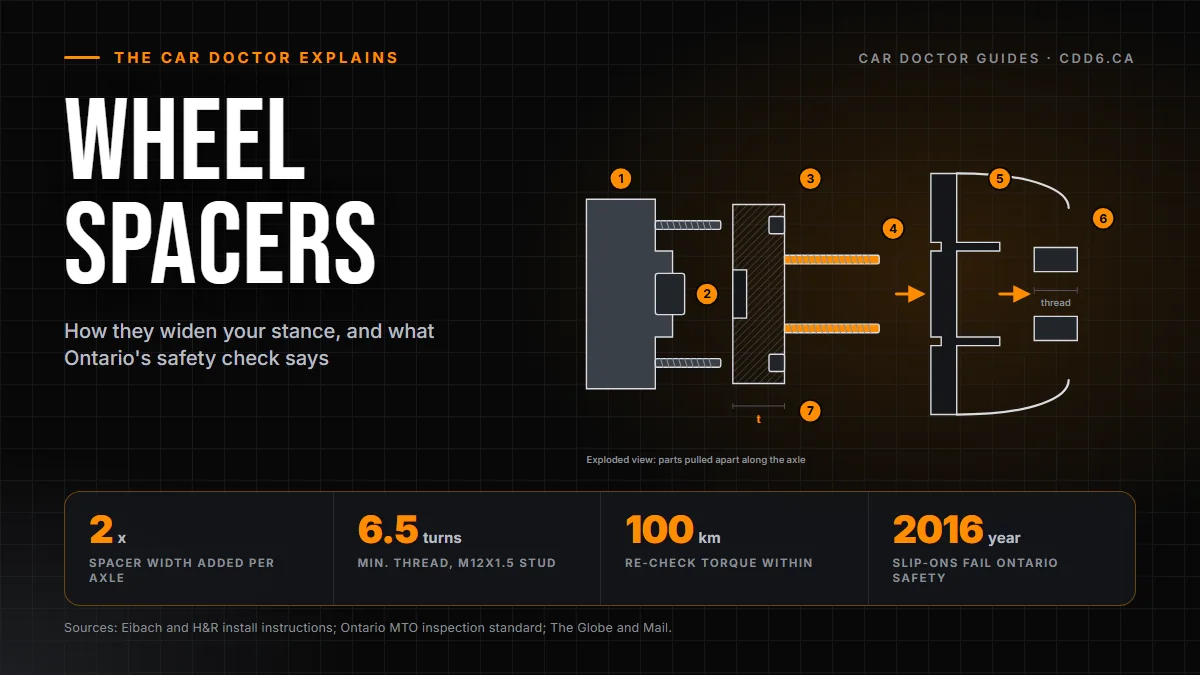
A wheel spacer is a machined disc, usually aluminum, that fits between the hub and the wheel. It moves the wheel outward by its own thickness, so the tire sits closer to the fender lip and the track gets wider: the flush look people want. One catch in Ontario: a slip-on spacer fails the safety inspection.
What does a wheel spacer actually do?
Every wheel bolts to a hub. Slide a disc between the two and the wheel ends up further out by the thickness of that disc. Fit one on each side of an axle and the distance between the left and right tires, called the track width, grows by twice the spacer's thickness. Jalopnik and SlashGear both describe spacers this way: a widened track and a more aggressive stance, usually from a billet aluminum part.
The thinnest slip-on spacers are around 3 mm, a range H&R starts its pass-through series at and SlashGear also cites. Bolt-on types are far thicker: both Eibach and H&R sell 25 mm sizes, for example.
How a wheel spacer widens the stance
Each 25 mm spacer moves its wheel out 25 mm, so the track gets 50 mm wider. Movement exaggerated so you can see it. A 25 mm spacer moves each wheel out by 25 mm, so the track across that axle grows by about 50 mm.
Source: Spacer moves the wheel out by its thickness: Eibach Pro-Spacer instructions (stud must be longer by the spacer's thickness) and The Autopian; 25 mm sizes: Eibach and H&R.

Slip-on spacer or bolt-on adapter: what is the difference?
A slip-on spacer has plain holes. The factory studs pass through it and the wheel's own lug nuts clamp the wheel and spacer to the hub together. Because the spacer uses up stud length, thicker ones need longer studs or bolts, as SlashGear and the Eibach instructions both point out.
A bolt-on spacer is fastened to the hub on the factory studs with its own nuts, and it carries a second set of studs that the wheel then mounts on. Ontario's inspection standard calls this an adapter. Some adapters also change the bolt pattern, so wheels drilled for a different pattern can fit, which H&R and SlashGear both describe.
A bolt-on spacer, pulled apart
- HubWithout a spacer, the wheel bolts straight to the hub on its factory studs.
- Hub-centric lipOn a hub-centric setup the centre bore fits snugly over this lip, so the hub helps carry the wheel along with the lugs.
- Bolt-on spacerFastened to the hub with its own nuts. Ontario's inspection standard calls this an adapter.
- Spacer studsThe wheel mounts on the spacer's own studs, not on the factory ones.
- WheelIt ends up further out by the thickness of the spacer.
- Lug nut threadEach nut needs enough thread: Eibach and H&R ask for at least 6.5 turns on an M12x1.5 stud.
- Thickness tThe wheel moves out by t, so the track across that axle grows by 2t.
Parts are pulled apart along the axle so you can see each one; in use they sit tight together. Simplified drawing; the layout differs between vehicles.
Source: Eibach, The Autopian, Ontario government, H&R, Jalopnik, Les Schwab and Machine Design
| Type | How it mounts | What it is used for | Ontario safety inspection |
|---|---|---|---|
| Slip-on spacer | Factory studs pass through it; the wheel's lug nuts hold wheel and spacer on | Thin, small changes in wheel position | Rejected: a spacer between a wheel and hub is a fail |
| Bolt-on spacer (an adapter in the standard) | Bolted to the hub; the wheel mounts on the spacer's own studs | Thicker spacing for a wider stance | Not an automatic fail; rejected if damaged or if fasteners are the wrong length, material or grade |
| Bolt pattern adapter | Bolted to the hub like a bolt-on spacer, with studs in a different pattern | Fitting wheels drilled for another bolt pattern | Inspected the same way as any adapter |
Source: Ontario Ministry of Transportation, Passenger / Light-Duty Vehicle Inspection Standard, Section 9, item 7; The Globe and Mail, June 22, 2016; H&R TRAK+; Jalopnik; SlashGear.
Hub-centric vs lug-centric: why it matters
On a hub-centric setup, the centre hole fits tightly over the raised lip of the hub, so the hub locates the wheel and shares the load with the studs. On a lug-centric setup, the hole is bigger than the hub and the lug nuts alone do the centring. That is how Les Schwab and Machine Design define the two.
The difference shows up as vibration. Machine Design explains that bumps can bend the studs slightly on a lug-centric fit until the wheel no longer runs true on the hub, and Les Schwab links an off-centre wheel to shake you feel through the steering wheel or seat. The established spacer makers, Eibach and H&R, build their spacers hub-centric, and both sets of instructions have the installer confirm the spacer sits on the hub with no play. My advice: buy hub-centric.
How much thread, how tight, and when to re-torque
The nut has to grab enough thread to hold the wheel. Eibach and H&R both publish the minimum number of full turns a nut must make on the stud, and their figures match. Ontario's inspection standard also fails any wheel nut that is not fully engaged with its stud.
| Thread size | Minimum full turns of the nut | Approx. load-bearing thread |
|---|---|---|
| M12x1.25 | 8.0 | 10 mm |
| M12x1.5 | 6.5 | 10 mm |
| M12x1.75 | 6.5 | 12 mm |
| M14x1.5 | 7.5 | 11 mm |
Source: Eibach Pro-Spacer System 6 installation instructions, step 6; H&R TRAK+ System DR instructions, step 7. If your automaker's workshop manual says otherwise, it takes priority.
Both makers want the final tightening done with a torque wrench, not an impact gun, to the figure in your automaker's manual (or the wheel maker's, for aftermarket wheels), working across the wheel in an alternating pattern. Then check it again soon after: Eibach says at about 40 km (25 miles) and again near 800 km (500 miles), and H&R says at about 100 km. Both also say the job belongs with a trained technician in a proper shop.
What spacers change: steering feel, wheel bearings and tire rub
Steering. Pushing the wheel out moves the tire's contact patch further from the line the wheel pivots on when you steer. That gap is the scrub radius. Jalopnik notes a bigger scrub radius can make low-speed steering heavier, and H&R's technical article on scrub radius says too much of it adds steering effort and road feel.
Wheel bearings. The further out the wheel sits, the more leverage it has on the bearing. Jalopnik, SlashGear and The Autopian all say that extra load can shorten bearing life, and Jalopnik's bearing piece adds that how much depends on how thick you go, and that a lower-offset aftermarket wheel loads the bearing the same way.
Tire rub. Too thick a spacer puts the tire out past the fender lip, where it can rub. SlashGear warns it gets worse on a lowered vehicle and that metal on rubber can cut a tire in a hard corner. Check clearance at full lock before you call it done.
Do wheel spacers void your warranty?
Not by themselves, going by what automakers publish. Ford of Canada says an aftermarket part does not necessarily void its new vehicle warranty, but repairs caused by that part are not covered. Chrysler's warranty booklet takes the same line: add-on parts don't void the warranty on their own, but the warranty does not pay for repairs the installation causes. An early bearing failure behind a thick spacer could be one of those. Read your own warranty booklet and ask the service department before you install.
Are wheel spacers legal in Ontario?
Ontario's Passenger / Light-Duty Vehicle Inspection Standard, the rulebook for a Safety Standards Certificate, treats any spacer fitted between a wheel and its hub as grounds to fail the vehicle. It defines a spacer as a disc the studs pass through without engaging, and treats a bolted-on adapter separately, checking it for damage and correct fasteners. The Globe and Mail reported the spacer ban when the standard took effect on July 1, 2016, and the province's 2026 inspection directive still points technicians to that standard.
The Ontario government requires a Safety Standards Certificate before a used vehicle can change hands (a sale to your spouse is the exception), and to register a vehicle brought in from another province or country, among other cases. Inspections are done at licensed DriveON Vehicle Inspection Centres. So a truck sold with slip-on spacers won't certify until they come off.
On the road, the Highway Traffic Act, section 66(3), requires mudguards, fenders or a similar device that effectively cuts spray from the wheels unless the body already does the job, a rule The Globe and Mail has covered for Jeeps with exposed tires. We could not find any section of the Act that names wheel spacers, and how far a tire may stick out past the fender is not clearly spelled out. Before you buy, ask a licensed Vehicle Inspection Centre how they would treat your setup.
Before you fit spacers
Ontario safety check
A spacer between the wheel and hub fails Ontario's safety inspection under the 2016 standard.
Torque by hand
Finish with a torque wrench, not an impact gun, and re-check the torque soon after fitting.
Bearings and steering
More leverage on the wheel bearings, and heavier steering at low speed.
Watch for rub
Too thick a spacer can push the tire past the fender lip, where it can rub.
Where to buy wheel spacers, and what to check first
We can't vouch for specific products, so these Amazon.ca searches are a starting point: hub-centric wheel spacers, a thread pitch gauge to confirm your stud thread, and a torque wrench for the final tightening.
Whatever you buy has to match your vehicle's bolt pattern, centre bore and stud thread size and pitch; Eibach's instructions make the installer check all three before fitting. Buy hub-centric where it is offered, remember a slip-on spacer will fail an Ontario safety, and have a professional install and torque them. Upsizing tires on a Wrangler at the same time? Start with Jeep Wrangler tire sizes. Shopping for a truck that already looks right from the factory? Have a look at the RAM 1500.
Every CDD6 deal at Golden Mile Chrysler comes with two years of free tire storage, the lifetime oil change* and a gas card, so a second set of wheels has somewhere to live when it is off the truck.
Wheel Spacers: Common Questions
What do wheel spacers do?
A wheel spacer sits between the hub and the wheel and moves the wheel outward by its own thickness. With one on each side of an axle, the track width grows by twice that thickness, which gives a wider, flusher stance.
What is the difference between a wheel spacer and a wheel adapter?
A slip-on spacer is a disc the factory studs pass through, and the wheel's lug nuts hold both on. An adapter bolts to the hub with its own nuts and carries its own studs for the wheel. Some adapters also change the bolt pattern so wheels with a different pattern can fit.
Are wheel spacers legal in Ontario?
Ontario's safety inspection standard rejects a vehicle with a spacer between a wheel and hub, a rule in place since July 1, 2016. A bolted-on adapter is not an automatic fail but is checked for damage and correct fasteners. Beyond the safety inspection the rules are not clear, so ask a licensed Vehicle Inspection Centre.
Should I buy hub-centric or lug-centric spacers?
Hub-centric. Their centre bore fits snugly over the hub lip, so the hub centres the wheel and shares the load. A lug-centric fit relies on the studs alone, and road impacts can bend them enough that the wheel runs off-centre and vibrates.
When should wheel spacers be re-torqued?
Soon after installation. Eibach says to re-check all fasteners at about 40 km and again near 800 km, while H&R says to re-tighten at about 100 km. Use a torque wrench, not an impact gun.
Do wheel spacers wear out wheel bearings?
They add load. Moving the wheel outward gives it more leverage on the bearing, which can shorten its life, and the thicker the spacer the bigger the effect. A lower-offset aftermarket wheel puts the same extra load on the bearing.
Will wheel spacers void my warranty?
Not on their own, according to the warranty terms Ford of Canada and Chrysler publish. But if the spacer causes a failure, such as a worn bearing, that repair is not covered. Check your own warranty booklet first.
Talk to the Car Doctor
Straight answers, no games, no runaround. The line is open.
437-524-1747