
Types of Tires, and How to Tell Which Ones Are on Your Car

By Navin Kotecha, The Car Doctor
Published
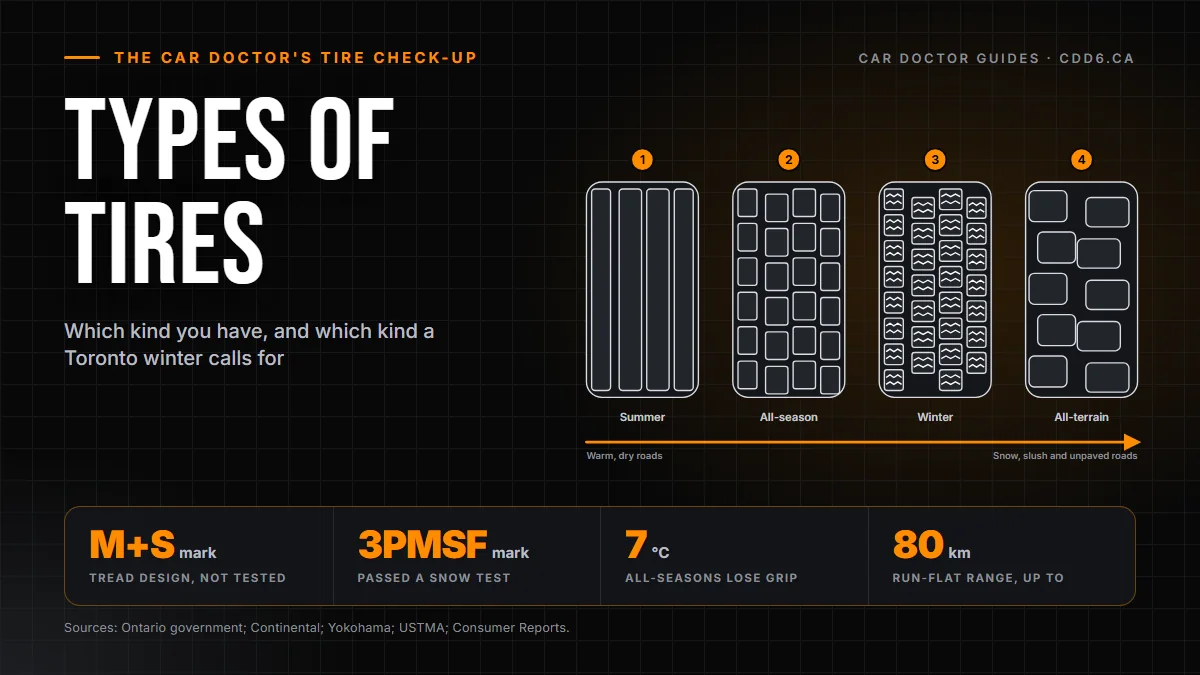
Most cars run on one of four seasonal types: summer, all-season, all-weather or winter. Pickups and SUVs add all-terrain, mud-terrain and highway tires, and some cars use run-flats. To tell which you have, read the sidewall: the tire's model name, the M+S mark, the snowflake symbol and the letters at the start of the size give it away.
What are the main types of tires?
Think of tire types in two groups. The first group is about temperature and weather: how soft the rubber stays in the cold and how the tread handles snow and slush. The second group is about the road: pavement, gravel or mud, and how much weight the tire has to carry. The table sums up both.
| Type | Built for | Watch out for | Usual sidewall clue |
|---|---|---|---|
| Summer | Grip and steering on warm, dry and wet roads | Rubber stiffens in the cold; no grip on snow or ice | Model name; no snowflake |
| All-season | One set for mild, moderate weather | Starts to lose grip around 7°C; weaker in a harsh winter | M+S |
| All-weather | Year-round use with a passed snow test | Still trails a dedicated winter tire in deep winter | M+S plus the snowflake |
| Winter (studless or studded) | Cold, snow, slush and ice; rubber stays soft below freezing | Wears fast on warm, dry pavement; take them off in spring | Snowflake symbol |
| Highway (on-road truck and SUV) | Pavement driving and loads on pickups and SUVs; quieter ride | Match the load rating your truck or SUV needs | Model name; check the maker's description |
| All-terrain | Pavement plus gravel, dirt and light off-road | Not the same thing as an all-season tire | Model name; some carry the snowflake |
| Mud-terrain | Serious off-road: mud, rocks and wet snow | Built for off-road first, not for the daily highway run | Model name; check the maker's description |
| Run-flat | Driving a limited distance after a puncture, on reinforced sidewalls | Usually cannot be repaired; distance and speed are limited | A run-flat marking; codes vary by maker |
Source: Consumer Reports tire buying guide; Continental Canada: tire types, off-road tires and SUV tires; Yokohama; Ontario government; Jalopnik; Les Schwab.
Four tread types, seen from above
- SummerMade for warm roads, wet or dry. The rubber stiffens as it gets cold, and it does not grip on snow or ice.
- All-seasonBuilt for moderate climates without winter features, and it can start to lose grip below 7 °C.
- WinterRubber that stays pliable in freezing weather, with a tread made for snow, slush and ice.
- All-terrainA rugged tread for pavement plus unpaved and snowy roads. Mud-terrain tires go further off-road.
Each panel looks down at the tread. The patterns are illustrative, not a specific tire. Simplified drawing; the layout differs between vehicles.
Source: Consumer Reports, Continental, Ontario government, Tire and Rubber Association of Canada and Yokohama
Summer, all-season, all-weather or winter: what is the difference?
Summer tires use a compound tuned for warm roads. Consumer Reports says summer performance tires are not made for cold weather and will not grip on snow or ice, and Continental warns the rubber stiffens as it gets colder.
All-season tires split the difference. They suit moderate climates, but they lack the winter features of a true winter tire. The Ontario government is clear that all-seasons are not winter tires and can start to lose grip at 7°C, the same temperature the Tire and Rubber Association of Canada uses as the cue to switch.
All-weather tires carry the three-peak mountain snowflake, so they have passed the same snow traction test as winter tires. Jalopnik and Les Schwab both note the symbol on all-weathers. They are still a compromise: Jalopnik says they fall behind proper winter tires in the conditions winter tires are made for. Our guide to the three-peak mountain snowflake symbol explains what that test does and does not check.
Winter tires use rubber that stays pliable below freezing and a tread made for snow, slush and ice. The soft compound wears quickly on warm, dry pavement, so they are a seasonal tire that comes off in spring. Studded tires are a separate category with metal studs, and in Ontario they are allowed only on vehicles registered in Northern Ontario, plus visitors from outside the province.

What about truck and SUV tires: all-terrain, mud-terrain and highway?
Highway tires, which Consumer Reports files under all-season truck tires, are the road tire for pickups and SUVs: built to carry heavy loads and ride quietly on pavement. All-terrain tires add a more rugged tread for gravel, dirt and snowy back roads while staying livable on the highway; Continental stresses they are not the same thing as all-seasons. Mud-terrain tires go further, with an aggressive tread for vehicles that spend real time off the pavement; Yokohama suggests picking between the two by how your driving splits between road and trail. If you drive a Wrangler, our Jeep Wrangler tire sizes page lists the factory tires by trim.
What are run-flat tires?
Run-flats have reinforced sidewalls that hold the car up after a puncture, so you can keep driving to a shop instead of changing a tire on the shoulder of the 401. Continental puts the range at up to 80 km, and Yokohama sets the same distance limit for its run-flats. Both say a punctured run-flat should be replaced, not repaired. Check your owner's manual for your vehicle's limits.
LT or P-metric: what do the letters before the size mean?
A size that starts with P is a passenger tire. A size that starts with LT is a light-truck tire, the kind made for pickups, as Yokohama explains and the U.S. Tire Manufacturers Association uses in its own definitions. Stick with the type your vehicle came with unless the manufacturer says otherwise. The rest of the size code is covered in how to read a tire size.
How can I tell which tires are on my car?
Walk around the car with this checklist. It takes two minutes and needs nothing but a flashlight on a dark November evening.
| Where to look | What you will see | What it means |
|---|---|---|
| Sidewall, near the brand | The brand and model name, molded into the rubber | Search the model name on the maker's site to see whether it is a summer, all-season, all-weather or winter tire |
| Sidewall marks | M+S (or MS, M/S, M&S) | Tread design for some mud and snow; common on all-seasons; not performance-tested |
| Sidewall marks | Mountain with a snowflake inside | Passed a packed-snow traction test: a winter or all-weather tire |
| Sidewall marks | Mountain with icicles | Ice Grip symbol: also tested for braking on ice |
| Start of the size code | P, LT, or no letter | P is passenger, LT is light truck |
| Sidewall marks | A run-flat label or code | A run-flat tire; codes differ by maker, so confirm with the model name |
| Driver's door or door frame | The tire information label | The pressure, and the size the vehicle was built for; the owner's manual has it too |
Source: Yokohama: product information, markings and sizing; Continental Canada: tire markings and tire size; USTMA bulletins Vol. 37 No. 3 and Vol. 56 No. 1; Transport Canada.
The model name is the most reliable clue. An M+S mark alone usually means an all-season. A snowflake means winter or all-weather, and the maker's page for that model settles which.
Quick takeaways
Watch 7 °C
All-seasons can start to lose grip below 7 °C, which is when to switch to winters.
Snowflake means tested
The three-peak mountain snowflake means a snow traction test was passed; M+S is not a test.
Four, never two
Fit winter tires on all four wheels and do not mix tire types.
Run-flats get replaced
Run-flats can carry on up to about 80 km after a puncture, but a punctured one should be replaced.
Which tires make sense for Toronto driving?
For a typical GTA commute, the safe setup is all-seasons from spring to fall and a set of four winter tires once it turns cold. Ontario's own advice is to fit winter tires on all four wheels and not to mix tire types on one vehicle, and Consumer Reports also says to run winter truck tires as a set of four. Summer tires belong in storage by late fall. If you would rather not swap, all-weathers carry the snowflake, but check with your insurer before assuming they earn the winter tire discount. The dates to swap, the discount and the Quebec rule are in our winter tires guide for Toronto.
Running two sets means storing one of them. Every CDD6 deal at Golden Mile Chrysler comes with two years of free tire storage, along with the lifetime oil change* and a gas card.
Types of Tires: Common Questions
How do I know if I have winter tires or all-season tires?
Check the sidewall. A winter tire carries the three-peak mountain snowflake, a small mountain outline with a snowflake inside. An all-season usually shows only M+S. All-weather tires carry the snowflake too, so look up the tire's model name on the maker's site to be certain.
What is the difference between all-season and all-weather tires?
All-weather tires have passed the snow traction test behind the three-peak mountain snowflake; most all-seasons have not and carry only M+S. The Ontario government says all-season tires can start to lose grip at 7°C. All-weathers still trail dedicated winter tires in deep winter conditions.
Can I drive on summer tires in a Toronto winter?
It is a bad idea. Consumer Reports says summer performance tires are not made for cold weather and will not grip on snow or ice, and Continental warns their rubber stiffens in the cold. Switch to winter tires before temperatures drop below 7°C.
What does LT mean on a tire?
LT at the start of the size means a light-truck tire, designed for pickups. A P at the start means a passenger tire. Keep the type your vehicle was built with unless the manufacturer approves a change; the tire label on the driver's door shows the original size.
How far can you drive on a run-flat tire?
Up to about 80 km after a puncture, according to Continental, and Yokohama sets the same distance limit for its run-flats. Both say a punctured run-flat should be replaced rather than repaired. Your owner's manual gives the limit for your vehicle.
Are all-terrain tires good in snow?
Some are. All-terrain tires have a rugged tread meant for unpaved and snowy roads, and some carry the three-peak mountain snowflake, which means they passed a snow traction test. Without that symbol, an all-terrain is not a substitute for winter tires.
Are studded tires legal in Toronto?
Not for vehicles registered in Southern Ontario. Ontario permits studs only on vehicles registered in Northern Ontario, plus visitors from outside the province. Studless winter tires are the normal choice in Toronto.
Talk to the Car Doctor
Straight answers, no games, no runaround. The line is open.
437-524-1747