
Tire Wear Patterns: How to Read Your Tread and Sidewalls

By Navin Kotecha, The Car Doctor
Published
Uneven tread wear is a symptom, and where the rubber is vanishing points to the cause. Wear down the middle usually means too much air; both shoulders worn means too little. One shoulder worn means alignment. Scooped patches suggest worn shocks or a wheel out of balance, and saw-tooth blocks point to toe.
What do the different tire wear patterns look like?
Match your tire to a pattern
- Even wear (healthy)
- Centre worn
- Both edges worn
- One edge worn
- Cupping (scalloped dips)
- Feathering (ribs worn at a slant)
- Flat spot
Each drawing is a cross-section of the tread: compare the shape of your worn tire with the pattern it matches, then read the likely cause below. Drawings are simplified, not to scale.
Source: Pattern and cause pairs from Michelin, Bridgestone and Les Schwab; cupping from Bridgestone; flat spots from Michelin and Firestone Complete Auto Care.
Park on level ground and turn the steering to full lock so you can see the full width of a front tire. Look across the tread from shoulder to shoulder, then run your palm over it both ways. Even wear edge to edge is what you want.

Worn down the centre: is the tire over-inflated?
Usually, yes. Pump a tire past the pressure the vehicle maker calls for and the middle of the tread ends up carrying most of the load. Michelin, Bridgestone and Les Schwab all tie centre wear to over-inflation, and Transport Canada notes an over-inflated tire rides on the middle of its tread.
Inflate to the number printed on the driver’s door-jamb placard (your owner’s manual lists it too), not the maximum moulded into the sidewall, and check it at least once a month, as both Transport Canada and Bridgestone advise.
Worn on both edges: is the tire under-inflated?
Run a tire soft and its two shoulders take the beating and wear out ahead of the middle. Michelin and Les Schwab both link wear on both shoulders to low pressure, and Les Schwab adds overloading. Bridgestone says skipped rotations can play a part. Top the pressure up to spec and lighten the load.
Worn on one edge only: is it alignment?
Almost always. When the inner or the outer shoulder is clearly lower than the rest of the tread, the wheel is not sitting at the angle the vehicle maker specified. Bridgestone calls this camber wear, after one of the alignment angles, and Michelin lists one-sided wear as an alignment fault. Book an alignment check, and look at the other tires while you are at it.
What causes cupping or scalloping?
Cupping looks like dips scooped out of the tread at intervals around the tire, and it tends to get noisy as it develops. The tire is bouncing instead of rolling smoothly. Bridgestone and Les Schwab point to worn shocks, struts or other suspension parts, and Michelin and Bridgestone both name a wheel and tire out of balance as a cause. Have the suspension inspected and the wheels balanced.
What does feathering mean?
Feathered tread blocks are worn smooth and low on one side and left high and sharp on the other. You often feel it before you see it: stroke the tread one way and it is smooth, stroke it back and it catches. Michelin, Bridgestone and Les Schwab all trace feathering to the toe setting in the alignment. An alignment fixes the cause.
Why does my tire have a flat spot?
Two usual reasons. A hard stop that locks and skids a wheel grinds tread off one patch, and a car parked for weeks can take a set where the tire touches the ground. Michelin and Firestone Complete Auto Care describe both, and both say cold weather makes parking flat spots likelier. If the vibration does not settle once the tires warm up, or the spot came from a skid, have a technician look.
Tire wear patterns at a glance
| Condition | What it looks like | Likely cause | What to do |
|---|---|---|---|
| Centre wear | Middle ribs lower than the shoulders | Over-inflation | Set pressure to the door placard, check monthly |
| Both-edge wear | Both shoulders lower than the middle | Under-inflation or overloading | Correct pressure, reduce the load |
| One-edge wear | Inner or outer shoulder clearly lower | Alignment, usually camber | Have the alignment checked |
| Cupping (scalloping) | Scooped dips at intervals around the tread | Worn shocks, struts or suspension parts, or a wheel out of balance | Inspect suspension, balance the wheels |
| Feathering | Tread blocks smooth on one side, sharp on the other | Toe misalignment | Have the alignment checked |
| Flat spot | One flattened patch, vibration at speed | A skid on locked brakes, or long parking | Drive to warm the tires; if vibration stays, have it inspected |
| Sidewall bulge or bubble | A lump sticking out of the sidewall | Impact damage to the cords inside, such as a pothole or curb | Replace the tire; fit the spare rather than keep driving |
| Cracking (dry rot) | Fine or deep cracks in the rubber | Age, heat and ozone | Have it inspected; replace if cracks are deep or open up |
| Puncture | Nail or screw in the tread | Road debris | Repairable only in the tread area and up to 6 mm, by a technician |
| Worn to the wear bars | Tread flush with the bars in the grooves | Normal wear, 1.6 mm (2/32 in) left | Replace the tire |
Source: Michelin (wear, sidewall and flat spot pages); Bridgestone (wear causes, cupping, tire safety); Les Schwab; Transport Canada; U.S. Tire Manufacturers Association and Tire Industry Association for repair limits.
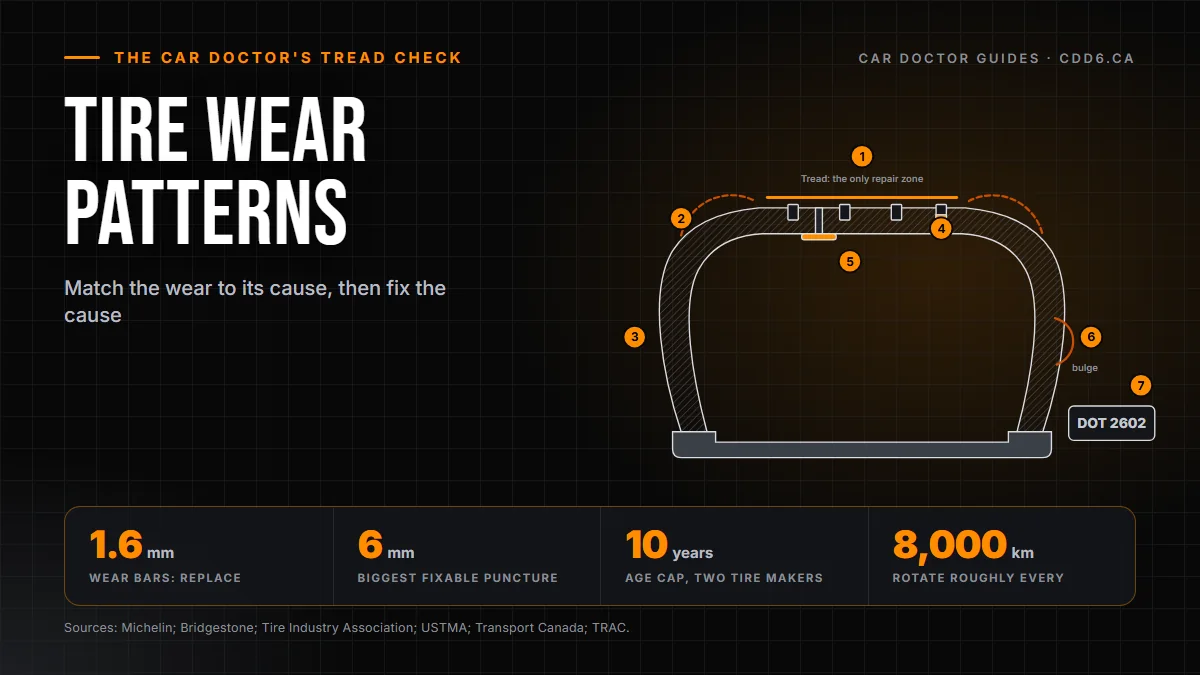
Inside the tire: what can be fixed and what cannot
- Tread areaThe only place a puncture can be repaired, and only up to 6 mm (1/4 inch) across.
- ShoulderDamage on the shoulder cannot be repaired.
- SidewallSidewall damage cannot be repaired either. Cracks here come from age, heat and ozone.
- Wear barSmall raised bars across the bottom of the grooves sit at 1.6 mm. Replace the tire when the tread is flush with them.
- Plug and patchWith the tire off the wheel, a plug fills the hole and a patch seals the inner liner, often as one unit.
- BulgeA bubble means broken cords inside, often after a pothole or curb. Replace the tire right away.
- Date codeThe last four digits after DOT give the week and year it was made: 2602 is week 26 of 2002.
A cut through one side of the tire on its rim. The orange line marks the repairable tread; the dashed orange arcs mark the shoulders. Simplified drawing; the layout differs between vehicles.
Source: Michelin, Les Schwab, Bridgestone, Firestone Complete Auto Care, USTMA, Tire Industry Association and Tire and Rubber Association of Canada
Can you drive on a tire with a sidewall bulge?
No. A bubble on the sidewall means the cords inside have broken and air has pushed into the gap, often after a hard hit on a pothole or a curb. Michelin and Bridgestone both say to replace the tire right away, because the damage can end in a sudden failure, and sidewall damage cannot be repaired. Put the spare on and get the tire replaced.
Are sidewall cracks and dry rot dangerous?
It depends how deep they go. Rubber breaks down with age, heat and ozone, and the first sign is fine cracking on the sidewall. Michelin says shallow surface cracks show age but may not be an immediate danger; cracks that are deep, numerous or open up when the tire flexes mean replacement. Les Schwab warns cracks can lead to air loss and failure.
Age counts even with tread left. The last four digits of the DOT code give the week and year of manufacture, so 2602 is week 26 of 2002, as Bridgestone and the Tire and Rubber Association of Canada explain. Bridgestone retires its tires at ten years whatever the tread, and Michelin also puts replacement at ten. Both flag spares and tires that sit unused as prone to ageing.
Which cuts and punctures can be repaired?
Only a small hole in the tread. The U.S. Tire Manufacturers Association and the Tire Industry Association set the same limits: the damage must be in the tread area, no wider than 6 mm (1/4 inch), and nowhere near the shoulder. A cut or puncture in the shoulder or sidewall means a new tire.
How it is done matters too. Both groups say the tire must come off the wheel so the inside can be inspected, and that a plug alone or a patch alone is not a proper repair: it takes a plug to fill the hole and a patch to seal the inner liner, often as one combined unit. A string plug pushed in from outside will get you home; it is not a fix.
How do I know when the tread is worn out?
Look for the small raised bars that sit across the bottom of the main grooves. They are set at 1.6 mm (2/32 inch), and once the tread is level with them anywhere on the tire, it is finished. Michelin and Bridgestone both say to replace a tire at that point. Winter tires need a lot more tread than that to work in snow; our guide to winter tires in Toronto covers the depth to look for, and the dates to swap.
Does rotating tires prevent uneven wear?
It evens out the difference between positions: front tires steer and, on a front-wheel-drive car, also pull, so they wear faster. The Tire Industry Association suggests every 8,000 to 11,000 km (5,000 to 7,000 miles) depending on the vehicle, and Bridgestone gives a similar range; your owner’s manual sets your interval. Rotation will not cure a pressure, alignment or suspension fault, and Michelin and Bridgestone both note that fixing the cause stops further damage but cannot restore worn rubber.
Fix the cause, not just the tire
Pressure
Centre wear usually means too much air; both edges usually means too little. Check monthly.
Alignment
Wear on one edge, or feathered tread blocks, points to an alignment problem.
Suspension and balance
Cupping comes from worn shocks, struts or other suspension parts, or a wheel out of balance.
Rotate
Rotating roughly every 8,000 km evens out the difference between front and rear.
Running bigger or different tires on a Wrangler? Our page on Jeep Wrangler tire sizes lists the factory sizes by trim. And if your set is due for a seasonal swap, every CDD6 deal at Golden Mile Chrysler comes with two years of free tire storage, plus the lifetime oil change* and a gas card. See the current deals, or browse our used cars.
Tire Wear Patterns: Common Questions
What does it mean when a tire wears in the middle?
Centre wear usually means the tire has been run with too much air, so the middle of the tread carries most of the load. Michelin, Bridgestone and Les Schwab all link it to over-inflation. Set the pressure to the driver’s door placard, not the maximum printed on the sidewall.
What causes tires to wear on the outside edges?
If both shoulders are worn, the usual cause is under-inflation, sometimes with heavy loads, according to Michelin and Les Schwab. If only the inner or outer edge is worn, Michelin and Bridgestone point to wheel alignment, specifically camber, so book an alignment check.
What does tire cupping mean?
Cupping, or scalloping, is a run of scooped-out dips around the tread. Bridgestone and Michelin link it to a wheel out of balance and to worn shocks, struts or other suspension parts. Fixing the cause stops it spreading, but the cupped tread will not grow back.
Can I keep driving on a tire with a bubble in the sidewall?
No. A sidewall bulge means the cords inside are damaged, often by a pothole or curb. Michelin and Bridgestone both say to replace the tire as soon as possible because it can fail suddenly. Sidewall damage cannot be repaired, so fit the spare.
Can a puncture near the sidewall be repaired?
No. Industry procedures from the U.S. Tire Manufacturers Association and the Tire Industry Association limit repairs to the tread area, with a hole no wider than 6 mm (1/4 inch). The tire must come off the wheel, and the repair needs a plug and a patch together.
How often should I rotate my tires?
Follow the interval in your owner’s manual. As a general guide, the Tire Industry Association suggests every 8,000 to 11,000 km (5,000 to 7,000 miles), and Bridgestone gives a similar range. If one pair is wearing faster, Michelin says to rotate right away.
Talk to the Car Doctor
Straight answers, no games, no runaround. The line is open.
437-524-1747