
What the Three-Peak Mountain Snowflake Symbol on Your Tires Actually Means

By Navin Kotecha, The Car Doctor
Published
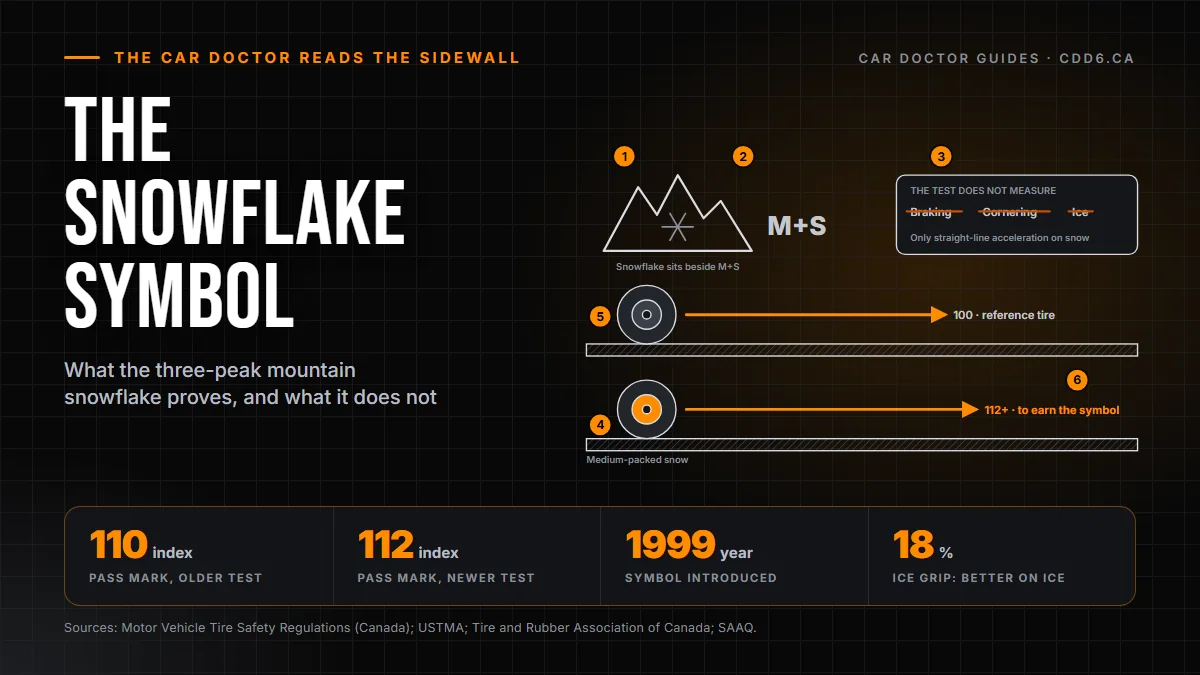
The three-peak mountain snowflake, often shortened to 3PMSF, tells you a tire went through a standard traction test on packed snow and beat a reference tire by a set margin. It is the only winter marking on a sidewall that rests on a measured result. It says nothing about stopping on ice, and M+S does not mean the same thing.
What does the symbol certify?
To carry the symbol, a tire is run through the ASTM F1805 test: a single wheel accelerating in a straight line on a medium-packed snow surface, compared with a standard reference test tire. Canada's Motor Vehicle Tire Safety Regulations spell out two ways to pass. Under the 2006 version of the test, the tire needs a traction index of at least 110 against the older 14-inch reference tire. Under the 2020 version, the bar is 112 against a 16-inch reference tire. Put simply, the tire has to pull roughly 10 to 12 per cent harder in snow than the benchmark, a margin Jalopnik also describes.
| Version of the test | Reference tire | Traction index needed | Surface |
|---|---|---|---|
| ASTM F1805-06 | P195/75R14 standard reference test tire (ASTM E1136) | 110 or more | Medium-packed snow, straight line |
| ASTM F1805-20 | P225/60R16 standard reference test tire (ASTM F2493) | 112 or more | Medium-packed snow, straight line |
Source: Motor Vehicle Tire Safety Regulations, SOR/2013-198, s. 5(4); USTMA (then RMA) Tire Information Service Bulletin Vol. 37 No. 3; Jalopnik.
Snow traction index a tire needs for the symbol
The reference tire scores 100 by definition. The symbol only goes to tires that clear the reference tire by the margin shown.
Source: Motor Vehicle Tire Safety Regulations, SOR/2013-198; Autoguide.
The symbol, and the test behind it
- The symbolA three-peak mountain outline with a snowflake inside, moulded on at least one sidewall.
- M+SA mark based on tread design only. The snowflake goes next to it and adds to it.
- What it skipsThe test checks straight-line acceleration on snow. It does not measure braking, cornering or ice.
- Medium-packed snowThe tire is tested accelerating in a straight line, one wheel driving, on medium-packed snow.
- Reference tire: 100A standard reference test tire is rated 100 and sets the scale.
- Pass markThe tire needs a traction index of at least 112 under the newer version of the test, or 110 under the older one.
Arrow lengths are drawn to the index: 100 for the reference tire, 112 for the pass mark. Simplified drawing; the layout differs between vehicles.
Source: Motor Vehicle Tire Safety Regulations, USTMA, Tire and Rubber Association of Canada, Continental, AutoGuide, Jalopnik, Modern Tire Dealer, Les Schwab and SAAQ
Who created the three-peak mountain snowflake?
The tire industry did, in 1999. The Rubber Manufacturers Association in the U.S. (now the U.S. Tire Manufacturers Association) and the Rubber Association of Canada (now the Tire and Rubber Association of Canada) set out a shared definition of a tire for severe snow, as Modern Tire Dealer recounts. Today Transport Canada writes the requirement into regulations under the Motor Vehicle Safety Act.

How is it different from M+S?
M+S (also printed MS, M/S or M&S) is based on the shape of the tread, not on a test. Continental says plainly that the snow performance of an M+S tire is neither defined nor measured, and Modern Tire Dealer calls it a visual standard. Most all-season tires carry M+S. The snowflake sits next to the M+S marking rather than replacing it, so a real winter tire usually shows both.
Can all-weather tires carry it?
Yes. All-weather tires typically have the symbol, and so do some all-terrain truck tires, according to Jalopnik and Les Schwab. That is why the symbol alone does not make a tire a dedicated winter tire. Jalopnik notes that all-weathers lose out to true winter tires in the very conditions winter tires are built for. Our guide to the types of tires explains the difference.
What does the 3PMSF test not check?
Ice, braking and cornering. The test measures grip while accelerating in a straight line on snow, and nothing else, as both Autoguide and Les Schwab point out. For ice there is a separate mark, the Ice Grip symbol: a mountain with icicles. The U.S. Tire Manufacturers Association says a tire earns it by braking on ice at least 18 per cent better than a reference tire under ISO 19447. The Tire and Rubber Association of Canada reports the same 18 per cent margin.
Where do you find it on the sidewall?
Look on the sidewall near the M+S marking. The industry definition puts the snowflake beside M+S, and the Canadian regulations require it on at least one side of the tire, so if you do not see it, check the other side before you give up. It is a small outline of three mountain peaks with a snowflake inside. If you also want to make sense of the size code on the same sidewall, read how to read a tire size.
How do Quebec and Ontario use the symbol?
Quebec makes winter tires mandatory from December 1 to March 15 for vehicles registered there, and its Highway Safety Code counts only two things as winter tires: tires bearing the snowflake pictogram, and studded tires. Both the SAAQ and the Quebec government state this. An all-season with only M+S does not pass.
Ontario does not require winter tires, but the Ontario government points to the symbol as the simplest way to tell a tire is built for severe snow, and insurers that offer the winter tire discount look for it too. The discount amounts and the dates insurers want the tires on are in our winter tires guide for Toronto.
| Marking | What it is based on | What it tells you |
|---|---|---|
| M+S (MS, M/S, M&S) | Tread design, no performance test | Some mud and snow intent; common on all-season tires |
| Three-peak mountain snowflake | ASTM F1805 straight-line traction test on packed snow | Beats the reference tire in snow by the required margin |
| Ice Grip symbol | ISO 19447 braking test on ice | Brakes at least 18 per cent better on ice than the reference tire |
Source: Continental Canada; Modern Tire Dealer; USTMA bulletins Vol. 37 No. 3 and Vol. 56 No. 1; Tire and Rubber Association of Canada.
What the snowflake does and does not tell you
Passed on snow
The tire beat a reference tire in a packed-snow traction test.
Not an ice test
Braking, cornering and ice are not part of it. Ice Grip is a separate symbol.
Quebec counts it
Quebec requires winter tires from December 1 to March 15 and counts the pictogram.
Insurers look for it
Ontario insurers that give the winter tire discount look for the mountain snowflake.
Once you have the right set, you still need a place to keep the other one. Every CDD6 deal at Golden Mile Chrysler includes two years of free tire storage, along with the lifetime oil change* and a gas card.
The Snowflake Symbol: Common Questions
What does the mountain with a snowflake on a tire mean?
It means the tire passed the ASTM F1805 traction test on medium-packed snow. Under Canadian regulations it must reach a traction index of at least 110 against the older reference tire, or 112 against the newer 16-inch reference tire, which works out to about 10 to 12 per cent more snow grip than the benchmark.
Is M+S the same as the three-peak mountain snowflake?
No. M+S is based on tread design and is not performance-tested; most all-season tires carry it. The three-peak mountain snowflake requires a measured result in a snow traction test. Quebec does not accept an M+S marking alone as a winter tire.
Does the 3PMSF symbol mean a tire is good on ice?
Not by itself. The snowflake test only checks straight-line acceleration on packed snow, not braking, cornering or ice. Tires tested for ice can carry a separate Ice Grip symbol, which requires braking on ice at least 18 per cent better than a reference tire.
Do all-weather tires have the snowflake symbol?
Usually, yes. All-weather tires typically carry it, and some all-terrain truck tires do too. Having the symbol means the tire passed the snow traction test, but a dedicated winter tire still grips better in deep winter conditions.
When was the three-peak mountain snowflake introduced?
In 1999. The U.S. and Canadian tire industry associations, now the U.S. Tire Manufacturers Association and the Tire and Rubber Association of Canada, agreed on a shared definition of a tire for severe snow and the symbol that marks it.
Do my tires need the symbol in Quebec?
If the vehicle is registered in Quebec, yes, from December 1 to March 15. Quebec's Highway Safety Code counts only tires with the snowflake pictogram, or studded tires, as winter tires during that period.
Do Ontario insurers check for the snowflake symbol?
Insurers that give the winter tire discount look for tires marked with the three-peak mountain snowflake. Each insurer sets its own discount and dates, so check your policy. Our winter tires guide for Toronto lists the ranges insurers use.
Talk to the Car Doctor
Straight answers, no games, no runaround. The line is open.
437-524-1747