
How to Read Tire Size and the Other Codes on Your Sidewall

By Navin Kotecha, The Car Doctor
Published
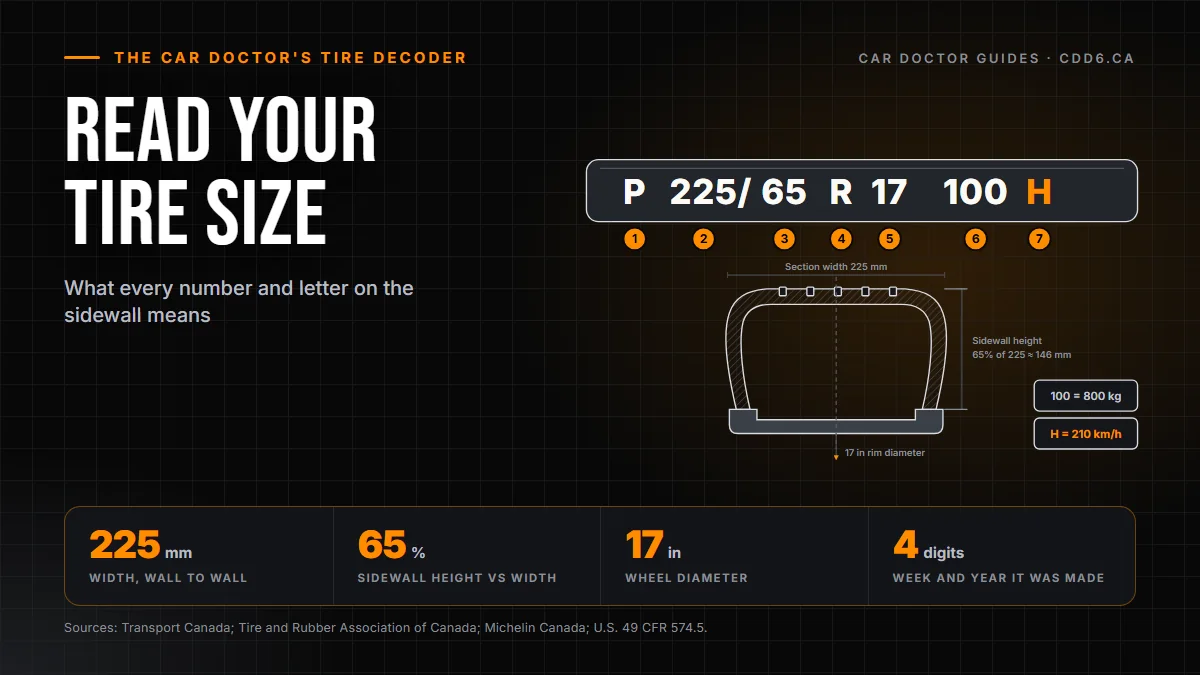
A tire size like P225/65R17 100H reads left to right: P for passenger, 225 mm wide, a sidewall 65 per cent as tall as that width, R for radial, a 17-inch wheel, load index 100 and speed rating H. The rest of the sidewall says when the tire was made and what weather it suits.
If you have ever crouched beside a wheel wondering which of those numbers matter, this is for you. Below, every code is decoded in the order you will find it, followed by the short list of what has to match when you replace tires.
What does each part of a tire size mean?
P225/65R17 100H, piece by piece
- P: tire typeP marks a passenger tire. LT in the same spot means a light-truck tire built for heavier loads.
- 225: section widthThe width in millimetres, measured from one sidewall to the other.
- 65: aspect ratioThe sidewall height as a percentage of the width, which works out to about 146 mm here.
- R: constructionR means radial, the build used by nearly every passenger and light-truck tire sold today.
- 17: rim diameterThe wheel the tire fits, measured in inches.
- 100: load indexA code for the most weight one tire is rated to carry: 100 stands for 800 kg.
- H: speed ratingThe top speed the tire is rated for when loaded and inflated properly: H stands for 210 km/h.
The top strip is the code as it is moulded on the sidewall; the section below shows what the first three numbers measure. Simplified drawing; the layout differs between vehicles.
Source: Tire and Rubber Association of Canada, Transport Canada, Michelin Canada, Consumer Reports, Tire Industry Association, Continental, Pirelli and Hankook
| Part | Example | What it tells you |
|---|---|---|
| Tire type | P | Passenger tire. LT in this spot means a light truck tire, a tougher build meant for heavier work and loads |
| Section width | 225 | Width of the tire from one sidewall to the other, in millimetres |
| Aspect ratio | 65 | Sidewall height as a percentage of the width: here about 146 mm (65 per cent of 225) |
| Construction | R | Radial. Nearly every car and light truck tire sold today is built this way |
| Rim diameter | 17 | The wheel it fits, measured in inches, not millimetres |
| Load index | 100 | A code for the most weight one tire is rated to carry; 100 works out to 800 kg |
| Speed rating | H | A letter for the top speed the tire is rated for when correctly loaded and inflated; H is 210 km/h |
Source: Tire and Rubber Association of Canada, Tire Basics; Transport Canada, tire safety guide TP 2823; Michelin Canada; Tire Industry Association; Consumer Reports. Load and speed values from the charts below.
Notice the mix of units. The width is metric, the wheel is in inches, and the sidewall is a percentage, so a 65 on a wide tire means a taller sidewall than a 65 on a narrow one.
Tire size explorer: move the sliders
Size code on the sidewall: P225/65R17 100H
P passenger · width mm / aspect ratio % · R radial, rim in inches · 100H is an example load index and speed rating: they come from the tire you choose, not from the size.
- Tire size
- 225/65R17
- Sidewall height
- 146 mm
- Overall diameter
- 724 mm (28.5 in)
- Revolutions per km
- 439
- Diameter vs 225/65R17
- +0.0%
Move the sliders for width, aspect ratio and wheel size and watch how the sidewall height, overall diameter and revolutions per kilometre change against the 225/65R17 starting size. The drawing is to scale and the numbers are calculated, so check a real tire's published specs before you buy.
Source: Sidewall height is width × aspect ratio ÷ 100, and overall diameter is the wheel diameter in millimetres plus two sidewalls, per Pirelli, Continental and the Tire Industry Association; 1 inch = 25.4 mm exactly (NIST). Revolutions per km = 1,000,000 mm ÷ (π × diameter in mm), the circumference of an unloaded tire.
Why does overall diameter matter when you change sizes?
Your speedometer is set up for the tire size the vehicle left the factory on. Change the overall diameter and the speedometer is no longer accurate, as Pirelli and Continental both point out. Consumer Reports advises keeping the overall diameter of any new combination close to the original, and warns that a poor fit can also affect braking and handling.
Run the numbers with the formula above and you can see how this works. Our 225/65R17 starting size comes out to about 724 mm tall. A 225/60R18, one inch more wheel and a shorter sidewall, lands within a few millimetres of it. A 245/65R17 adds about 26 mm of height, which is the kind of jump to clear with a tire professional and your owner's manual first. If you drive a Wrangler, our page on Jeep Wrangler tire sizes lists the factory sizes by trim.
How do you read the load index and speed rating?
The two characters after the size are codes, not measurements. Look them up in a chart. The load index stands for the most weight a single tire is rated to carry. The speed letter does not follow the alphabet in order: H sits between U and V.
| Load index | Maximum load per tire |
|---|---|
| 91 | 615 kg |
| 92 | 630 kg |
| 93 | 650 kg |
| 94 | 670 kg |
| 95 | 690 kg |
| 96 | 710 kg |
| 98 | 750 kg |
| 99 | 775 kg |
| 100 | 800 kg |
Source: Tire and Rubber Association of Canada, Tire Basics, Table 1 and Hankook Tire Canada. Index 97 is left out because the two charts list slightly different values for it.
| Speed rating | Rated top speed |
|---|---|
| S | 180 km/h |
| T | 190 km/h |
| H | 210 km/h |
| V | 240 km/h |
| W | 270 km/h |
| Y | 300 km/h |
Source: Tire and Rubber Association of Canada, Tire Basics, Table 2; Hankook Tire Canada; Continental.
The speed rating is a test result, not permission. The posted limit on the 401 or the DVP is the same whatever letter your tires carry.
How do you tell how old a tire is?
Find the letters DOT on the sidewall. The string of characters after them is the tire identification number, and its final four digits are the date code: the first two are the week, the last two are the year. So 2324 means the tire came out of the factory in the 23rd week of 2024. U.S. federal rules (49 CFR 574.5) and Canada's Motor Vehicle Tire Safety Regulations both set out the code this way. Can't spot it? Check the other sidewall.
While you are there, look for a small maple leaf. Transport Canada and the Tire and Rubber Association of Canada both describe it as Canada's national tire safety mark: the maker is certifying the tire meets Transport Canada's requirements.
M+S or the mountain snowflake: which one matters in winter?
This one matters every November in Toronto. M+S stands for mud and snow, and Michelin notes the manufacturer applies it on its own say-so. Transport Canada's guide says tires with M+S and no snowflake symbol can handle most weather but are not designed for roads covered in snow and ice. The three-peak mountain snowflake is different: under Canada's tire regulations, a tire can only carry it after reaching a set traction score on packed snow. The Ontario government calls that symbol the simplest way to spot a tire built for severe snow. For when to put them on, see our guide on winter tires in Toronto.
What do the UTQG treadwear, traction and temperature grades mean?
Many tires also carry a line like TREADWEAR 500 TRACTION A TEMPERATURE A. These are the Uniform Tire Quality Grades, a U.S. government system (49 CFR 575.104) that the Tire and Rubber Association of Canada explains for Canadian drivers. Winter tires do not carry them.
| Grade | Range | What it means |
|---|---|---|
| Treadwear | A number, such as 300 or 500 | A comparison on a government test course: a 400 lasted twice as long there as a 200 |
| Traction | AA, A, B, C (AA best) | Stopping on wet pavement in a straight line. It does not measure cornering |
| Temperature | A, B, C (A best) | How well the tire stands up to heat build-up in a lab test |
Source: U.S. 49 CFR 575.104; Tire and Rubber Association of Canada, Tire Basics; Tire Industry Association.
One more number lives on the sidewall: the maximum pressure. It is the pressure needed to carry the tire's maximum load, not the pressure you should run. Transport Canada, the tire association and Michelin all send you to the label in the driver's door frame instead. Our tire pressure guide covers how to read that label and how often to check.

What has to stay the same when you replace tires?
Start with the tire information label on the driver's door frame. It lists the size the vehicle came with, so you have a reference even if the last owner fitted something else. Then hold any new set to these rules:
| Keep this | Rule | Confirmed by |
|---|---|---|
| Size | Same as the original, unless a tire professional confirms an alternative | Transport Canada; Consumer Reports |
| Load index | Same as the original or higher, never lower | Transport Canada; Tire and Rubber Association of Canada; Consumer Reports |
| Speed rating | Same as the original or higher, never lower | Transport Canada; Tire and Rubber Association of Canada; Consumer Reports |
| Tire type | The same type on all four wheels | Transport Canada; Ontario government |
Source: Transport Canada, TP 2823; Tire and Rubber Association of Canada, Tire Basics; Consumer Reports; Ontario government; door label contents per U.S. FMVSS 110.
Five things to take from the sidewall
Match the size
Start from the size on the driver's door label, the one the vehicle came with.
Never go lower
Load index and speed rating on a replacement should be the same or higher, never lower.
Keep the diameter
Stay close to the original overall diameter so the speedometer stays accurate.
Read the age
The last four digits after DOT give the week and year the tire was made.
Winter needs the snowflake
M+S alone is not a winter tire; look for the three-peak mountain snowflake.
Shopping for a vehicle and a second set of tires at the same time? Every CDD6 deal at Golden Mile Chrysler includes two years of free tire storage, so the off-season set has somewhere to live. See this month's lease deals, or browse our used cars.
Reading Tire Size: Common Questions
What does 225/65R17 mean on a tire?
The tire is 225 millimetres wide, its sidewall is 65 per cent as tall as that width (about 146 mm), R means radial construction, and it fits a 17-inch wheel. A P in front marks a passenger tire, and LT marks a light truck tire.
Where do I find the right tire size for my vehicle?
Check the tire information label on the driver's door frame or door edge, or the owner's manual. The label lists the size the vehicle was built with, which is the safest reference if the tires on it now were chosen by a previous owner.
How do I find out how old my tires are?
Look for DOT on the sidewall and read the last four digits of the number that follows. The first two are the week and the last two are the year, so 0525 means the fifth week of 2025. If it is not on one side, check the other.
Can I use a tire with a lower load index or speed rating?
No. Transport Canada says new tires should match the originals on both load capacity and speed rating, and the Tire and Rubber Association of Canada and Consumer Reports both say never to go below them. The original figures are on the tires the vehicle came with and in the owner's manual.
Is an M+S tire a winter tire?
Not by itself. M+S is a mud and snow marking the manufacturer applies, and Transport Canada says tires lacking the mountain snowflake aren't built for roads under snow and ice. A tire with the three-peak mountain snowflake has passed a packed-snow traction test set in Canada's tire regulations.
What does LT mean on a tire?
LT stands for light truck. It is a sturdier tire built for heavier service and bigger loads than a P (passenger) tire. When in doubt, go by the size on your door label.
Is the pressure on the sidewall the pressure I should use?
No. The sidewall shows the maximum pressure, the amount needed to carry the tire's top rated load. Use the cold pressure printed on the label in the driver's door frame or in your owner's manual, and never go above the sidewall maximum.
Talk to the Car Doctor
Straight answers, no games, no runaround. The line is open.
437-524-1747