How to Install a Car Seat or Infant Seat in Canada, Including With a Seat Belt

By Navin Kotecha, The Car Doctor
Published
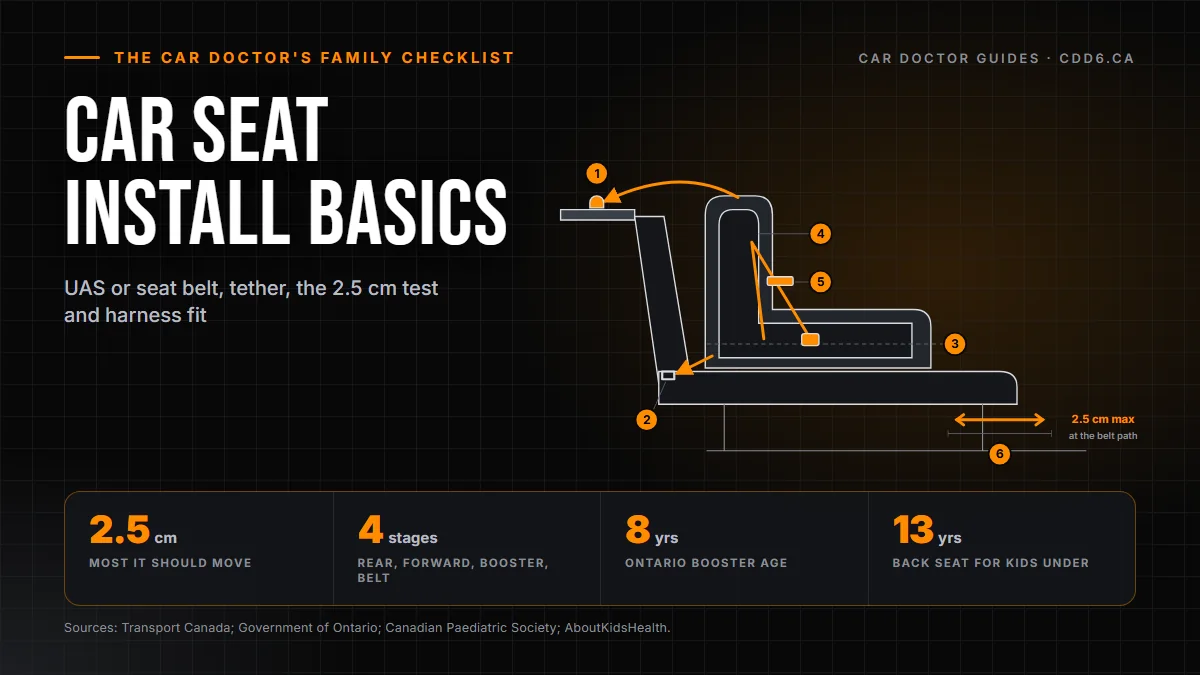
You can install a car seat safely with either the universal anchorage system (UAS) or the seat belt. Lock the belt if you use it, tighten until the seat moves less than 2.5 cm at the belt path, and add the top tether to every forward-facing seat. Your seat and vehicle manuals have the final word.
Read both manuals before you start; Transport Canada and the Ontario government both put that first. This guide sticks to the general Canadian advice.
Which car seat stage does my child need in Ontario?
Transport Canada describes four stages: rear-facing, forward-facing with a harness, booster seat, then the seat belt alone. Keep your child in each stage until they max out the seat's weight or height limit. Ontario sets legal minimums; federal and medical advice asks for more.
| Stage | Ontario legal requirement | What safety guidance adds |
|---|---|---|
| Rear-facing | Up to at least 9 kg (20 lb) | Stay rear-facing to the seat's own limit; Transport Canada says forward-facing is for kids of at least 10 kg (22 lb) |
| Forward-facing with harness | 9 to 18 kg (20 to 40 lb) | Always attach the top tether; keep using the harness up to the seat's limits |
| Booster seat | Under age 8, 18 to 36 kg (40 to 80 lb) and under 145 cm (4 ft 9 in) | Only in a seating position with a lap and shoulder belt |
| Seat belt alone | Once the child turns 8, or reaches 36 kg (80 lb), or reaches 145 cm (4 ft 9 in) | Lap belt low on the hips, shoulder belt across the chest, never the neck |
Source: Government of Ontario; Transport Canada; AboutKidsHealth (SickKids); Sonnet; Canadian Paediatric Society.
In Ontario, every child under 8 has to ride in the right seat or booster, and the driver is responsible for anyone under 16 being buckled. Getting it wrong can mean a fine and two demerit points under the Highway Traffic Act, according to the Ontario government. Kids under 13 are safest in the back seat.
Where should the car seat go?
In the back. A front airbag deploys with enough force to injure a child, and a rear-facing seat must never sit in front of an active one. Transport Canada's rear-facing guidance and Ontario's page both say to install seats in the rear, clear of active airbags.
UAS or seat belt: which is safer?
Neither is safer when it is done properly. UAS uses two lower anchor bars tucked into the crease between the seat back and the cushion. Vehicles built after 2002 have them in some rear seats, but many have none in the centre position. If your chosen seating spot has no lower anchors, the seat belt is the way to go, per Transport Canada and Alberta Health Services.
A forward-facing seat, installed: what to check
- Top tether and its anchorAlways used on a forward-facing seat. In a sedan the anchor is usually behind the rear seat; your owner's manual shows where.
- Lower anchor (UAS)A bar between the seat back and the cushion, found in some rear seats of vehicles made after 2002.
- Belt pathIf you use the seat belt instead, route it through the path the seat's label marks for the way it faces.
- Harness strapsAt or above the shoulders on a forward-facing seat.
- Chest clipAt armpit level.
- The 2.5 cm testAt the belt path, the seat should move no more than 2.5 cm (1 inch) side to side or front to back.
The child is left out so the straps and anchors are easy to see. Simplified drawing; the layout differs between vehicles.
Source: Transport Canada: forward-facing seats, Transport Canada: rear-facing seats, Ontario: choosing a child car seat, Caring for Kids (Canadian Paediatric Society) and Alberta Health.
Lower anchors have a weight limit, printed in your manuals. If you can't find one and your child is 18 kg (40 lb) or heavier, both sources above say to use the lower anchors, the seat belt and the tether together.
Installing with the seat belt, step by step
A belt only holds a car seat tight once it is locked. Here is the general order; your manuals give the routing.
| Step | What to do | Why |
|---|---|---|
| 1. Route the belt | Thread the lap and shoulder belt through the belt path marked for the direction the seat faces | The seat's label or manual shows the right path |
| 2. Buckle | Click the tongue into the buckle before you let go of the belt | Stops the belt retracting early |
| 3. Lock the belt | In many vehicles, slowly draw the shoulder belt all the way out, then let it feed back; it should now only get shorter, not longer | If it still pulls out, it is not locked |
| 4. Use a clip or lock-off if required | Some vehicles need a locking clip, and some seats have a built-in lock-off; follow the manual that calls for it | Not every belt has a switchable retractor |
| 5. Tighten | Press down into the seat with your weight while feeding slack back into the retractor | Removes slack |
| 6. Test | Grip the seat at the belt path and push side to side and front to back | No more than 2.5 cm (1 inch) of movement |
Source: Transport Canada, rear-facing and forward-facing installation pages; Honda Canada owner's manual, child seat with a lap/shoulder belt; Ontario Ministry of Transportation, archived install tips; Government of Ontario.
For a rear-facing seat, also check the recline. The seat's angle indicator, label or manual tells you the right range.
Do I need the tether strap?
On every forward-facing seat, yes, whether you used UAS or the belt. The tether hooks to the anchor point your owner's manual shows. Snug the tether, push down on the seat, retighten the anchors or belt, then take up the tether again. Transport Canada, Ontario and the Canadian Paediatric Society all say to use it every time.

How tight should the harness be?
Rear-facing, the straps come out at or just below your child's shoulders; forward-facing, at or just above. Buckle up, tighten, then do the pinch test: try to pinch a fold of strap at the collarbone between your thumb and finger. If you can, it is too loose. Slide the chest clip up to armpit level. Recheck it every ride; growth and clothing change the fit.
Harness checks, every ride
Strap height
At or below the shoulders rear-facing; at or above them forward-facing.
Pinch test
If you can pinch a fold of strap at the collarbone, tighten it.
Chest clip
Slide it up to armpit level.
No puffy coat
Buckle in thin layers, then put the coat on backwards or a blanket over the straps.
Can my child wear a winter coat in the car seat?
Not a puffy one under the harness. A thick coat feels snug, but in a crash the padding squashes flat and leaves the straps loose. BCAA and The Globe and Mail give the same fix for a Toronto January: dress your child in thin warm layers like fleece, take the big coat off in the car, buckle and tighten, then put the coat on backwards over the straps or tuck a blanket on top.
Skip padded inserts and bunting bags that didn't come with the seat. Transport Canada warns that add-on products may not be safe, and BCAA notes they can add slack to the harness.
Why can't my child just use the seat belt?
Because a vehicle's belts are sized for grown-ups. A booster lifts a child so the belt crosses the strong parts of the body: the lap belt low over the hips and upper thighs, and the shoulder belt across the middle of the shoulder and chest. Transport Canada, the Ontario government, the Canadian Paediatric Society and the American Academy of Pediatrics all describe that fit, and all say the belt must stay off the belly and away from the neck or face. Never let a child tuck the shoulder belt behind their back or under an arm.
In Ontario the booster stays until the child turns 8, reaches 36 kg (80 lb) or reaches 145 cm (4 ft 9 in), whichever comes first. Meeting the law is not the same as fitting the belt, though. Transport Canada says to keep using the booster if the belt doesn't sit snugly on the hips and across the middle of the shoulder. Before you retire the booster, run these checks with your child sitting in the vehicle seat on its own.
| Check | What a good fit looks like | Confirmed by |
|---|---|---|
| 1. Back | Sits all the way back against the vehicle seat back | Transport Canada; AboutKidsHealth; American Academy of Pediatrics |
| 2. Knees | Bend comfortably at the front edge of the seat | Transport Canada; AboutKidsHealth; Canadian Paediatric Society |
| 3. Lap belt | Low and snug on the hips or upper thighs, off the belly | Transport Canada; Government of Ontario; American Academy of Pediatrics |
| 4. Shoulder belt | Sits across the centre of the shoulder and over the chest, away from the neck | Transport Canada; Canadian Paediatric Society; American Academy of Pediatrics |
| 5. The whole ride | Stays sitting this way for the entire trip, no slouching | AboutKidsHealth; American Academy of Pediatrics |
Source: Transport Canada, stage 4: seat belts; AboutKidsHealth (SickKids); Canadian Paediatric Society; Government of Ontario; American Academy of Pediatrics, HealthyChildren.org. If any check fails, go back to the booster.
Does the type of vehicle matter for car seats?
I looked for published crash-injury figures for children broken down by cars, SUVs, minivans and pickups, confirmed by two reliable sources, and could not find them, so there is no vehicle-type injury table here. What does change from one vehicle to the next is the hardware and the seating layout, and that is worth checking before you buy or install.
| Check | Why it matters | Confirmed by |
|---|---|---|
| Which seats have lower anchors | Some rear seats have UAS bars and some don't; the centre seat often lacks them, so you'd use the seat belt there | Transport Canada; Alberta Health Services |
| Where the tether anchors are | It depends on the vehicle: often behind the rear seat in a sedan, and on the seat back, floor or ceiling in many minivans, SUVs and pickups; IIHS found them on the cab's back wall in the extended-cab RAM 1500 it rated | American Academy of Pediatrics; IIHS; Transport Canada |
| Front seat and airbags | A rear-facing seat never goes in front of an active airbag, and children under 13 belong in the back | Transport Canada; Government of Ontario; Canadian Paediatric Society |
| Lap-only belts | A booster needs a lap and shoulder belt; don't use one in a lap-belt-only position | Government of Ontario; Transport Canada; Ontario Ministry of Transportation (archived) |
| Head support | With a booster, the child's head needs support from the booster or the vehicle's head restraint | Government of Ontario; Transport Canada |
Source: Transport Canada, forward-facing and booster pages; Alberta Health Services; American Academy of Pediatrics; IIHS, 2025 RAM 1500 extended cab; Government of Ontario; Canadian Paediatric Society; Ontario Ministry of Transportation, archived. Your owner's manual shows the exact positions.
Does my car seat expire, and what does the label mean?
Most seats sold in Canada carry an expiry or useful-life date set by the maker, and Ontario says not to use a seat past it. Transport Canada doesn't set those dates, so call the manufacturer if you can't find yours. Also look for the round maple-leaf National Safety Mark, which shows the seat meets Canadian safety standards. That label lists the Canadian standards the seat meets, CMVSS 213 for child seats, 213.1 for infant seats and 213.2 for boosters.
Thinking about a hand-me-down? Transport Canada recommends against used seats, and Health Canada says to pass on any seat whose history the owner can't vouch for.
Where can I get my car seat checked?
Book a check at a child car seat clinic. Transport Canada and the Canadian Paediatric Society both point parents to local clinics, and Ontario's former transportation ministry guidance told parents to call their local public health unit about installation help. A trained technician can check your work or help you install the seat.
Shopping for a family vehicle with easy anchors and room for two or three seats? Our minivan comparison looks at the vans Ontario families cross-shop, and you can see the current Chrysler lineup here.
Car Seat Installation: Common Questions
How do I lock the seat belt for a car seat?
In many vehicles you slowly pull the shoulder belt all the way out to switch the retractor to locking mode, then let it feed back in while you press the seat down. If the belt can still be pulled out afterward, it is not locked. Some vehicles need a locking clip instead, and some seats have built-in lock-offs. Your vehicle owner's manual says which applies.
How do I know the car seat is tight enough?
Hold the seat where the belt or UAS strap passes through it and push side to side and front to back. Transport Canada, Ontario and the Canadian Paediatric Society all say it should move no more than 2.5 cm (1 inch) there.
When can my child face forward in Ontario?
Ontario's legal minimum for rear-facing is 9 kg (20 lb), but safety guidance says to wait. Transport Canada reserves forward-facing seats for kids who have outgrown the rear-facing seat and are 10 kg (22 lb) or more. Keeping your child rear-facing until the seat's own weight or height limit is the safest choice.
When does my child need a booster seat in Ontario?
Once they outgrow the forward-facing harness seat and are 18 kg (40 lb) or heavier. Ontario requires a booster until the child turns 8, reaches 36 kg (80 lb) or reaches 145 cm (4 ft 9 in). Use a booster only where the vehicle has a lap and shoulder belt.
When can my child use just the seat belt in Ontario?
Legally, once they turn 8, reach 36 kg (80 lb) or reach 145 cm (4 ft 9 in). Transport Canada adds that the belt must also fit: back against the seat, knees bent at the edge, lap belt low on the hips, shoulder belt across the middle of the shoulder. If it doesn't fit, keep the booster.
Is it safe to put a car seat in a pickup truck?
It can be, in a rear seat with the hardware the car seat needs. Check your owner's manual for which rear positions have lower anchors and where the tether anchors are; in some pickups they sit on the back wall of the cab. Never put a rear-facing seat in front of an active airbag.
Talk to the Car Doctor
Straight answers, no games, no runaround. The line is open.
437-524-1747