
How to Open a Trunk, Tailgate or Liftgate When the Car Battery Is Dead

By Navin Kotecha, The Car Doctor
Published
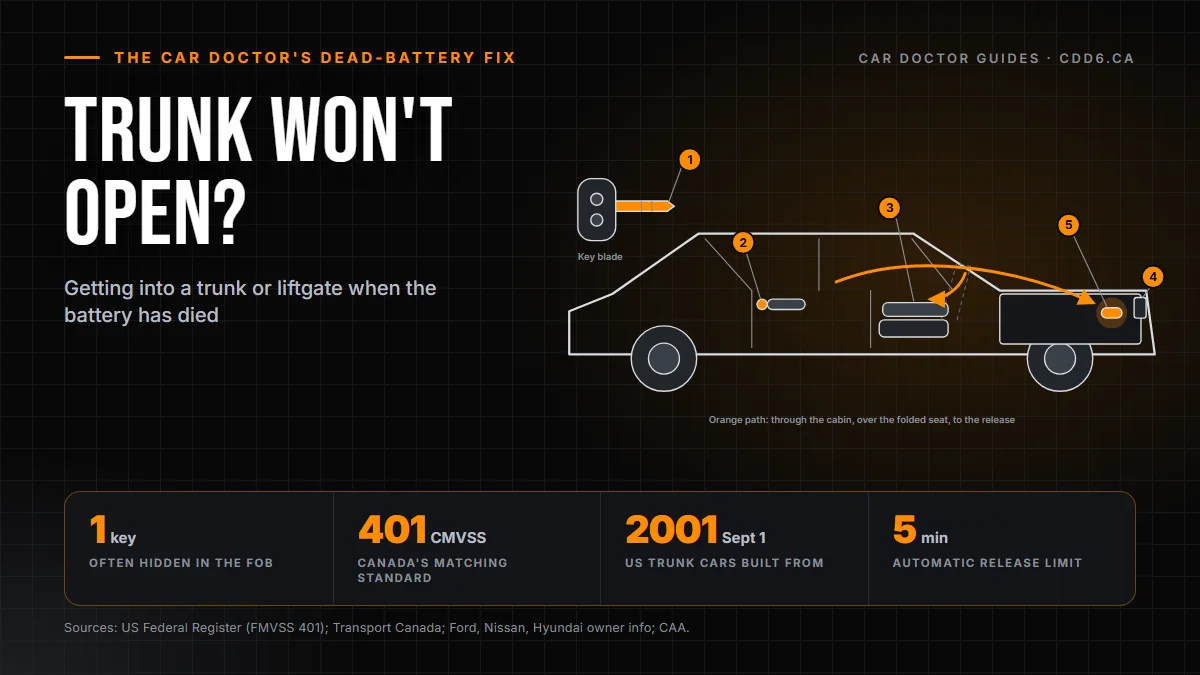
A dead battery usually leaves the fob button and trunk switch useless, because the latch is electric. Try this order: pull the mechanical key out of the fob to get into the cabin, restore power with a jump or a booster pack, then try the trunk again. No power? Reach the trunk from inside the car.
Everything below is general. Trunks, tailgates and liftgates differ from model to model, so the emergency section of your owner's manual has the final word on where the releases are and how they work.
Why won't the trunk open when the battery dies?
Most modern trunks and liftgates are locked and unlatched by an electric actuator. Mazda's owner's manual states it plainly: with a flat battery, the liftgate stays locked, and the first fix is to deal with the battery by jump-starting. Capital One's guide makes the same point: once a jump brings the power back, the remote and the trunk button start working again.
Step 1: Is there a key hidden in my key fob?
Very likely. Most proximity fobs carry a small metal key blade for exactly this situation. Ford tells owners to slide a release on the back of the fob and pull the blade out, and Nissan's manual describes the same idea with a lock knob on the back of its Intelligent Key. Look for a small latch or button on the fob and you will usually find it.
The keyhole can be harder to find than the key. On some cars it sits on the underside or side of the driver's door handle, and on others it hides under a plastic cap on the handle that you pry off with the key blade. Hyundai's manual walks through removing that cover and warns against scratching or snapping the plastic, and Capital One suggests checking the manual before you force anything.
Once you are inside, you can pop the hood for a jump, fold the rear seats, or reach any release that lives in the cabin.
Step 2: Should I jump-start the car first?
Yes, if you can. Restoring power is the cleanest way in, because the trunk then opens normally and nothing gets pried or forced. Boost it from a second car with cables, or use a portable jump pack, and follow the jump-starting steps in your owner's manual; Consumer Reports points to the manual because it spells out the correct connection points for your vehicle. If the trunk still will not open once the car has good power, stop forcing it and have a technician look at it.
Step 3: How do I open the trunk from inside the car?
If there is no way to get power back, go in through the cabin. On a sedan with folding rear seatbacks, fold them down and crawl through to the trunk, as both Capital One and SlashGear describe. Once you are back there, look near the latch for the emergency release handle, which is often made to glow in the dark.
That handle is not an accident. In the United States, FMVSS 401 requires a release inside the trunk of every passenger car with a trunk compartment built on or after September 1, 2001. A manual release must be easy to see in a closed, dark trunk, with lighting or phosphorescence given as examples; a maker can instead fit an automatic system that unlatches the lid within 5 minutes of someone being shut inside. Canada has a matching standard, CMVSS 401, Interior Trunk Release, built on the US rule.
Two things to know before you count on it. The rule covers cars with a separate trunk; the US agency left out trucks and multipurpose vehicles, and the 2001 amendment confirms it does not apply to cars with a back door, so most hatchbacks, wagons, SUVs and minivans fall outside it. And the release is meant for someone trapped inside, so you still have to get into the trunk space to reach it.
Your way into the trunk, from the outside in
- Key blade in the fobMost fobs hide a mechanical key that a slide, latch or knob on the back releases.
- Driver's door keyholeIt can sit under or beside the handle, or behind a plastic cap that the key blade pops off.
- Rear seatbackFold it forward and crawl through to the trunk.
- Trunk latchThe emergency release sits close to it.
- Glow-in-the-dark releasePassenger cars with a trunk built from September 1, 2001 must have an inside release that is easy to see, such as one that glows.
The orange path runs from the back seat to the release. Jump-starting the car comes first, because restoring power often lets the trunk button work again. Simplified drawing; the layout differs between vehicles.
Source: Capital One, SlashGear, Ford, Nissan and the US Federal Register on FMVSS 401.
What about an SUV liftgate or a minivan?
Many SUVs and vans have an emergency liftgate release anyway, usually behind a small cover at the bottom of the liftgate on the inside. Hyundai has you take off that cover and slide a latch, Kia uses a lever in the same area, and Mazda has you pry off a cover on the inner face of the liftgate with a cloth-wrapped flat screwdriver, then work a lever. To reach it, climb over or fold the rear seats into the cargo area.
Hyundai and Kia both attach a firm warning to these releases: they are for emergencies, and no person or pet should ever travel in the cargo area, because it offers no protection in a crash. If your vehicle has no interior release, the liftgate will not open until it has power again.
| Method | What it gets you | Needs battery power? | Where your manual covers it |
|---|---|---|---|
| Mechanical key from the fob | Into the cabin through the driver's door, sometimes behind a cap on the handle | No | Keys, or locking and unlocking |
| Jump-start or portable booster | Power back to the trunk button and the fob | Supplies it | Jump-starting |
| Fold the rear seatbacks | A path from the cabin into the trunk, where the seats fold | No | Seats |
| Interior trunk release (sedan) | Opens the trunk lid from inside the trunk | No, on a manual release | Interior trunk release |
| Emergency liftgate release (SUV, van) | Opens the liftgate from the cargo area, where fitted | No | Emergency liftgate release, or when the liftgate cannot be opened |
| CAA or your roadside plan | A boost, a battery test or a lockout service | No | Your roadside plan |
Source: Ford and Nissan on the key blade; Mazda, Hyundai and Kia owner's manuals; Capital One; US Federal Register, FMVSS 401; CAA South Central Ontario. Section names vary by maker.
Getting in, in the order to try it
Restore power
Jump-start the car with cables or a portable jump starter, following your owner's manual. Power usually brings the remote and trunk button back.
Take out the key blade
Release the mechanical key from your fob.
Unlock the driver's door
Find the keyhole on the handle, removing the cap with the key if there is one. Check the manual first so you don't break the plastic.
Fold the rear seat
Fold the seatback forward and reach or crawl into the trunk.
Pull the release
Find the emergency release beside the latch. It often glows in the dark.

Is there a manual trunk release near the driver's seat?
On some cars, yes. Capital One describes a pull-up lever on the driver's side of the floor, next to the seat, and SlashGear lists the dashboard, centre console and door sill as other places a trunk release can sit. Whether yours works without power depends on the car, so check the manual rather than guessing.
When should I call roadside assistance?
Call when you cannot get into the cabin, you have no way to restore power, the release you need is out of reach, or it is dark, cold and you are on the shoulder of the 401. CAA lists battery service (testing, boosting or replacing) and lockout service among its roadside services. Members can dial *CAA (*222) from a cell phone or 1-800-222-4357 anywhere in Canada and the US, per CAA South Central Ontario and CAA Manitoba. If you have a different roadside plan, keep its number in your glovebox.
If the battery keeps dying, it is telling you something. If your car will not start at all and has to be moved, read how to move a car that won't start, including how to get a dead car out of Park. And if you are shopping for something newer, see this month's deals or browse our used cars.
Trunk Won't Open With a Dead Battery: Common Questions
Can I open my trunk with the key fob if the car battery is dead?
Usually not. The fob talks to the car's electronics, and a power trunk or liftgate needs battery power to unlatch. Use the metal key blade inside the fob to get into the cabin, then restore power with a jump or a booster pack, or reach the trunk from inside. Your owner's manual explains the options for your model.
Where is the keyhole if my car door doesn't seem to have one?
On many cars it is on the driver's door handle: on the underside, on the side, or under a small plastic cap that comes off with the key blade. Owner's manuals from makers such as Hyundai show how to remove the cap without breaking it. Check your manual before prying.
Do all cars have a glow-in-the-dark trunk release?
No. In the United States, FMVSS 401 requires an interior release in passenger cars with a trunk built on or after September 1, 2001, and a manual release has to be easy to see in the dark. Cars with a back door, such as most hatchbacks and wagons, and trucks and multipurpose vehicles are not covered. Canada has a matching standard, CMVSS 401.
How do I open an SUV liftgate with a dead battery?
Restoring power with a jump or a booster is the first choice. Many SUVs and minivans also have an emergency liftgate release inside the cargo area, often behind a small cover at the bottom of the liftgate. Fold or climb over the rear seats to reach it, and follow the steps in your owner's manual.
Will jump-starting the car let me open the trunk?
In most cases, yes. Once the electrical system has power again, the trunk button and the fob normally work, and you may not need to pry anything. Boost it from a second car or a portable jump pack, and follow the jump-starting steps in your owner's manual. If it still will not open, have it checked.
Who do I call if I can't get my trunk or car open?
CAA members can call *222 from a cell phone, or 1-800-222-4357 in Canada and the US, for battery service or lockout service. If you use a different roadside plan, call the number it gave you.
Talk to the Car Doctor
Straight answers, no games, no runaround. The line is open.
437-524-1747