
How to Move a Car That Won't Start, Including How to Shift a Dead Car Into Neutral

By Navin Kotecha, The Car Doctor
Published
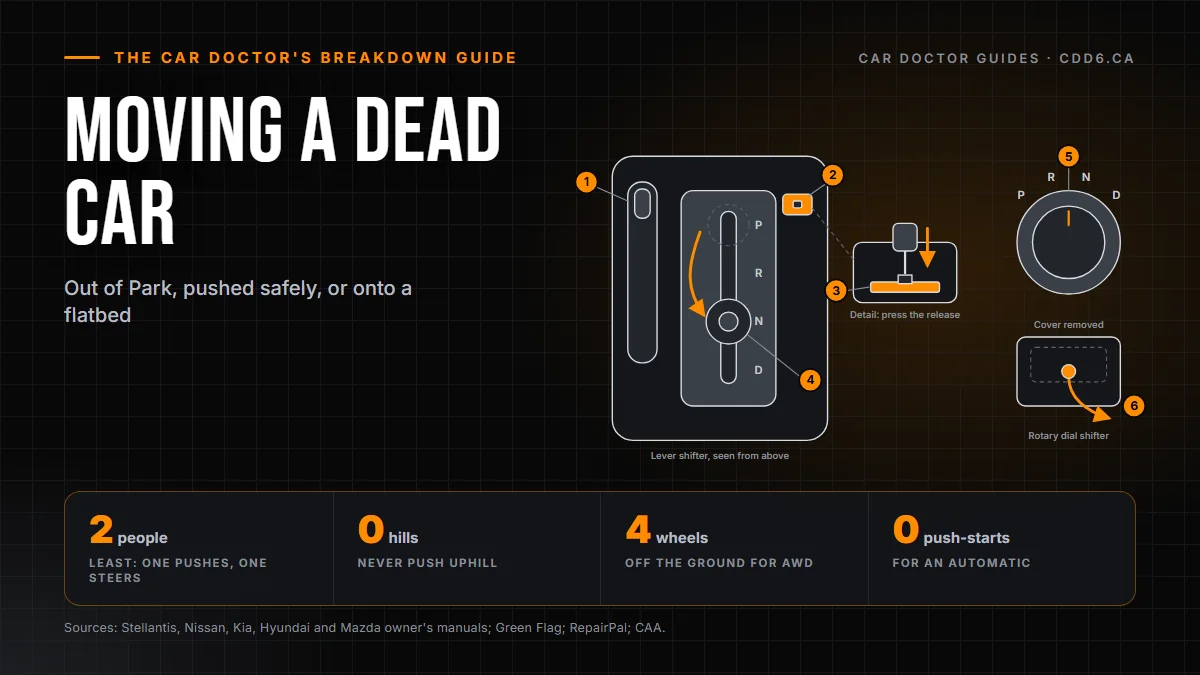
To move a car that won't start, first get it out of Park: with a dead battery, most automatics stay locked in P. Use the shift lock release beside the shifter, or the manual park release your owner's manual describes, with the parking brake on. Then push it on level ground with someone steering, or call a tow.
This is general guidance. Shifters, releases and towing rules differ from one vehicle to the next, so the emergency and towing sections of your owner's manual come first. If anything here disagrees with your manual, follow the manual.
Can I jump-start it instead of moving it?
Try that first. If the problem is a flat battery, a boost from another vehicle or a portable jump starter may get you running, and then nothing needs pushing. Follow the jump-starting steps in your owner's manual; Consumer Reports recommends it because the manual gives the right procedure for your vehicle. If the engine still won't turn over, or it isn't the battery, read on. For a trunk or liftgate that won't open with a dead battery, see our trunk guide.

How do I put a car in neutral when the battery is dead?
On most automatics, the shifter will not leave Park unless the car has power and your foot is on the brake. With a flat battery, that interlock keeps it in P. Nissan's manual says so directly: with a weak or dead battery, the lever may refuse to move out of P even with the brake pressed and the shifter button pushed.
For a traditional lever, the way around it is the shift lock release, usually a small slot or button under a cover on the console next to the shifter. The general sequence, which Nissan's manual and NAPA both describe: set the parking brake, pop off the cover, press down on the release with a key or small tool, and while holding it, move the lever to N. Where your car's release is, which way it moves, and whether your foot needs to be on the brake are details for your owner's manual.
What if my car has a dial or push-button shifter?
Electronic shifters, such as rotary dials, push buttons and levers that spring back to centre, are a different story: with no power, the shifter on its own generally will not select Neutral, so the maker provides a separate release. Ram trucks with the rotary dial are a good example. The Ram owner's manual describes a Manual Park Release for exactly this case, so the truck can be pushed or towed when it will not come out of Park, and 1A Auto shows it on a Ram 1500: a plastic cover comes off, and pulling an orange tether all the way out leaves the transmission in Neutral. Other makes do it differently, so look up the section on yours before you need it, not on the shoulder of the DVP.
The Ram manual's warning applies to any car: once the park release is pulled, nothing holds the vehicle but the brakes. Set the parking brake before you activate it, be behind the wheel pressing hard on the brake pedal, and only let the parking brake off when the vehicle is secured to a tow truck or you are ready to push it.
| Shifter type | With a dead battery | The usual way into Neutral | Before you start |
|---|---|---|---|
| Traditional lever (automatic) | Usually locked in Park by the shift interlock | Shift lock release under a small cover beside the shifter | Parking brake on; follow your manual for the brake pedal and the release direction |
| Electronic shifter (dial, buttons, spring-back lever) | The shifter alone generally cannot select Neutral | The maker's manual park release, such as the tether on a Ram | Parking brake on, driver seated with a foot on the brake |
Source: Nissan owner's manual; NAPA Know How; 2022 Ram 2500/3500 owner's manual (Mopar); 1A Auto, Ram 1500 manual park release. Details vary by vehicle; check your manual.
Getting a dead car out of Park
- Parking brakeSet it before you touch the release, so the car can't roll.
- Shift lock release coverA small cover beside the shifter hides the release.
- Release slotPop the cover off, then press the release down with a key or a small tool.
- Shifter to NeutralHold the release down and move the lever into Neutral.
- Dial or electronic shifterWith no power it usually can't select Neutral by itself, so the maker adds a separate manual park release.
- Manual park release tetherOn a RAM 1500 dial shifter, take off the plastic cover and pull the orange tether all the way out to leave the transmission in Neutral.
Sit in the driver's seat with your foot on the brake while you do this. Once the transmission is out of Park, the vehicle can roll. Simplified drawing; the layout differs between vehicles.
Source: Nissan, Kia and Hyundai owner's manuals, NAPA, RAM owner's manuals (2022 RAM 2500/3500, 2020 RAM 1500) and 1A Auto.
Will the steering and brakes work with the engine off?
The brakes work, but the power assist does not. Hyundai and Kia both say that without the engine running you can still stop, but you will have to press the pedal much harder and the car will take longer to stop. Both also tell you not to pump the pedal once the assist is gone. Keep the speed to a walking pace.
The steering wheel can lock when the car is off. Nissan's manual warns against moving the vehicle with the wheel locked, and has you switch the ignition on to unlock it; RepairPal gives the same advice for pushing a car. If you cannot get the wheel to unlock, that is a tow, not a push.
How do I push a car safely?
Short distances only, on flat ground, to get out of a live lane or into a parking spot. Green Flag and RepairPal agree on the basics:
Hazard lights on before anyone gets out. One person in the driver's seat to steer and brake, with everyone else pushing; Never push uphill. My own rule: if there is any slope at all, or traffic is moving fast around you, don't push. Stay safe and call for a tow.
Pushing a car safely
Hazards on
Switch on the hazard lights before anyone starts pushing.
Unlock the steering
Turn the ignition on so the wheel isn't locked.
One person steers and brakes
Brake assist is gone with the engine off, so press the pedal firmly and don't pump it.
At least two people
One person steers while the others push.
Never uphill
Never push a car uphill.
Can I push-start an automatic?
No. Kia's manual says vehicles with an automatic or dual-clutch transmission cannot be push-started and can only be jump-started, and Nissan's says the same of its automatic (DCT) models. Jump it, or have it towed.
Can an AWD or 4x4 be towed with its wheels on the ground?
Usually not. Mazda wants every wheel of an AWD model lifted clear of the road for a tow and warns the drivetrain can be damaged otherwise. Hyundai and Kia both specify a flatbed, or a wheel lift with dollies, so that no wheel of an AWD model touches the pavement, and Hyundai frames its towing rules around preventing damage. The rules differ by vehicle, so read the towing section of your manual, and tell the tow dispatcher the vehicle is AWD or 4x4 so they send the right truck.
When should I just call CAA or roadside assistance?
Most of the time, honestly. Call if you are on a highway or a busy road, the car is on any grade, the steering is locked, you can't find the release, it is AWD or 4x4, or you don't have enough people. CAA's roadside services include battery boosts, testing and replacement, plus towing; members can call *CAA (*222) from a cell phone or 1-800-222-4357, according to CAA South Central Ontario and CAA Manitoba.
A car that keeps leaving you stranded may be telling you it is time for a change. Have a look at this month's deals or our used cars, and if you are weighing your options, our guide to lease versus finance lays out the difference.
Moving a Car That Won't Start: Common Questions
How do I get my car out of Park if the battery is dead?
On a car with a traditional lever, use the shift lock release: a small slot or button, usually under a cover next to the shifter. Set the parking brake, press the release with a key or small tool and move the lever to Neutral. Cars with electronic shifters use a different manual release, so follow your owner's manual.
Where is the shift lock release on my car?
Usually on the console beside the shift lever, under a small removable cover. On vehicles with electronic shifters it can be somewhere else entirely; on Ram trucks with the rotary dial, for example, the Manual Park Release sits behind a removable plastic cover. Your owner's manual shows the exact spot.
Is it safe to push a car by myself?
No. You need at least two people: one in the driver's seat to steer and brake, and one or more pushing. Turn the hazard lights on first, push only on level ground, and never push uphill. If the road is busy or there is any slope, call for a tow instead.
Can you push-start a car with an automatic transmission?
No. Owner's manuals from Kia and Nissan state that automatic and dual-clutch models cannot be push-started. A car with an automatic transmission can be jump-started with cables or a portable jump starter, following the steps in the owner's manual, or it has to be towed.
Does an all-wheel-drive car need a flatbed tow?
Usually. Mazda, Hyundai and Kia say an AWD vehicle should be towed with every wheel lifted, on a flatbed or with dollies, and Mazda warns the drivetrain can be damaged otherwise. Rules vary, so check your manual and tell the tow company it is AWD.
Why are the brakes so hard to press when the engine is off?
The power assist only works with the engine running. Hyundai and Kia manuals say you can still stop, but it takes far more pedal force and a longer distance, and you should not pump the pedal. That is why a pushed car should only ever move at a walking pace.
What number do I call for CAA roadside assistance?
CAA members can dial *222 (*CAA) from a cell phone, or 1-800-222-4357 in Canada and the US. Roadside services include battery boosts and towing. If the vehicle is AWD or 4x4, say so when you call.
Talk to the Car Doctor
Straight answers, no games, no runaround. The line is open.
437-524-1747