
Car Battery Specs Explained: Battery Types, CCA, Reserve Capacity and Group Size

By Navin Kotecha, The Car Doctor
Published
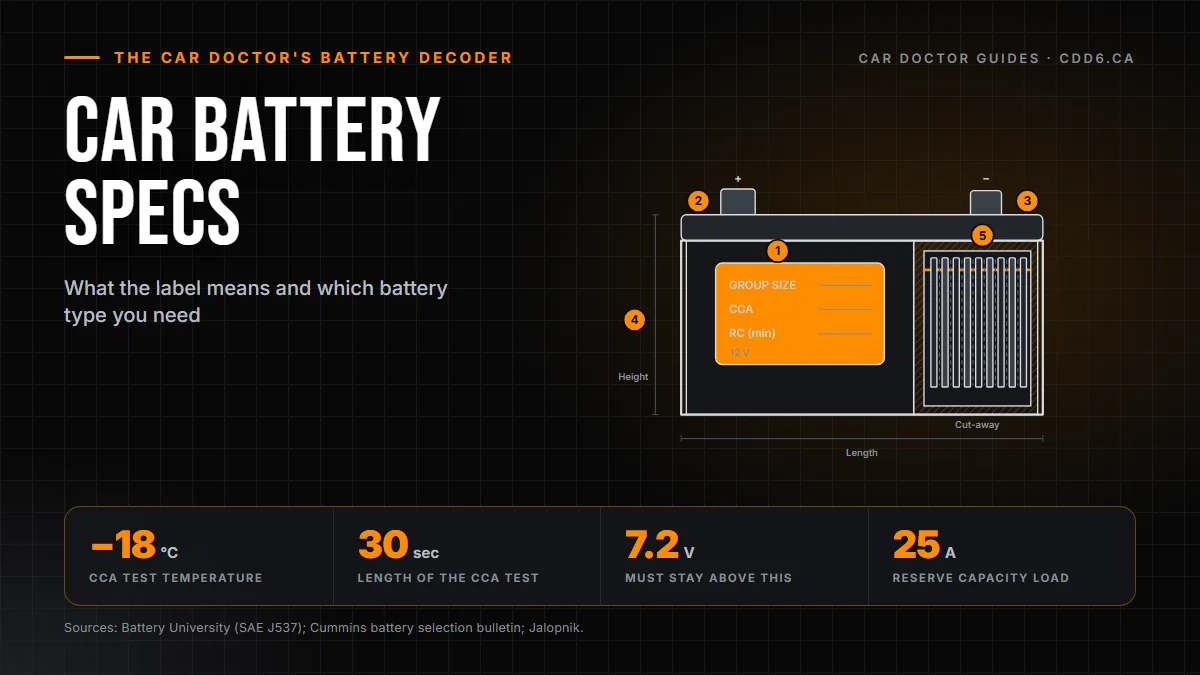
Most cars use one of three 12-volt battery types: flooded lead-acid, enhanced flooded (EFB) or absorbent glass mat (AGM). The label tells you how much starting power it has in the cold (CCA), how long it can run things without the alternator (reserve capacity) and its physical size (group size). Match all of them to your owner's manual.
Batteries rarely give a polite warning. They tend to quit on the coldest morning of the year, in a parking lot off the 401. Here is how to pick the right type, read every number on the label and find the specs your vehicle calls for. When it is time to swap it, read how to change a car battery.
What are the main types of car batteries?
All three common types are lead-acid batteries; the difference is how the acid is held and how much cycling they can take. A flooded battery is the traditional design with liquid electrolyte. An EFB is a tougher version of the flooded battery, built for cars with a basic start-stop system. An AGM battery soaks its acid up in a fine glass-fibre mat, which makes it spill-proof and maintenance-free; battery makers Varta and Banner both point to it for start-stop cars that also recover braking energy or carry a heavy electrical load.
| Type | How it is built | Typically fitted to |
|---|---|---|
| Flooded lead-acid | Lead plates in liquid electrolyte | Vehicles without start-stop |
| EFB (enhanced flooded) | An upgraded flooded design with liquid electrolyte, made to handle more charge cycles | Vehicles with a basic start-stop system |
| AGM (absorbent glass mat) | Acid held in a glass-fibre mat; sealed and spill-proof | Start-stop vehicles with brake energy recovery or high electrical demand |
Source: Varta, EFB and AGM differences; Banner, difference between AGM and EFB; Battery University, BU-201a.
The type is not a free choice. If your vehicle came with an AGM battery, stay with AGM, as both Varta and Jalopnik advise. Banner says a conventional starter battery must not go into a start-stop vehicle, and Varta warns that the wrong battery can upset the start-stop system and shorten the battery's life.
Where do I find my battery's specs?
Start with the battery itself. The label on the top or side of the original battery usually lists its group size, reserve capacity and CCA rating, as a Cummins battery bulletin illustrates. Then check your owner's manual: Ford and NAPA both tell drivers to use it for the approved group size and the minimum CCA. If the old battery was a replacement, trust the manual over whatever is under the hood.
How do I read the ratings on a battery label?
Each rating comes from a set lab test, which is why the numbers can be compared between brands. Here is what each test does.
What the outside of a car battery tells you
- Spec labelPrinted on the top or side of the battery, it lists the group size, the cold cranking amps (CCA) and the reserve capacity (RC).
- Positive postWhere the positive cable clamps on. The post layout has to match your vehicle, not just the case size.
- Negative postIts cable comes off first and goes back on last when you swap a battery.
- Case sizeThe group size describes the outside dimensions of the case, so the battery fits the tray and the hold-down.
- Inside the caseFlooded and EFB batteries hold liquid electrolyte here; an AGM battery holds its acid in a glass-fibre mat, which makes it spill-proof.
Check your owner's manual for the group size and minimum CCA your vehicle needs. Simplified drawing; the layout differs between vehicles.
Source: Label and group size from Ford and Cummins; battery types from Battery University and VARTA; cable order from Cars.com and NAPA Know How.
| Rating | What the test measures | Why it matters |
|---|---|---|
| CCA (cold cranking amps) | Amps a charged 12 V battery supplies for 30 seconds at −18°C (0°F) while staying at or above 7.2 V | Starting power on a cold morning; the number to compare |
| CA (cranking amps) | The same test run at 0°C (32°F) | Always a bigger number than CCA, so do not compare the two |
| RC (reserve capacity) | Minutes a charged battery can deliver 25 A at about 27°C (80°F) before it falls to 10.5 V | How long the battery can keep things running if the alternator quits |
| Ah (amp-hours) | How much charge the battery stores | Gives a sense of capacity; cranking ratings are the better guide for starting |
| Group size | Physical dimensions of the case, with the post layout to check | The battery has to fit the tray, hold-down and cables |
Source: Cummins battery selection bulletin; Battery University, BU-902a and BU-201; Jalopnik; Optima; Ford.

Watch for labels that show only cranking amps, hot cranking amps or marine cranking amps. Those are measured at warmer temperatures, so a big number there does not tell you much about a January start. Ford and NAPA both say to shop by CCA.
Why is CCA so important in a Canadian winter?
Cold works against you twice. As NAPA explains, cold oil makes the engine harder to turn over, and the battery's chemistry gives less in the cold, right when the starter needs more. That is exactly the condition CCA measures. NAPA and Ford agree on the buying rule: never go below the CCA your vehicle specifies, and a battery with more CCA than the minimum is a sensible choice where winters are harsh.
Reserve capacity matters more than it used to as well. NAPA notes that modern vehicles keep drawing a little power with the key off, and short trips may not put back what a cold start took out. Plenty of stop-and-go GTA driving fits that description.
The label in five lines
CCA
Amps a charged battery gives for 30 seconds at −18 °C while holding at least 7.2 volts. Never buy below your spec.
Reserve capacity
Minutes the battery can supply 25 amps before falling to 10.5 volts, which matters if the alternator quits.
Group size
The case dimensions, and the post layout has to match too.
Type
A car that came with AGM gets AGM again, and a start-stop car should not get a conventional battery.
Manual first
Your owner's manual lists the approved group size and the minimum CCA.
Ready to replace it?
Once you know the type, group size and CCA you need, the swap itself is a short job on most vehicles, with a few rules that matter: the negative cable comes off first and goes back on last, and some newer vehicles need the new battery registered with a scan tool. The full walk-through, including where to recycle the old one in Toronto, is in our guide on how to change a car battery.
Rather not do it yourself? Our service team at Golden Mile Chrysler can test and replace it. And if a dead battery is the final straw for an old car, every CDD6 deal comes with the lifetime oil change*, a gas card and two years of free tire storage. Browse this month's deals or our used cars.
Car Batteries: Common Questions
What does CCA mean on a car battery?
Cold cranking amps: the current a fully charged 12-volt battery can supply for 30 seconds at −18°C without its voltage falling below 7.2 volts. It is the best single measure of how well a battery will start a car on a cold morning.
Is a higher CCA better?
Never buy below the CCA your vehicle specifies. Going above the minimum is fine and helps in cold climates, according to both NAPA and Ford. The battery still has to be the right group size and type for your vehicle.
What is the difference between CA and CCA?
Both are 30-second cranking tests, but CA is measured at 0°C and CCA at −18°C. Because a battery delivers more current when it is warmer, the CA figure is always higher. Compare batteries using CCA.
What is reserve capacity on a battery?
Reserve capacity counts the minutes a battery, starting full, can keep supplying 25 amps until its voltage sinks to 10.5 volts. It shows how long the battery could keep essential systems running if the alternator stopped charging.
Can I put a regular battery in a car with start-stop?
No. Battery makers say start-stop vehicles need an EFB or AGM battery, and Banner says a conventional battery should not be fitted even if start-stop is switched off. If the car came with AGM, replace it with AGM.
Where do I find the right battery for my car?
Check the label on your current battery, which usually shows the group size, CCA and reserve capacity, then confirm against your owner's manual. The manual lists the approved group size and the minimum CCA, which matters if a previous owner fitted a different battery.
Talk to the Car Doctor
Straight answers, no games, no runaround. The line is open.
437-524-1747