
Changing Your Own Oil at Home: What It Costs You, What It Saves, and Where It Goes Wrong

By Navin Kotecha, The Car Doctor
Published
Can you change your own oil at home? Yes, as long as you have a flat spot to work, a safe way to raise the vehicle, and somewhere to take the old oil afterwards. You give up a trip to the shop, and in return you spend your own time, buy a handful of tools once, and handle the cleanup yourself.
Doing it yourself is a good skill. Doing it wrong can cost you an engine, or a trip to emergency. Here is the honest version for GTA driveways: the kit, the safe way to get underneath, the mistakes that cause leaks, and where the old oil goes in Ontario.
What does it really cost to change your own oil?
Think of it in three parts. Every time, you buy the oil your engine calls for and a new filter. Once, you buy the tools. And every time, you give up part of a weekend, plus a run to a drop-off site with the old oil and filter. The tools only pay for themselves if you keep using them. Planning one oil change and never another? The shop wins.
What tools and supplies do you need?
Start with your owner's manual. It gives the oil grade and how much your engine holds, and that is not something to guess. Ram's manual, for one, tells owners to use only the fluid the manufacturer recommends. If the numbers on the jug confuse you, read engine oil grades explained first.
| Item | Why you need it | Tip |
|---|---|---|
| Engine oil | Refills the engine | Match the grade and amount in your owner's manual exactly |
| New oil filter | The old one is full of trapped dirt | Replace it at every oil change, not every second one |
| Drain plug washer or gasket | Seals the drain plug | Fit a new one if your manual or service guide calls for it |
| Wrench or socket for the drain plug | Opens the drain | Use the correct size so you do not round off the plug |
| Oil filter wrench | Grips a tight filter | Have it on hand before you start |
| Drain pan and funnel | Catches old oil and pours in new | A wide, shallow pan spills less |
| Ramps, or a jack plus jack stands | Holds the vehicle up while you are under it | The jack only lifts; stands or ramps hold |
| Wheel chocks | Stops the vehicle from rolling | Use them on wheels that stay on the ground |
| Gloves and safety glasses | Protects skin and eyes from oil | Nitrile or rubber gloves work well |
| Sealed container | Carries the old oil to a drop-off | The empty jug from your new oil works |
Source: Compiled from Haynes: how to do an oil change at home, Castrol Canada: how to change car oil, Castrol: how to change your engine oil, Haynes: Caravan and Town & Country oil change and the Ram owner's manual.
Is it safe to get under your car on a jack?
No. A jack lifts; it does not hold. The Ram owner's manual says not to get under the vehicle while it sits on a jack, and to use a service centre with a lift if you need to be under a raised vehicle. Haynes gives home mechanics the same rule: jack stands or ramps, every time. Work on firm, level ground with the parking brake on and the wheels chocked.
Mind the heat. Castrol and Haynes both want the oil warm enough to flow but not hot, so run the engine briefly, shut it off and give it a few minutes. Wear gloves and safety glasses throughout; oil irritates skin, and Haynes says to keep used oil off your hands.
How do you change your oil, step by step?
This is the general pattern. Your owner's manual or a service manual for your model has the specifics.
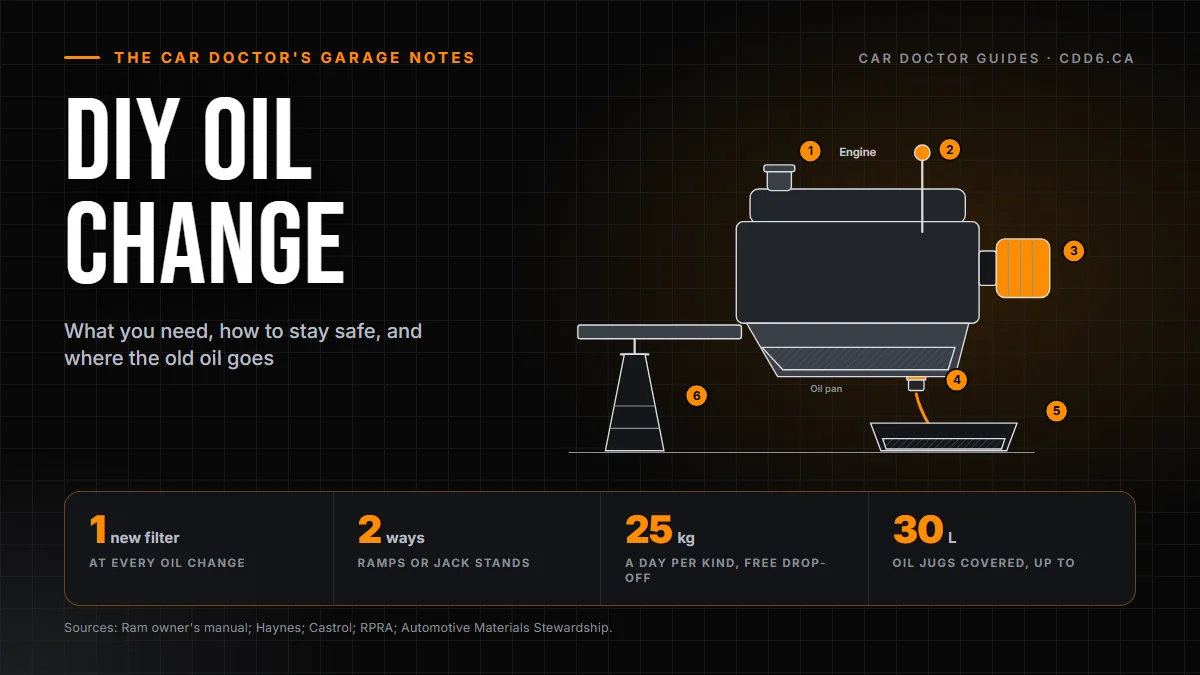
The parts you touch during an oil change
- Oil filler capTake it off before you drain so the old oil flows out freely.
- DipstickAdd the new oil in stages and read the dipstick on level ground, so you do not overfill.
- Oil filterReplace it at every oil change. Wipe fresh oil on the new gasket and tighten it by hand.
- Drain plug and washerFit a new washer if your vehicle uses one and tighten the plug to the specification, never past it.
- Drain panCatches the warm oil. It then goes into a sealed container for a depot, never down a drain or into the garbage.
- Jack standHolds the vehicle up while you work. Never get under a vehicle held up only by a jack.
The orange line is the old oil draining into the pan. Simplified drawing; the layout differs between vehicles.
Source: Steps from the Ram owner's manual, Haynes and Castrol; disposal from the City of Toronto.
Oil change in seven steps
Warm, raise, secure
Run the engine a few minutes, then drive onto ramps or lower the vehicle onto stands and chock the wheels. Some vehicles have an undertray or splash shield that comes off first.
Drain
Remove the oil filler cap so it drains freely, set the pan, and pull the drain plug. Make sure it is the engine plug, not a transmission plug.
Swap the filter
Spin-on filters unscrew; some engines use a paper element in a housing instead. Wipe the mounting surface and confirm the old rubber gasket came away with the old filter.
Close up
Clean the drain plug, fit a new washer if your vehicle uses one, and tighten it to the torque in your service information, not by feel. Smear fresh oil on the new filter's gasket and tighten the filter by hand as its instructions say.
Refill in stages
Pour in the amount your manual lists a bit at a time, checking the dipstick as you go. Adding oil is easy; removing it is not.
Check
Start the engine and look for drips at the drain plug and filter, staying clear of moving parts. Shut off, wait, and recheck the level on level ground.
Reset the oil-life monitor
A dealer resets it after a service, so at home it is your job. The method varies: Ram uses the instrument cluster controls, while the Haynes Caravan guide uses a key-and-pedal sequence. Follow your manual, and if the reminder returns at the next start, the reset did not take.
What can go wrong with a home oil change?
A double gasket. If the old filter's gasket stays stuck to the engine and the new filter goes on over it, oil can escape once the engine runs. Castrol calls a double-gasketed or loose filter the most common cause of a leak after an oil change, and Haynes says to scrape off any old gasket left behind.
The wrong oil. Grade and spec come from the manual, not the shelf or an old receipt. Consumer Reports warns against getting creative here.
Overfilling. Extra oil builds crankcase pressure that can push oil past seals, according to Castrol and Haynes. Consumer Reports says to add oil a little at a time for that reason.
Burns and falls. Hot oil and a vehicle on a jack alone are how this job hurts people. Do not skip the safety steps above.
Does changing your own oil affect your warranty?
Your warranty booklet sets the rules, so read its maintenance section first. For Chrysler, Dodge, Jeep and Ram vehicles sold here, the owner's manual points to the FCA Canada warranty information for the terms. Either way, stay on the maintenance schedule in your manual, because skipped service can damage the engine.
Then keep proof. The Ram manual tells owners to keep all receipts, and Consumer Reports says the same to anyone doing their own service. For a home oil change, keep the receipts for the oil and filter and note the date and odometer reading in km.
Where do you take used oil and filters in Ontario?
Never down a drain, into the sewer, onto the ground or into the garbage. Pour the old oil into a sealed, leak-proof container (the new oil's jug works) and let the filter drain into the pan before you bag it.
| What | Where it goes | Good to know |
|---|---|---|
| Used oil filters | A free collection site under Ontario's Hazardous and Special Products rules | Let it drain into your pan first |
| Empty oil jugs | A free collection site | Covered when the container holds 30 litres or less |
| Antifreeze | A free collection site | Same program as filters and jugs |
| Used motor oil (Toronto) | A City of Toronto drop-off depot, or a Toxic Taxi pickup | Must be in a sealed container that does not leak |
| Anything else | Call the site first | Confirm what they take before you drive over |
Source: RPRA: Hazardous and Special Products producers; Ontario Recycles; Automotive Materials Stewardship; City of Toronto: household hazardous waste; Environment and Climate Change Canada.
Under Ontario's Hazardous and Special Products regulation, the companies that sell oil filters, oil jugs and antifreeze must run collection sites that take them back free, at least 25 kg a day of each kind per person. Find one on Ontario Recycles, run by the Resource Productivity and Recovery Authority, or the Automotive Materials Stewardship locator.
The used oil itself goes through municipal household hazardous waste programs. In Toronto, motor oil is on the city's list: take it to a drop-off depot or book a Toxic Taxi. Elsewhere, check your municipality's depot.
When does it make more sense to go to a shop?
No safe place to work. No level driveway, stands or ramps? Even the Ram manual points you to a service centre with a lift.
A cartridge filter. Paper elements in a housing can need a large, sometimes model-specific socket and a new seal for the cap.
Panels in the way. Many vehicles hide the drain plug behind an undertray or splash shield.
Your time. Supplies, the job, cleanup and a depot run add up to most of a Saturday.
Shopping for a vehicle anyway? Every CDD6 deal at Golden Mile Chrysler comes with the lifetime oil change*, so the oil, filter, lift and disposal are handled for you. See this month's current deals or contact us.
Changing Your Own Oil: Common Questions
Is it cheaper to change your own oil?
It can be, but not automatically. You still buy the oil and filter every time, you buy tools once, and you spend your own time plus a trip to a drop-off site. The tools only pay off if you keep using them. If you do one oil change and stop, a shop is usually the better deal.
Can I change my oil using just a jack?
No. Never get under a vehicle held up only by a jack. Lower it onto jack stands or drive it onto ramps, chock the wheels, and work on firm, level ground. The Ram owner's manual goes further and says to use a service centre with a lift if you need to be under a raised vehicle.
Do I need to replace the oil filter every time?
Yes. Ram's owner's manual says to fit a new filter at every oil change, and Haynes warns that a clogged filter can let dirty oil bypass it. Before you fit the new one, check that the old rubber gasket did not stay stuck to the engine, then oil the new gasket and tighten it by hand.
What happens if I put in too much oil?
Overfilling builds pressure inside the engine that can force oil past seals and cause leaks. Add oil in stages, check the dipstick between pours, and do the final check with the engine off and the vehicle on level ground. If you have clearly overfilled, drain some out before driving.
Will doing my own oil change void my warranty?
Read your warranty booklet, because it sets the terms. Whatever it says, follow the maintenance schedule in your owner's manual on time and keep every receipt for the oil and filter, plus the date and odometer reading. The Ram owner's manual and Consumer Reports both tell owners to keep their receipts.
Where can I drop off used motor oil in Toronto?
Used motor oil and oil filters are on the City of Toronto household hazardous waste list. Take them to a city drop-off depot or book a Toxic Taxi pickup, with liquids in a sealed container that does not leak. Never pour oil down a drain, into the sewer or onto the ground.
Where do I recycle oil filters and empty oil jugs in Ontario?
Under Ontario's Hazardous and Special Products regulation, used oil filters, empty oil containers of 30 litres or less, and antifreeze go to free collection sites. Search for one on Ontario Recycles, run by the Resource Productivity and Recovery Authority, or on the Automotive Materials Stewardship locator, and call ahead to confirm.
Talk to the Car Doctor
Straight answers, no games, no runaround. The line is open.
437-524-1747