
How to Change Windshield Wiper Blades: Signs, Sizes, Blade Types and the Steps

By Navin Kotecha, The Car Doctor
Published
To change a wiper blade, stand the arm up off the glass, press the release tab where the blade joins the arm, slide the old blade down and out of the hook, click the new one into place and ease the arm back down. Before you start, check the length for each side, the arm type, and protect the windshield.
How do I know my wiper blades need replacing?
The first warning is usually on the glass: lines of water left behind, a smeared film, or patches the blade skips. Noise comes next: a blade that judders (chatter) or squeals is often stiff or worn. Then lift the arm and look. The Stellantis owner's manual lists worn or uneven edges, hardening, cracking and a deformed blade as reasons to replace, and Consumer Reports suggests running a finger along the edge to feel for rigid or chipped rubber.
Clean before you buy. Bugs, tree sap, grime and car-wash hot wax can make a good blade wipe badly, Kia's manual notes, and in a Toronto winter a lot of that film is road salt. Wipe the rubber and the glass with washer fluid or a mild cleaner. If the streaks come straight back, replace the blade.
| What you notice | Usual cause | What to do |
|---|---|---|
| Streaks, smears or missed patches | Worn edge, or dirt on the blade or glass | Clean the blade and windshield; replace if it keeps happening |
| Chatter or squeaking | Dirty or dry glass, or rubber stiffened by cold or age | Clean, use washer fluid, never wipe dry glass; replace if it persists |
| Hard, cracked, chipped or uneven rubber | The rubber has aged out | Replace the blade |
| Bent blade or damaged arm | Physical damage | Replace the damaged part; do not try to repair it |
Source: Stellantis owner's manual, wiper blades; Consumer Reports wiper blade buying guide; Trico, four signs; Hyundai owner's manual, wiper blades; Transport Canada.
How often should wiper blades be changed?
It varies, and sources differ. Consumer Reports, CAA and Trico work on roughly six months; Valeo recommends once a year. The Stellantis manual says blade life depends on climate and use, and Hyundai's says to check them every six months. My advice: inspect them when the winter tires go on and when they come off, and replace whenever the signs above appear.
What size wiper blades do I need?
Do not assume both fronts match. Consumer Reports notes one car can use several sizes, and Trico says driver and passenger lengths often differ. Get the sizes from your owner's manual, measure each current blade, or use a parts lookup by year, make and model. Buy for each side separately, and check the rear blade too.
Which wiper arm attachment does my car have?
The blade also has to fit the end of the arm. The hook arm, usually called a J-hook, is the classic: Consumer Reports found it the most popular mount by far, and it is what the Stellantis manual shows on Ram heavy-duty pickups. Fitting guides from Valeo and Trico also list bayonet and pinch-tab arms, among others. Match your old blade's connector, or the adapter in the new blade's box, to your arm.
Conventional, beam, hybrid or winter blades?
| Type | How it is built | Worth knowing |
|---|---|---|
| Conventional | A rubber strip held by a metal frame that presses it onto the glass at several points | The traditional design, and still widely sold |
| Beam (flat) | No outside frame; spring steel inside the blade holds it against the glass | Shaped to follow the curve of a modern windshield |
| Hybrid | A beam-style blade under a protective outer cover | Offered by major blade makers next to the other two |
| Winter | Built specifically for snow and ice | CAA and Transport Canada both mention them for winter |
Source: Consumer Reports; Trico, beam vs conventional and hybrid blades; Valeo; CAA; Transport Canada.
How to change a J-hook wiper blade, step by step
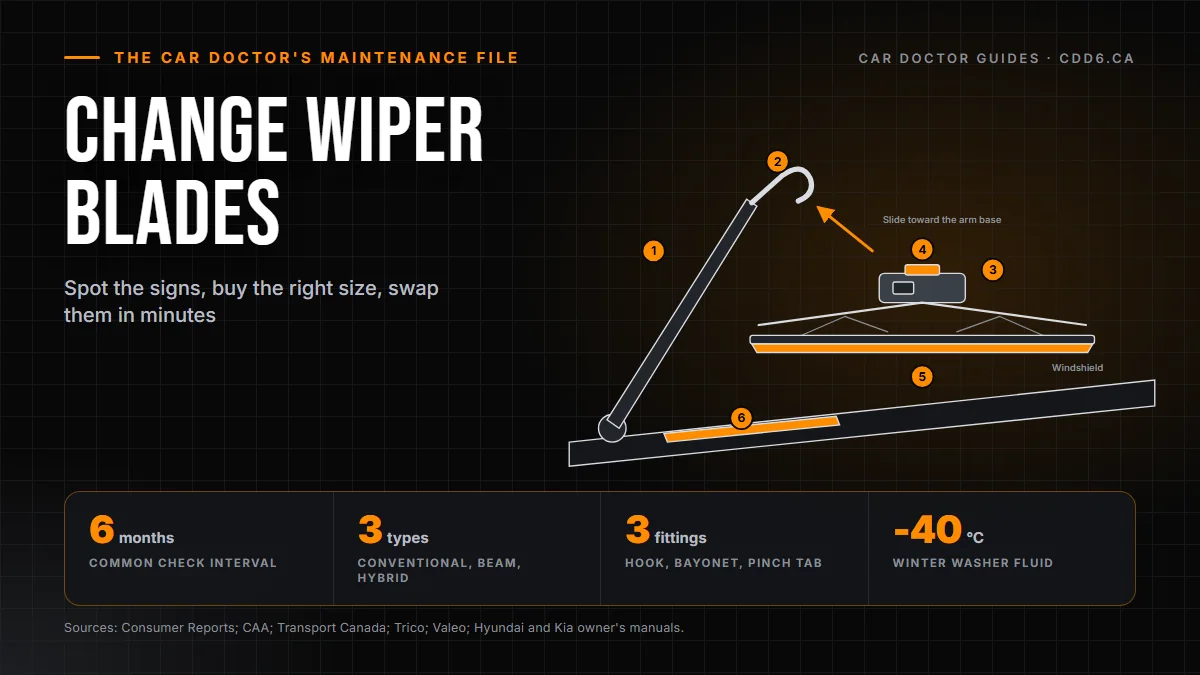
The parts of a J-hook wiper
- Wiper armRaise it until it stays upright. A bare arm that springs back can chip or crack the windshield.
- J-hookThe classic and most common arm fitting. The blade slides into its curve.
- Blade adapterNew blades come with adapters to match different arms.
- Locking and release tabFlip the locking cover, press the release tab, then slide the blade toward the arm base to free it.
- Rubber edgeReplace the blade when the rubber is hard, cracked, chipped or worn unevenly.
- Towel on the glassProtects the windshield in case the arm drops while the blade is off.
The dashed orange arrow shows the direction the old blade slides off the hook. Simplified drawing; the layout differs between vehicles.
Source: Parts and steps from the Stellantis owner's manual, Trico and Consumer Reports.
J-hook blade swap in seven steps
Park and switch off
If your wipers rest down under the back edge of the hood, put them in the service position first (next section).
Protect the glass, then raise the arm
Fold a towel and lay it on the windshield where the arm rests, then pull the arm up until it stays upright. This matters: a bare arm that springs back onto the glass can chip or crack it, a risk the Stellantis and Kia manuals both flag.
Release the blade
Find the small tab where the blade meets the hook. Some designs have a locking cover to flip up first; then press the release tab.
Slide it off
Push the blade toward the base of the arm so it drops out of the curve of the hook, then pull it free.
Compare
Rest the bare arm gently on the towel and hold the old blade against the new one to confirm the length and the connector match.
Fit the new blade
Pass the hook through the opening in the new blade's connector and slide the blade up into the hook until it clicks. Close any locking cover.
Check and test
Tug the blade lightly to make sure it is locked, lower the arm slowly, and repeat on the other side. Then spray washer fluid and run the wipers at a few speeds, watching for streaks or chatter.
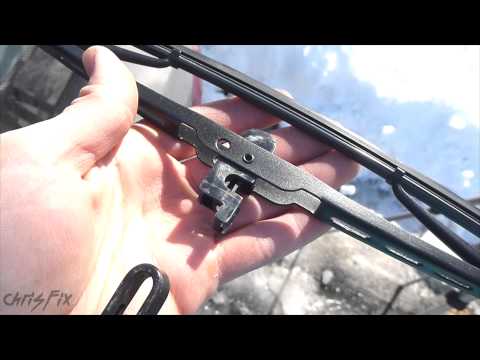
The Stellantis removal steps, Trico's guide and Consumer Reports follow this same sequence. Other arm types release differently; if a blade will not come off without force, stop and check your manual.
What if my wipers park under the hood?
Some vehicles tuck the wipers below the rear edge of the hood, where they cannot be lifted. Do not pry them up: the Hyundai and Kia manuals both warn against moving the wipers by hand, and Kia adds that the service position protects the hood paint. In both 2026 manuals I checked, you push the wiper stalk to the mist position within 20 seconds of switching off and hold it about two seconds; the wipers then climb the glass. Afterward, lower the arms and turn the ignition on to park them. Steps vary by model, so check your manual.
How do I change the rear wiper?
The rear blade is easy to forget, but it lives out in the weather too, and Consumer Reports says to check it with the fronts. It often fits differently: in the Hyundai and Kia manuals, the old rear blade comes out of a slot in the arm and the new one pushes in until it clicks, and the same stalk trick parks the rear wiper where you can reach it. Run it once afterward to confirm it is seated.
Winter wiper tips for Toronto drivers
Clear the ice yourself; wipers are not scrapers. Use a brush, a scraper and the defroster first. The Hyundai and Kia manuals say heavy snow or ice needs about 10 minutes of defrosting, and that wiping over it can damage the wiper and washer system; the Stellantis manual also says not to use the blades on frost or ice.
If the wipers stop in a storm, check for buildup. On some vehicles the wipers pause on purpose when snow piles up at the top or bottom of the windshield, to protect the motor. Pull over somewhere safe, clear the snow, and they will work again, according to the Hyundai manual and the Kia manual.
Use winter washer fluid, and warm the glass first. Transport Canada, CAA and the Ontario government all say to use fluid rated to -40°C. Never top up with engine coolant or radiator antifreeze; the Stellantis, Hyundai and Kia manuals all rule it out. In freezing weather, run the defroster before you spray, or the fluid can freeze on the windshield. More on what goes in that reservoir in our guide to car fluids.
Keep the rubber clean and away from fuel. Wipe the blades now and then with washer fluid or a mild cleaner, avoid running them on dry glass, and keep gasoline, oil and other solvents off the rubber.
Every CDD6 deal at Golden Mile Chrysler comes with the lifetime oil change*, a gas card and two years of free tire storage, so you will be in often enough to ask us to look at your blades.
Wiper Blades: Common Questions
How often should I replace my windshield wiper blades?
It varies with climate and use. Consumer Reports, CAA and Trico use roughly six months as a rule of thumb, while Valeo recommends once a year. Inspect them regularly and replace them as soon as they streak, chatter, or show hard or cracked rubber.
Are the driver and passenger wiper blades the same size?
Often not. Many vehicles use a different length on each side, so check your owner's manual, measure each blade, or use a parts lookup by year, make and model, and buy for each side separately.
How do I lift wipers that are hidden under the hood?
Use the service position described in your owner's manual. In the 2026 Hyundai and Kia manuals checked for this guide, you push the wiper stalk to the mist position within 20 seconds of switching off and hold it for about two seconds. Never force hidden wipers up by hand.
Should I check the rear wiper blade too?
Yes. The rear blade is exposed to the same weather as the fronts and wears out over time, even if you use it less. It often has its own size and fitting, so look it up separately when you buy front blades.
Can I use my wipers to clear ice off the windshield?
No. The Stellantis, Hyundai and Kia owner's manuals all say to clear snow and ice first, with a scraper and the defroster. Running the wipers over ice can damage the blades and the wiper and washer system.
Talk to the Car Doctor
Straight answers, no games, no runaround. The line is open.
437-524-1747