
How to Change a Cabin Air Filter: Signs, Intervals and the Glovebox Method

By Navin Kotecha, The Car Doctor
Published
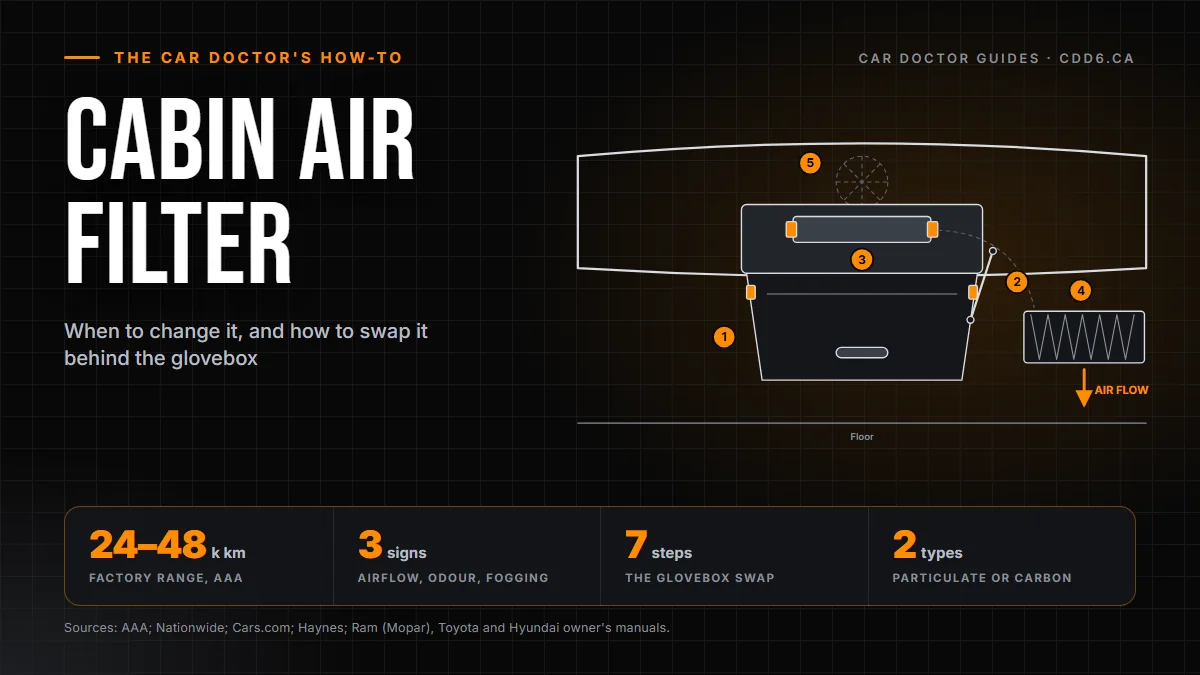
On most vehicles, changing the cabin air filter means lowering the glovebox, unclipping a small cover, sliding the old filter out and pushing a new one in with its marking pointed the right way. How often depends on your owner's manual, but the usual range is about once a year or every 24,000 to 48,000 km.
On most vehicles it is a short job. Below: what the filter does, how to tell it is clogged, where to find it, and the glovebox swap in order.
What does a cabin air filter do, and how is it different from the engine air filter?
The cabin air filter cleans the outside air your heater, fan and air conditioning blow into the cabin. AAA and Cars.com both list what it catches: dust, dirt, pollen, mould and soot, among other debris. In short, it protects the people breathing inside the vehicle.
The engine air filter is a separate part with a separate job. It sits in the intake and keeps grit out of the engine itself, as Cars.com and Kelley Blue Book both explain. Changing one does nothing for the other, so when a shop says your air filter is dirty, ask which one.
What are the signs a cabin air filter needs changing?
| What you notice | What is going on | Confirmed by |
|---|---|---|
| Weak airflow from the vents, even on high | A clogged filter restricts the air reaching the cabin | AAA, Nationwide, Cars.com, Toyota owner's manual |
| A bad smell that keeps coming back through the vents | Listed as a warning sign by all three sources | AAA, Nationwide, Cars.com |
| Windows that fog up quickly and are slow to clear | Weaker airflow means weaker defogging | AAA, Nationwide, Cars.com |
| More sneezing on the drive when pollen is up | Pollen is one of the things the filter is there to catch | AAA, Cars.com |
Source: AAA; Nationwide; Cars.com; Toyota owner's manual.
The fogging one matters most in a Toronto winter. Cars.com ties weak airflow to poor windshield defogging in cold weather, and AAA lists glass that is hard to defrost as a symptom. If your glass stays misted on a slushy January morning on the DVP no matter how long the defroster runs, check the filter before you blame the heater.
How often should you replace a cabin air filter?
Here the sources do not agree on one number, so I will give you both camps and then the rule that settles it. The figures are published in miles; I have converted them to kilometres, which is what your Canadian odometer shows.
| Source | Interval as published | In kilometres (approx.) |
|---|---|---|
| AAA (factory intervals it surveyed) | 15,000 to 30,000 miles | 24,000 to 48,000 km |
| Nationwide | 15,000 to 30,000 miles | 24,000 to 48,000 km |
| Cars.com (common practice) | Every year, or 12,000 to 15,000 miles | Every year, or 19,000 to 24,000 km |
| Haynes (Grand Caravan / Town & Country) | Once a year, or 12,000 miles | Once a year, or about 19,000 km |
Source: AAA; Nationwide; Cars.com; Haynes. Kilometres converted at 1 mile = 1.609 km and rounded. Your owner's manual overrides all of these.
The rule that settles it: your owner's manual wins. AAA, Nationwide and Cars.com all point you to it, and Toyota's manual sends you to its maintenance schedule. Go earlier if you do a lot of stop-and-go city driving or drive on dusty roads; AAA, Cars.com and Toyota all say dusty or heavy-traffic conditions use a filter up faster.
Where is the cabin air filter located?
On most vehicles it is behind the glovebox. Nationwide and Cars.com both say that is the usual spot, and it is where the Ram, Hyundai and Toyota owner's manuals we checked put it, as does Haynes for the Dodge Grand Caravan. On some vehicles it is under the hood instead, near the bottom of the windshield, which can mean more parts to take off. Your manual shows exactly where yours is.
How do you change a cabin air filter behind the glovebox?
This is the common layout, put together from the Ram owner's manual, a Hyundai owner's manual and Haynes. The details change from model to model, so keep your manual open beside you.
What you see behind the glovebox
- Glovebox stopsSqueeze both sides of the glovebox inward so it slips past its stops and hangs down.
- Support rod or tetherUnhook it first; it slows the glovebox door on one side.
- Filter door tabsPress the tabs or lock on the narrow cover to open the filter housing.
- Cabin air filterSlide it straight out. On the Ram, Hyundai and Grand Caravan, the arrow on the new filter points down toward the floor.
- Blower fanTurn the vehicle off first. With the filter out and the fan running, the blower can catch fingers and throw dirt.
The filter is shown pulled out to the right so you can see its pleats and arrow. Simplified drawing; the layout differs between vehicles.
Source: Layout and steps from the Ram owner's manual, a Hyundai owner's manual and Haynes.
The glovebox swap in seven steps
Shut the vehicle off
Both the Ram and the Toyota manuals make this the first step. Ram warns that with the filter out and the fan running, the blower can catch your fingers and blow dirt at your eyes.
Empty the glovebox
Everything in it is about to tip toward the floor.
Release the arm and the stops
Many gloveboxes have a support rod or tension tether on one side that slows the door; unhook it. Then squeeze both sides of the glovebox inward so it slips past its stops and hangs down on its hinges. Do not force it; if it will not move, go back to the manual.
Open the filter door
Behind the glovebox is a narrow cover across the filter housing. Press its tabs or lock and pull it free.
Note the marking, then pull the old filter
Before it comes out, look at which way its marking faces, or snap a phone photo as Nationwide suggests. Slide it straight out. If loose leaves or dust fall into the housing, vacuum them out, as AAA recommends.
Slide in the new one the right way
On the Ram, the Hyundai and the Grand Caravan, the arrow on the filter points down toward the floor. Other makes can mark their filters differently, so match the new filter to the old one and to your manual. A backwards filter is not harmless: Hyundai says it can make noise and filter less, and Ram says it will need changing sooner.
Put it all back
Clip the cover on until it seats, lift the glovebox back past its stops, and reattach the support rod or tether. Both Hyundai and Haynes simply say to reverse the removal steps.

Particulate or activated carbon: which filter type should you buy?
First, buy the size and type listed for your exact vehicle; AAA says the new filter should match and fit snugly without being forced. Beyond that, you will usually see two kinds on the shelf. A standard particulate filter is pleated media that traps dust, pollen and similar particles. An activated carbon filter adds a carbon layer to cut down on odours. Both AAA and Cars.com describe the carbon option, and HEPA-labelled filters are sold for some vehicles as well. If odours from traffic bother you, carbon is the one to look for.
When should you let a shop change it?
If your manual shows the filter behind the glovebox, this is a job most owners can handle. Hand it off if the filter is under the hood, if your manual's steps involve taking off trim panels, or if you would simply rather not risk a broken clip. Cars.com notes that some filters are harder to reach, and AAA says some vehicles need trim or glovebox fasteners removed before the filter comes out.
An easy habit: ask for the cabin filter to be checked whenever the car is in for an oil change. Every CDD6 deal at Golden Mile Chrysler includes a lifetime oil change*, so those visits come around regularly anyway. Before winter, read our winter tires guide too.
Cabin Air Filters: Common Questions
How often should I change my cabin air filter?
Follow your owner's manual. As a guide, AAA and Nationwide give a range of 15,000 to 30,000 miles, roughly 24,000 to 48,000 km, while Cars.com and Haynes suggest once a year or about 19,000 to 24,000 km. Change it sooner if you drive in heavy traffic or on dusty roads.
Is the cabin air filter the same as the engine air filter?
No. The cabin air filter cleans the air blown into the passenger compartment through the heating and air conditioning. The engine air filter sits in the intake and keeps dirt out of the engine. They are separate parts in separate places, and changing one does not help the other.
Can a dirty cabin air filter cause foggy windows?
Yes. AAA, Nationwide and Cars.com all list windows that fog easily and clear slowly as a sign of a clogged cabin filter, because less air gets to the defroster. In a Toronto winter that is a visibility problem, so check the filter if your windshield will not clear.
Which way does the arrow go on a cabin air filter?
It depends on the marking. On the Ram, Hyundai and Grand Caravan procedures we checked, the arrow points down toward the floor. Other makes can mark filters differently, so note how the old filter came out, match the new one to it, and confirm in your owner's manual.
Where is the cabin air filter on most cars?
Behind the glovebox, on most vehicles. You empty the glovebox, release its stops so it hangs down, and open a small cover over the filter. On some vehicles the filter sits under the hood near the base of the windshield instead. Your owner's manual shows the location for your model.
Is an activated carbon cabin filter worth it?
If smells bother you, it can be. An activated carbon filter traps particles like a standard filter and adds a carbon layer that helps reduce odours, according to AAA and Cars.com. Whatever type you choose, buy the size listed for your exact vehicle.
Should I turn the car off before changing the cabin air filter?
Yes. The Ram and Toyota owner's manuals both make switching off the first step. Ram warns that with the filter removed and the blower running, the fan can contact your hands and throw debris toward your eyes.
Talk to the Car Doctor
Straight answers, no games, no runaround. The line is open.
437-524-1747