
Engine Oil Grades Explained: What 0W-20, 5W-30 and the Symbols on the Bottle Mean

By Navin Kotecha, The Car Doctor
Published
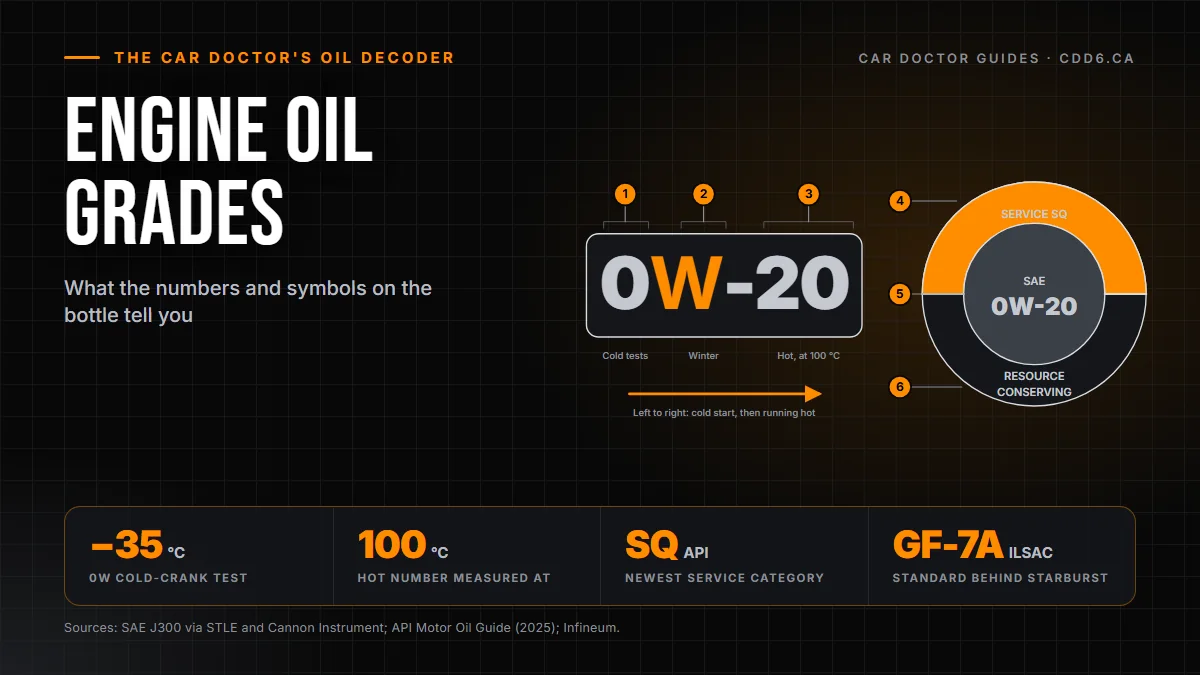
An oil grade like 0W-20 or 5W-30 has two halves. The W means winter: the number in front of it rates cold-start flow, and lower is better in the cold. The number after the dash rates how thick the oil stays once the engine is hot. Your owner's manual tells you which grade your engine needs.
That is the short version. Below I break down what each number is tested against, why the winter half matters on a January morning before you merge onto the 401, how to read the symbols on the back of the bottle, and when synthetic oil earns its keep.
What do the numbers in 0W-20 actually mean?
Oil grades come from a standard called SAE J300, published by SAE International. Castrol and the Society of Tribologists and Lubrication Engineers (STLE) both explain the W as short for winter, not weight. To earn a winter rating, an oil goes through two cold lab tests: one checks how hard it is for the starter to crank the engine through the oil, the other checks whether the oil pump can still pull it. Each W number has its own test temperature, and the oil gets the rating for the coldest one it passes.
The second number is about heat. J300 measures it at 100°C, and Castrol ties it to how the oil flows at normal running temperature. A bigger number means a thicker oil when hot. A two-part oil like 5W-30 is called a multigrade, and it has to meet the limits for both halves: the 5W cold tests and the 30 hot range.
Reading 0W-20 and the symbol on the bottle
- Winter number (0)Set by a cold-cranking test and a low-temperature pumping test. The oil earns the grade of the coldest one it passes.
- WStands for winter, not weight.
- Hot number (20)Measured at 100°C. A larger number means a thicker oil when the engine is hot.
- Top of the symbolNames the performance category. Gasoline categories start with S and diesel ones with C.
- CentreShows the SAE viscosity grade.
- BottomReads Resource Conserving when the oil qualifies.
Your owner's manual and the oil filler cap give the grade your engine needs. Simplified drawing; the layout differs between vehicles.
Source: Grades from STLE, Cannon Instrument and Castrol; symbol from the API Motor Oil Guide and Infineum.
| Winter grade | Cranking test temperature | Pumping test temperature |
|---|---|---|
| 0W | −35°C | −40°C |
| 5W | −30°C | −35°C |
| 10W | −25°C | −30°C |
| 15W | −20°C | −25°C |
| 20W | −15°C | −20°C |
| 25W | −10°C | −15°C |
Source: SAE J300 limits as published by Cannon Instrument Company and the SAE J300 summary on Wikipedia (2021 revision); 0W and 20W temperatures also confirmed by STLE.
How cold each winter grade is cranking-tested (degrees below zero)
Each step down in the W number moves the cold-crank test 5 degrees colder.
Source: SAE J300 via Cannon Instrument Company and Wikipedia's SAE J300 summary.
Why does the W number matter in a Toronto winter?
Oil thickens as it cools. NAPA points out that on a cold start the engine has to push through that thick oil, and at the same moment the battery is working at a disadvantage. An oil with a lower W number is rated to flow and crank at colder temperatures, so it reaches the moving parts sooner after you turn the key on a frosty driveway in Scarborough or North York. STLE describes the winter grade as a guide to how the oil behaves when an engine starts from cold.
None of that means you should pick a lower W number on your own. The engine was designed and tested around a specific grade, so use the one in your manual. Many Stellantis manuals add that the engine oil filler cap shows the grade too.
What do the donut, starburst and shield on the bottle mean?
Those symbols belong to the American Petroleum Institute (API), which licenses them. The round donut is the API Service Symbol. Its top ring shows the performance category, the middle shows the SAE grade, and the bottom may say Resource Conserving if the oil passes API's extra requirements for that label. Gasoline categories start with S; diesel categories start with C.
The starburst is an API Certification Mark. It now means the oil meets ILSAC GF-7A, the current passenger car standard from the International Lubricant Specification Advisory Committee. A newer mark, the shield, is reserved for oils that meet GF-7B, and that standard covers only 0W-16. API began licensing SQ, GF-7A and GF-7B on March 31, 2025, according to both API and Infineum.
| What you see | What it tells you | Current as of late 2026 |
|---|---|---|
| Donut, top ring | API performance category (S for gasoline, C for diesel) | SQ is the newest gasoline category; SP and older S categories down to SJ are still listed as current for older engines |
| Donut, centre | SAE viscosity grade | For example 0W-20 or 5W-30 |
| Donut, bottom | Resource Conserving, if the oil qualifies | An SQ oil labelled Resource Conserving meets the GF-7A requirements |
| Starburst | Meets the current ILSAC standard | GF-7A; never shown on 0W-16 oil |
| Shield | Meets ILSAC GF-7B | Used only on 0W-16 oil |
Source: API Motor Oil Guide (2025 edition); Infineum, API certification marks and symbols; API, latest oil categories.
Good news for older vehicles: API says the newest gasoline category carries the protection of the earlier ones, so it can be used where your manual names an older one, such as SN. API's own guidance on the GF-7 launch, reported by Motor, says the same of GF-7A oil in engines that called for GF-6A. The 0W-16 shield oils are the exception: use them only where 0W-16 is specified. Obsolete categories such as SH and older carry a warning that they are not suitable for most modern gasoline engines.
Which oil grades do Jeep, RAM and Dodge engines use?
It depends on the engine, and sometimes on the year, which is why I won't hand you a single answer. Stellantis owner's manuals list the grade together with a material standard, a code like MS-6395, that the oil has to meet. Here are examples I could confirm in the factory literature. Always confirm in your owner's manual; capacities change by engine and year.
| Vehicle and engine | Grade and standard named | Oil with filter |
|---|---|---|
| Jeep Wrangler JL, 3.6L V6 (2019 and 2022 specifications) | API Certified 0W-20 meeting MS-6395 | 4.73 L (5 US quarts) |
| Jeep Wrangler JL, 2.0L turbo (2019 and 2022 specifications) | 5W-30 full synthetic meeting MS-13340 | Check your manual |
| 6.4L V8 (2016 RAM Heavy Duty manual; 2022 Wrangler specifications) | 0W-40 meeting MS-12633 | Check your manual |
Source: Jeep Wrangler 2019 and 2022 specification sheets; 3.6L capacity also stated in Stellantis service bulletin 9004257; 6.4L standard from the 2016 RAM owner's manual. Other models and engines are left out until the grade and capacity can be confirmed in two sources.
If you drive a Wrangler, our page on Jeep Wrangler engines covers what is under the hood of each trim.
Is synthetic oil better than conventional?
In AAA's 2017 lab study of 5W-20 oils from five major brands, synthetic oils did 47 per cent better than their conventional versions across eight industry-standard tests, as AAA and Motor Authority both report. AAA pointed to drivers who tow, sit in heavy stop-and-go traffic or face very hot or very cold weather as the ones who benefit most. That sounds a lot like a winter commute on the DVP.
AAA also said a conventional oil that meets the manufacturer's specification is acceptable. The rule that overrides everything: if your manual calls for full synthetic, as some Stellantis manuals do, use full synthetic.
The simplest way to get it right every time
Match three things to your manual: the grade, the API category or starburst, and any material standard it names. Or let us handle it: every CDD6 deal at Golden Mile Chrysler includes the lifetime oil change*, along with a gas card and two years of free tire storage, so the right oil goes in at every visit. Still choosing a vehicle? Start with this month's deals.
Four things to match to your manual
The winter number
It comes from cold cranking and pumping tests; the oil gets the grade of the coldest test it passes.
The hot number
Measured at 100°C. The bigger it is, the thicker the oil runs when the engine is hot.
The bottle symbols
The service symbol names the category and grade; the starburst means the oil meets ILSAC GF-7A.
Any material standard
Stellantis manuals add a standard such as MS-6395 next to the grade. Look for it on the bottle.
Engine Oil Grades: Common Questions
What does the W stand for in 5W-30?
Winter. The number in front of the W comes from cold-temperature tests in the SAE J300 standard, and a lower number means the oil is rated to crank and pump at colder temperatures. It does not stand for weight.
What is the difference between 0W-20 and 5W-20?
Both are equally thick once the engine is hot. The 0W oil passes its cold-cranking test at −35°C, while a 5W oil is tested at −30°C, so the 0W is rated for colder starts. Use the grade your owner's manual specifies.
Can I use 5W-30 instead of 5W-20?
Only if your owner's manual allows it. The second number is thicker at operating temperature, and the engine was designed around a specific grade. Some manuals list different grades for different engines or uses, so check the one for your exact engine and model year.
What is API SQ oil?
SQ is the newest API service category for gasoline engines, licensed from March 31, 2025. API says the newest category includes the protection of earlier ones, so SQ oil can be used where an older category such as SP or SN is listed.
What does the starburst symbol on motor oil mean?
It is an API Certification Mark showing the oil meets the current ILSAC passenger car standard, now GF-7A. It is never applied to 0W-16 oil, which uses a separate mark, the shield, for the GF-7B standard.
Is synthetic oil worth it in a Canadian winter?
AAA's 2017 testing found synthetic oil did 47 per cent better than conventional in eight lab tests, and AAA listed very cold climates among the conditions where it helps most. If your manual requires full synthetic, it is not optional.
Where do I find the right oil for my vehicle?
In your owner's manual, which lists the grade, the oil capacity and, on Stellantis vehicles, a material standard such as MS-6395. On many Stellantis engines the oil filler cap shows the grade as well. Capacities change by engine and year.
Talk to the Car Doctor
Straight answers, no games, no runaround. The line is open.
437-524-1747