
Types of Car Fluids: What Each One Does, How to Check It and Who Should Change It

By Navin Kotecha, The Car Doctor
Published
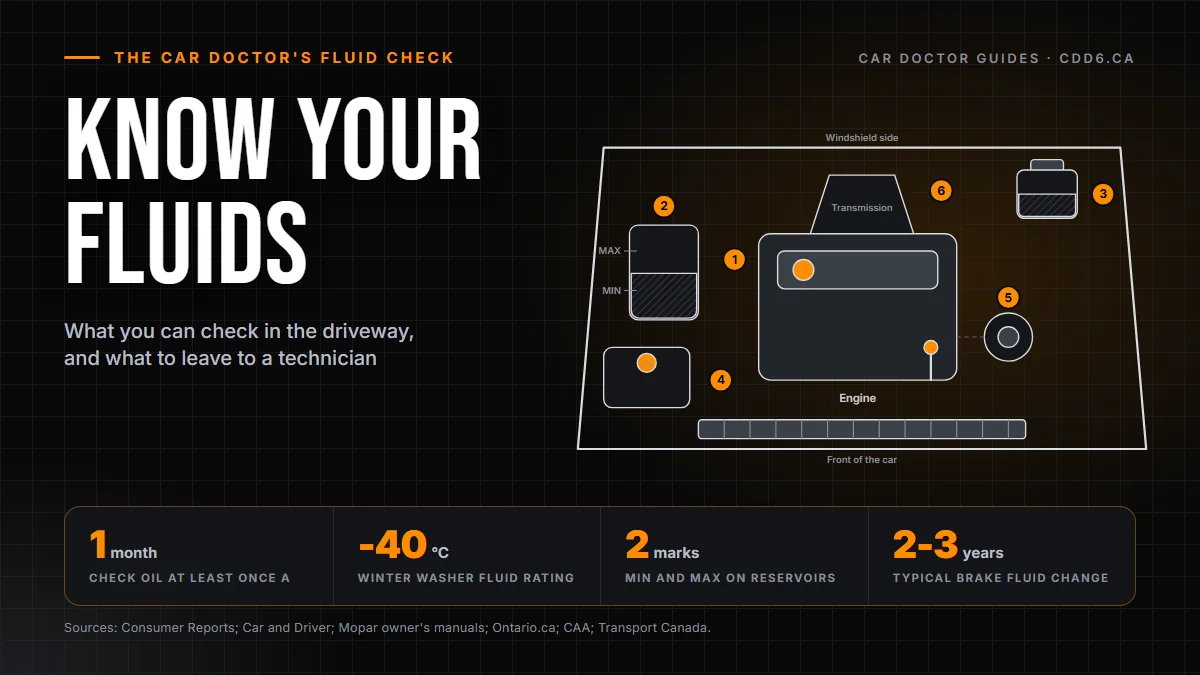
A typical gas or diesel vehicle uses engine oil, transmission fluid, brake fluid, engine coolant and windshield washer fluid, plus power steering fluid on older hydraulic systems, gear oil in the axles and transfer case of a 4x4, and refrigerant in the A/C. Oil, coolant, brake fluid and washer fluid you can eyeball yourself. The rest belong to a technician.
One rule sits above everything in this guide: the right type of each fluid, and when to change it, is printed in your owner's manual. Brands and models differ, so treat what follows as the general picture and let the manual have the final word.

What fluids does a car need?
| Fluid | What it does | How to check | Typical colour | Who should change it |
|---|---|---|---|---|
| Engine oil | Lubricates the engine's moving parts | Dipstick on most engines; some newer vehicles show the level electronically instead | Brown to black once it has been in use | Top it up yourself; have it changed at the interval in your manual or when the oil-life reminder comes on |
| Automatic transmission or CVT fluid | Lubricates and cools the transmission | A dipstick on some; many newer automatics have none, and the dealer checks the level with special tools | Red to reddish pink when healthy, darker with age | A technician |
| Brake fluid | Carries the force of your foot on the pedal out to the brakes | Translucent reservoir under the hood, marked MIN and MAX | Varies; go by the DOT type, not the colour | A technician, at the time interval in your manual |
| Power steering fluid | Supplies the pressure that makes steering easier on hydraulic systems | Reservoir under the hood, if your vehicle has one; electric power steering has no fluid | Check your owner's manual | A technician |
| Engine coolant (antifreeze) | Keeps engine temperature under control and resists freezing | Translucent overflow tank with MIN and MAX lines, engine cold only | Not a reliable guide to type; go by the label | A technician |
| Axle and transfer case fluid (4x4) | Gear oil for the differentials and the transfer case | Through a fill plug underneath; not a routine owner check | Check your owner's manual | A technician, sooner with heavy towing or off-road use |
| Windshield washer fluid | Cleans the glass; winter blends resist freezing | Reservoir cap marked with a windshield spray symbol | Varies by product | You |
| A/C refrigerant | Moves heat out of the cabin in a sealed, high-pressure system | Not an owner check | Not visible | A trained technician |
Source: Consumer Reports, oil change rules and transmission maintenance; Car and Driver on checking oil, transmission fluid, basic maintenance, power steering and coolant; Mopar RAM 2500/3500 owner's manual; 2026 RAM 1500 owner's handbook; U.S. EPA, MVAC refrigerants.
Where you check each fluid under the hood
- Engine oilCheck it at least once a month on level ground with the engine off: pull the dipstick, wipe it, push it back in and read it between the marks.
- Coolant overflow tankRead it with the engine cold, between MIN and MAX. Never open the cap on a hot engine.
- Brake fluid reservoirA see-through tank with MIN and MAX marks. Top up only with the type your manual names.
- Washer fluidThe cap carries a washer symbol. Use a winter fluid rated to -40°C, never plain water.
- Power steering reservoirOnly on hydraulic systems. Electric power steering, the norm on new cars, needs no fluid.
- TransmissionMany modern automatics have no dipstick and are checked by a technician.
Where each one sits changes from vehicle to vehicle, so your owner's manual has the map for yours. Simplified drawing; the layout differs between vehicles.
Source: Check points from Consumer Reports, Car and Driver and the Ram owner's manual.
How do you check your engine oil?
Park on level ground with the engine off. Pull the dipstick, wipe it, push it all the way back in, then pull it again and read it. Depending on the engine, the safe range is marked by two lines or holes, MIN and MAX, or a crosshatched patch. Anywhere inside that range is fine. Below it, add the oil type your manual lists, a little at a time, and recheck after a few minutes.
Sources split on timing. Car and Driver prefers a warmed-up engine, the Mopar manual for RAM heavy-duty trucks says about five minutes after a warm engine is shut off, and Consumer Reports says most automakers want it cool. Your manual settles it. Check at least monthly; some newer vehicles have no dipstick and report the level on the dash. For what the numbers on the bottle mean, see engine oil grades explained.
Which transmission fluid does my car use?
Whatever the manual specifies, and nothing else. Conventional automatics, dual-clutch boxes and CVTs each call for their own fluid, and Consumer Reports warns that a CVT needs CVT-specific fluid. Transmission fluid should not get used up the way engine oil can, so a low level usually points to a leak.
Do not be surprised if you cannot find a transmission dipstick. Many modern automatics are filled at the factory and checked only by a technician; the 8-speed in the RAM heavy-duty trucks has no dipstick at all, according to its manual. Change intervals vary widely from vehicle to vehicle, so follow the schedule for yours.
Can you mix DOT 3, DOT 4 or DOT 5.1 brake fluid?
Brake fluid comes in several grades set out in the U.S. federal brake fluid standard, FMVSS 116, labelled DOT 3, DOT 4, DOT 5 or DOT 5.1. Our advice is simple: do not mix them and do not swap one for another on your own. Car and Driver notes that the different types do not mix well, and the RAM manual warns that the wrong fluid can badly damage the brake system. Use only the type your manual names. The RAM heavy-duty trucks, for example, call for DOT 3.
Brake fluid also soaks up moisture from the air over time, which lowers its boiling point and weakens braking. That is why it is changed on a calendar: Car and Driver puts it at two to three years for most vehicles, and the 2026 RAM 1500 schedule says every 24 months regardless of distance.
Does my car have power steering fluid?
Maybe not. Older hydraulic systems use an engine-driven pump and fluid, which can leak and needs replacing from time to time. Car and Driver says electric power steering, which uses an electric motor instead, is now the norm on new cars and does away with that fluid. You can see the split in RAM's own books: the fluid chart in the 2026 RAM 1500 handbook lists no steering fluid, while the gas heavy-duty RAM still has a hydraulic reservoir. If your manual lists a power steering fluid, use exactly that one.
How do you check engine coolant safely?
Only with the engine cold. Look at the translucent overflow tank and confirm the level sits between its MIN and MAX lines. Never open the radiator or pressure cap on a hot engine: the system is under pressure, and both the RAM manual and Car and Driver warn it can spray scalding coolant. A level that keeps falling means a leak to have checked.
Coolant comes in different chemistries, such as organic additive technology (OAT) and hybrid (HOAT), and colour will not tell you which is which. Do not mix types unless your manual allows it. RAM's manual, for one, says its OAT coolant must not be mixed with HOAT or so-called globally compatible coolants. Before the snow, have the coolant's freeze protection tested, as CAA and Transport Canada both recommend.
Do 4x4 trucks need differential and transfer case fluid?
Yes. A 4x4 carries gear oil in the front and rear axles and its own fluid in the transfer case, each with its own specification in the manual. On RAM trucks, both the 1500 handbook and the heavy-duty manual say the axle level only needs checking if a leak is suspected, done through a fill plug with the truck level, and both advise more frequent fluid changes for heavy use such as towing, off-roading or fleet work. Book it with a technician. Curious how the system works? Read our guide to Jeep Wrangler 4WD.
What washer fluid should you use in a Toronto winter?
A winter blend rated to -40°C, with a spare jug in the trunk. The Ontario government, CAA and Transport Canada all give that same figure. Never fill the reservoir with plain water, which freezes; pick a product whose rating covers our coldest days, as the RAM manual advises. Salt spray on the 401 drains a reservoir quickly, so top up often. More winter prep is in our winter tires guide.
What about A/C refrigerant?
Leave it alone. Refrigerant sits in a sealed system under high pressure, and the RAM manual says adding it is a job for an experienced technician. Many newer vehicles use HFO-1234yf, which the U.S. EPA rates far lower in global warming potential than the older HFC-134a. Use only the refrigerant your vehicle was built for.
What colour is the leak under my car?
Check the ground where you park after the vehicle has sat overnight; both the RAM manual and Car and Driver suggest looking under it once it has been parked on clean, dry pavement. Then use this quick guide.
| What you see | Most likely | What to do |
|---|---|---|
| Red or reddish fluid | Automatic transmission fluid | Have the transmission checked soon |
| Brown to black, oily fluid | Engine oil | Check the dipstick, top up if needed and have the source found |
| Brake fluid reservoir dropping, or any fluid you suspect is brake fluid | Brake fluid leak | Do not drive it; get it fixed right away |
| Coolant tank level falling between checks | Coolant leak | Have the cooling system inspected before it overheats |
Source: Consumer Reports, transmission maintenance; Car and Driver on transmission fluid, antifreeze leaks and basic maintenance; Consumer Reports, oil; Mopar RAM 2500/3500 owner's manual.
Five driveway habits
Oil once a month
Check it at least monthly, parked on level ground with the engine off.
Coolant only when cold
Read the overflow tank between MIN and MAX with the engine cold, and never open a hot cap.
Winter washer fluid
Fill with a fluid rated to -40°C and keep a spare jug in the trunk.
Brake fluid by the calendar
It soaks up moisture over time, so it is typically replaced every two to three years.
Look where you park
Check the ground after the vehicle has sat overnight; the colour of a drip points to its source.
Shopping for your next vehicle? Every CDD6 deal at Golden Mile Chrysler comes with the lifetime oil change*, two years of free tire storage and a gas card.
Car Fluids: Common Questions
What fluids should I check regularly?
Engine oil, coolant, brake fluid and windshield washer fluid are the ones most owners can check by eye. Oil uses the dipstick, while coolant, brake fluid and washer fluid sit in reservoirs under the hood. Check oil at least monthly, and check coolant only when the engine is cold.
Why can't I find my transmission dipstick?
Many modern automatic transmissions do not have one. The fluid is filled at the factory, and the level is checked by a technician with special tools. Your owner's manual will say whether yours has a dipstick. If you see red fluid under the vehicle, have the transmission looked at soon.
Can I mix different brake fluids?
Do not do it. Brake fluid comes in several DOT grades and the types do not mix well, and using the wrong one can damage the brake system. Use only the type named in your owner's manual. If you are not sure what is in the reservoir now, have a technician handle it.
Is it safe to open the radiator cap?
Not when the engine is hot. The cooling system is pressurised, and opening the cap can spray scalding coolant. Wait until the engine has fully cooled, then check the level at the translucent overflow tank. If it keeps dropping, have the system checked.
Can I mix coolant types?
Only if your owner's manual allows it. Coolants use different chemistries, such as OAT and HOAT, and colour is not a reliable way to tell them apart. Some automakers, RAM among them, specifically warn against mixing OAT coolant with HOAT or globally compatible products.
What washer fluid is best for winter in Ontario?
A winter washer fluid rated to -40°C, which is what the Ontario government, CAA and Transport Canada all recommend. Keep an extra jug in the vehicle. Never use plain water, which can freeze in the reservoir.
See this month's deals, with the lifetime oil change and free tire storage
Talk to the Car Doctor
Straight answers, no games, no runaround. The line is open.
437-524-1747