
Where Is the Spare Tire? Finding It, Using It, and What to Do If Your Car Has None

By Navin Kotecha, The Car Doctor
Published
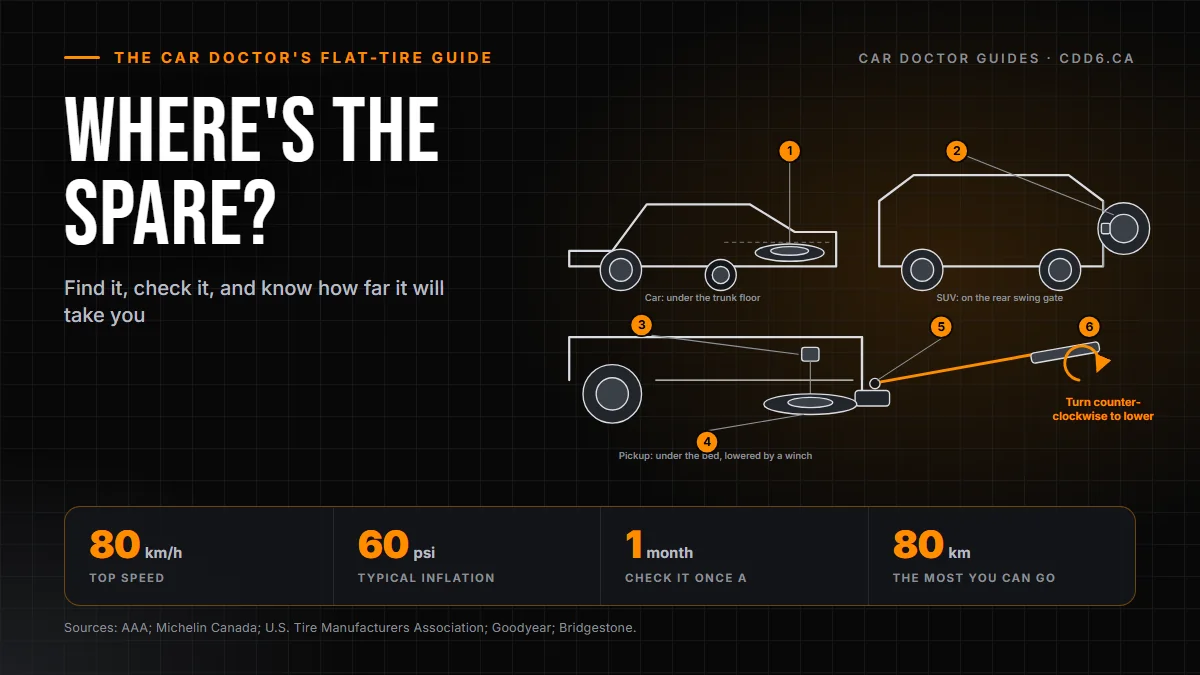
In most cars the spare lives under the floor of the trunk or cargo area. Pickups and minivans usually hang theirs under the vehicle on a cable that you lower with the jack tools, and the Jeep Wrangler carries it on the back door. None at all? Your car probably came with a sealant-and-inflator kit or run-flat tires instead.
A flat on the shoulder of the 401 in January is a bad time to discover what's in your trunk. Spend five minutes in your driveway with this guide and you will know where the spare is, what kind it is, and how far it can carry you.
Where do cars keep the spare tire?
Start with the cargo area. Lift the floor panel or trunk mat and you will usually find the spare in a well underneath, with the jack and wrench nearby. Consumer Reports notes that on trucks, minivans and some SUVs the spare is mounted under the vehicle instead and has to be lowered before you can use it. On RAM pickups, for example, the owner's manual sends you to a small access hole between the bottom of the tailgate and the top of the rear bumper, where the tools connect to a winch.
The Wrangler is the odd one out. It bolts its spare to a carrier on the rear swing gate, which is why its backup camera sits in the tire mount. If you run bigger tires on a Wrangler, read Jeep Wrangler tire sizes before you assume the spare still matches.
| Where | Usually found on | How you get to it |
|---|---|---|
| Under the trunk or cargo floor | Cars and many crossovers | Lift the floor panel or mat; the jack and wrench are usually close by |
| Under the vehicle, on a cable | Pickups, minivans and some SUVs | Feed the jack extension and wrench into the winch access hole and wind the tire down |
| On the rear swing gate | Jeep Wrangler | Mounted outside on a carrier; follow your owner's manual to remove it |
| Nowhere | Many newer cars, compacts and EVs, and cars on run-flat tires | Look for a sealant-and-inflator kit, or check the owner's manual to see if your tires are run-flats |
Source: Consumer Reports; Michelin Canada; AAA; RAM owner's manuals (RAM 2500, RAM 1500); Wrangler carrier from The Globe and Mail and Jeep/Mopar. Your owner's manual has the exact spot.
The three usual places to find the spare
- Under the trunk floorMost cars keep the spare here, with the jack and tools in the cargo area.
- On the rear swing gateThe Jeep Wrangler carries its spare on a carrier on the rear gate.
- WinchTrucks, minivans and some SUVs hang the spare under the vehicle, and a winch lowers it.
- Spare on its cableLower it until the tire sits on the ground with slack in the cable, then tilt the retainer and pull it through the centre of the wheel.
- Access holeOn RAM pickups it sits between the lower edge of the tailgate and the top of the rear bumper.
- Wrench and extension tubeFit the wrench to the extension tube, push it through the hole into the winch and turn it counterclockwise. Never use an air wrench or power tool.
Many newer cars have no spare at all, just a sealant kit or run-flat tires, so check your owner's manual first. Simplified drawing; the layout differs between vehicles.
Source: Consumer Reports, AAA, RAM owner's manuals (RAM 1500, RAM 2500), The Globe and Mail and Mopar.
Full-size spare or donut: what's the difference?
A full-size matching spare is simply a fifth wheel and tire identical to the other four. You can drive on it normally, and tire makers suggest working it into your rotation so it wears with the rest of the set. According to AAA and Consumer Reports, this is the kind you mostly find on pickups, Jeeps and bigger SUVs.
A compact temporary spare, the donut, is narrower and lighter, with shallow tread. It also runs at much higher pressure: Goodyear and the U.S. Tire Manufacturers Association_1.pdf) both put it at about 60 psi (420 kPa). It exists to get you to a tire shop, and that's all. Michelin and AAA are both clear that it is not meant for everyday driving.
How fast and how far can you drive on a donut spare?
Speed: 80 km/h at most. AAA, Consumer Reports and Michelin all give the same ceiling of 50 mph, which is 80 km/h. On the 401 or the DVP that is far below the flow of traffic, so if there is a sensible route on city streets to the nearest shop, take it.
Distance: the sources don't agree. AAA's rule of thumb is no more than 50 miles, roughly 80 km. Michelin Canada says mini spares typically allow around 100 to 200 km. The number that actually counts is the one on your spare's sidewall or in your owner's manual, and the tire association says the same: limits on speed, distance and even which wheel position you can use vary by vehicle.
| Option | Top speed | How far | Good to know |
|---|---|---|---|
| Full-size matching spare | Normal driving | Like any of your tires | Still get the flat repaired or replaced soon |
| Compact temporary spare (donut) | 80 km/h | Sources differ: about 80 km (AAA) to 100–200 km (Michelin Canada); your label rules | Needs about 60 psi; not for daily use |
| Run-flat tires | 80 km/h | Up to 80 km with no air | Needs a working tire pressure warning system; have the tire inspected after |
| Sealant-and-inflator kit | Follow the kit and owner's manual | Only to the nearest tire shop | Seals small tread punctures; no help with a sidewall cut or blowout |
Source: AAA; Michelin Canada; Consumer Reports; U.S. Tire Manufacturers Association_1.pdf); Goodyear Canada warranty; Bridgestone tire safety manual.
My car has no spare tire. What now?
You are not alone. Michelin Canada says many newer vehicles, especially compacts, EVs and cars on run-flat tires, leave the factory without a traditional spare. AAA says the same, and both point you to the owner's manual to find out what you got instead. Usually it's one of two things.
A sealant-and-inflator kit. This is a bottle of puncture sealant paired with a small air compressor that plugs into the car. It can close up a small hole in the tread and get air back in the tire. It can't fix a cut in the sidewall, a large gash or a blowout, as AAA, Consumer Reports and Michelin all warn. The tire association is blunt that using a kit is not a repair, only a way to limp to a shop, and Bridgestone says a tire full of sealant has to be dealt with by a professional as soon as possible. Follow the instructions on the kit and in your manual to the letter.
Run-flat tires. These are built to hold the car up for a while after they lose air. Bridgestone and Goodyear both rate theirs for up to 80 km at no more than 80 km/h with little or no pressure. Because they still ride well when flat, you may not feel the problem, so both makers say the car must have a working tire pressure warning system. After driving on one, get it inspected; Goodyear notes it may need replacing if you push it to those limits.
Would rather carry a real spare? Both AAA and Consumer Reports say dealers sell spare tire kits, with the wheel, jack and tools, for many models that shipped with a sealant kit. Ask the parts department whether one is made for your vehicle.
How do you lower a spare tire from under a truck or minivan?
Every vehicle is a little different, so treat this as the general idea and keep the owner's manual open. These steps follow the RAM 1500 and RAM 2500 manuals and a Stellantis dealer service procedure for the 2019 RAM 1500.
1. Get safe first. Pull well off the road onto firm, level ground, put it in Park and set the parking brake, as Consumer Reports advises. Hazards on. If you need to get out, use the door away from traffic.
2. Find the tools. Locate the jack, the extension tube and the lug wrench; the manual shows where they are stowed. Connect the wrench to the extension tube.
3. Find the access hole. On RAM trucks it is between the bottom of the tailgate and the top of the rear bumper, sometimes behind a small cover. Feed the tube in until it seats in the winch.
4. Wind it down. Turn the wrench counterclockwise until the tire sits on the ground with some slack in the cable. Do it by hand: both RAM manuals warn that an impact gun or any power tool can wreck the winch mechanism.
5. Free the tire. Slide it out from under the vehicle, raise it a little so you can angle the cable's end piece and slip it back out through the hole in the middle of the wheel. When you stow the flat or the spare again, put every tool back in its original spot.
Lowering a spare from under a truck or minivan
Park it safely
Pick firm, level ground, shift into Park and set the parking brake.
Assemble the wrench
Attach the wrench to the extension tube from the jack kit.
Find the access hole
Push the tube through the hole and into the winch. On a RAM it is above the rear bumper.
Turn counterclockwise
Keep turning until the tire is on the ground and the cable is slack. Hand tools only, never an air wrench.
Free the spare
Tilt the cable retainer and pull it through the centre of the wheel.

How often should you check the spare's pressure?
Check it every month and before any long drive. That's the advice from the U.S. Tire Manufacturers Association and Michelin Canada, and Consumer Reports suggests doing it whenever you check the other four. Tires lose a little air every month, and a spare tucked out of sight is the easiest one to forget. Set a donut to the pressure on its sidewall or the tire label, usually around 60 psi. The tire information label in the driver's door frame also lists the spare's cold pressure; our guide to correct tire pressure explains how to read it.
Replacing the flat itself? Our guide to types of tires explains all-season, all-weather and winter tires so the new one matches the others.
When should you just call for help?
If you are stuck in a live lane, on a narrow shoulder, or it's dark and snowing, don't be a hero. Turn on the hazards and call 911 if you are in danger, as CAA South Central Ontario and Transport Canada both advise, and only get out if there is a safer spot well away from traffic to move to. Then call roadside assistance, whether that is CAA, the plan that came with your vehicle, or your insurer's. Every CDD6 deal at Golden Mile Chrysler comes with two years of free tire storage, plus a lifetime oil change* and a gas card, so your other set of tires has somewhere to live between seasons.
Spare Tires: Common Questions
Where is the spare tire on most cars?
Under the floor of the trunk or cargo area, usually with the jack and lug wrench beside it. Trucks, minivans and some SUVs hang the spare under the vehicle on a cable instead, and the Jeep Wrangler mounts it on the rear swing gate. Your owner's manual shows the exact location.
How fast can you drive on a donut spare?
No faster than 80 km/h (50 mph). AAA, Consumer Reports and Michelin all give that ceiling for compact temporary spares. On a fast highway like the 401 that is well below traffic speed, so use a quieter route to the nearest tire shop when you can.
How far can you drive on a donut spare?
Sources differ. AAA says no more than about 80 km (50 miles), while Michelin Canada says mini spares typically allow around 100 to 200 km. The limit printed on your spare's sidewall or in your owner's manual is the one to follow. Either way, head straight to a tire shop.
What does it mean if my car has no spare tire?
It most likely came with a sealant-and-inflator kit or with run-flat tires. Michelin Canada and AAA say many newer vehicles, including compacts and EVs, ship this way. Check the owner's manual and the trunk so you know which one you have before you need it.
Can a tire sealant kit fix any flat?
No. A sealant kit can seal a small puncture in the tread and reinflate the tire, but it can't fix a sidewall cut, a large hole or a blowout. It is a temporary fix only: drive to a tire shop promptly so the tire can be properly inspected.
How far can you drive on a run-flat tire?
Bridgestone and Goodyear rate their run-flat tires for up to 80 km at a maximum of 80 km/h with little or no air. Your car needs a working tire pressure warning system, and the tire should be inspected afterwards.
How much air should a spare tire have?
A compact temporary spare usually needs about 60 psi (420 kPa), far more than a regular tire, according to Goodyear and the U.S. Tire Manufacturers Association. Use the figure on the spare's sidewall or the tire label in the door frame, and check it monthly and before road trips.
Talk to the Car Doctor
Straight answers, no games, no runaround. The line is open.
437-524-1747