
Car Won't Start in the Cold: Battery, Fuel or Something Else?

By Navin Kotecha, The Car Doctor
Published
When a car won't start on a cold morning, the battery is the usual suspect, but listen before you blame it. A rapid clicking or a slow, tired crank points to a weak battery. Total silence can mean a flat battery or a loose cable. If the engine spins at normal speed and never catches, look at fuel or spark instead.
I see this every winter: the first real cold snap arrives and a pile of cars refuse to wake up on driveways from the Beaches to North York. Below is how to read what your car is telling you, how to boost it without hurting yourself or the electronics, when to stop and call for help, and what to do in the fall so you never need this page. Your owner's manual has the final word on your vehicle, so if anything here disagrees with it, follow the manual.
Why does cold weather stop a car from starting?
Cold hits the starting system from two sides at once. The chemical reaction that lets a battery make electricity slows down as the temperature drops, so it has less to give. At the same moment, engine oil gets thicker, so the starter has to work harder to spin the engine. Less supply and more demand, right when you need to get onto the 401. Both the RAC and NAPA describe it this way.
You will see confident percentages online for how much power a battery loses in the cold. Treat them loosely: even two CAA clubs publish different numbers for the same conditions, so I won't pin one on it here. What everyone agrees on is the direction: the colder it gets, the less a battery delivers, and an older battery has less margin to begin with. That is why the cold cranking amps rating matters so much here, which our car battery specs guide explains.
What is your car telling you? Read the symptom first
Before you grab the cables, turn the key (or press the button) once and pay attention to two things: what you hear, and what the dash lights and headlights do. That ten-second check tells you more than a dozen frustrated tries.
| What happens | Most likely cause | What to try first |
|---|---|---|
| Nothing at all: no sound, maybe no dash lights | A completely flat battery, or a loose battery cable | Check that the battery cables are tight, then try a boost |
| Rapid clicking, lights dim or flicker | A weak battery that can't turn the engine over | Boost it, then have the battery tested |
| Slow, laboured crank that never quite catches | A weak battery struggling against cold, thick oil | Stop before it drains completely; boost it |
| One click, lights stay bright | Often the starter rather than the battery | A boost may not help; call for service |
| Cranks at normal speed but won't fire | Fuel or spark: fuel pump or filter, plugs, coils or a sensor | Don't keep cranking; call for service |
| Starts on a boost, then dies soon after | The charging system, usually the alternator | Get the charging system checked before you rely on it |
| Dash shows a key or security light and nothing happens | The car isn't recognising the key | Try the spare key, and check the key fob battery |
Source: RAC; RepairPal; Les Schwab; CAA North & East Ontario; Innova; ALLDATA DIY. A likely cause, not a certainty: a technician can confirm it.
Clicking or a slow crank: it's probably the battery
Rapid clicking is the classic weak-battery sound. The RAC, RepairPal and Les Schwab all read it that way: the battery is too weak to turn the engine over. A slow, groaning crank is the same story one step earlier. If the battery is three years old or more, it is the first thing I would check.
Cranks fine but won't catch: look at fuel or spark
If the engine spins over at its normal speed and simply never fires, a boost is unlikely to fix it, because the battery is doing its job. An engine needs fuel and spark to run, and RepairPal and Innova point to the usual culprits: a fuel pump or filter, worn plugs, an ignition coil or a failed sensor. Check the fuel gauge first, then stop cranking and get it looked at. Water in the fuel can also freeze in the cold and choke the supply, as the RAC notes, which is one reason Ontario's winter advice is to keep at least half a tank (more on that below).
First moves before you try again
Before the next try
Switch everything off
Headlights, heater fan, heated seats, radio and anything plugged into a power outlet. Every load you remove leaves more for the starter.
Look at the battery
Cables should be tight on the posts. If the case is cracked, bulging or you smell rotten eggs, stop here and call for help.
Crank in short bursts
No more than about 15 seconds at a time, then wait 10 to 15 seconds before the next try so the starter doesn't overheat.
Rule out the key
A security light on the dash and no response can mean the car isn't reading your key. Try the spare.
The cranking limits come from Stellantis owner's manuals (Ram and Jeep Grand Cherokee) and CAA-Québec, and your own manual may set a different limit. Grinding away for a minute straight doesn't help: it flattens what's left in the battery and heats up the starter.
How do you jump-start a car safely in the cold?
If the symptom says battery, a boost from another vehicle or a portable jump starter will usually get you going. Two checks come first. Look at the dead battery: never boost one that is frozen, swollen or cracked, a warning that appears in both CAA-Québec's guide and the Jeep Wagoneer owner's manual. And if either car is a hybrid or an electric vehicle, don't follow these steps at all; use the procedure in its manual or call a professional, as CAA North & East Ontario advises.
Batteries give off hydrogen gas, which can explode, so keep sparks, flames and cigarettes away, wear gloves and eye protection, and take off rings and metal watch bands. Park the two vehicles close but not touching, set both parking brakes, put them in Park (or Neutral for a manual), and turn both ignitions off.
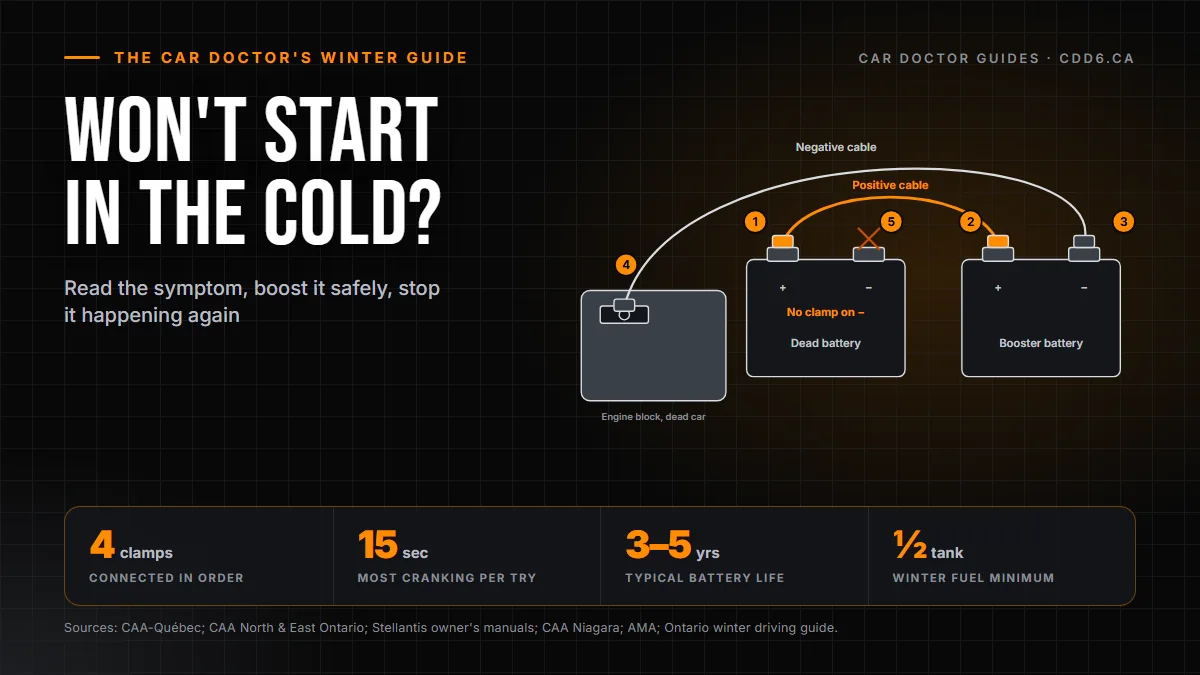
Jumper cable order, step by step
- Red clamp on the dead battery's positive (+) postThis one goes on first.
- Other red clamp on the booster battery's positive (+) postPositive to positive, never crossed.
- Black clamp on the booster battery's negative (−) postKeep the free black end away from everything metal.
- Last black clamp on bare, unpainted metal on the dead car's engineA bracket or a large bolt, away from the battery and the fuel system. This connection goes on last and comes off first.
- Never on the dead battery's negative (−) postA spark right beside the battery is how they explode.
To remove the cables, reverse the order: black off the engine first, then black off the booster, then the reds. Your owner's manual shows the connection points for your vehicle. Simplified drawing; the layout differs between vehicles.
Source: CAA-Québec; CAA North & East Ontario; Stellantis owner's manuals (2022 Ram 2500/3500, 2022 Wagoneer).
With all four clamps on, start the booster vehicle first and let it idle for a few minutes. Then try the dead car, still in short bursts. Once it is running, take the cables off in reverse order, as the drawing shows. Both CAA clubs and the Ram and Wagoneer manuals agree on that sequence. If you are using a portable jump starter, follow the instructions that came with it.

If it started, don't treat the problem as solved. The Ram owner's manual says a vehicle that keeps needing boosts should have its battery and charging system inspected, and a car that dies again shortly after a boost is pointing at the charging system. If it won't start even with a good boost, go back to the table above: it may not be the battery at all. And if it has to be moved, our guide on how to move a car that won't start covers getting it out of Park and onto a tow.
When should you stop and call roadside assistance?
A boost is a five-minute job in a driveway. It is a bad idea in some situations, and that is when you call your auto club or the roadside plan that came with your vehicle or insurance:
Call for help instead when
The battery looks wrong
Frozen, cracked, bulging or smelling of rotten eggs. Don't boost it.
It's a hybrid or EV
These have their own procedures. Use the manual or a professional.
You're on a live road
On a highway shoulder or in traffic, your safety comes before the car. Hazards on and wait for help.
A boost didn't work
Normal cranking with no start, or a single click with bright lights, needs a technician.
No second vehicle or jump starter
That alone is reason enough to call, as CAA North & East Ontario says.
How do you stop it happening again this winter?
Most cold no-starts are preventable, and the work happens in October or November, not on the coldest morning of January.
Test the battery before winter. A typical car battery lasts about three to five years, according to CAA Niagara and the Alberta Motor Association. AMA suggests a test at least once a year once it hits about three, and the RAC says the same age is when condition starts to matter. If it is due, our guides cover the right replacement and how to change it.
Give it a real drive. A string of short trips in stop-and-go traffic may never put back what each cold start takes out; both AMA and the RAC flag short trips as a winter battery killer. Unplug phone chargers and dash cams you don't need when the car is parked, because the Ram manual and CAA North & East Ontario both note that plugged-in devices can drain the battery.
Use the right oil. The W number on the bottle rates how well the oil flows when it is cold, and the RAC advises checking your handbook for the right grade. Stick to the grade your manual specifies; if your engine came with synthetic oil, AMA says to stay with synthetic. Our engine oil grades guide explains what 0W-20 and 5W-30 actually mean.
Plug in the block heater, if you have one. A block heater warms the engine so it turns over more easily on a frozen morning, as the Jeep owner's manual and the Natural Resources Canada advice quoted by the Citizens' Environmental Alliance both put it. Put it on an outdoor timer instead of running it all night. Sources differ on how long it needs: the Natural Resources Canada advice says two hours before you drive is enough, while AMA suggests three. Your owner's manual says where the cord is and any minimum time. And unplug before you drive off: the Jeep manual says so, and Winnipeg's fire service says an extension cord that a car has driven off with should be replaced, because of the fire risk.
Keep at least half a tank. Ontario's winter driving guide and CAA North & East Ontario both say to keep the tank at least half full through the winter. Ontario's reasons: it helps keep moisture out of the fuel system and adds weight for traction. It also means you're not running on fumes if you get stuck on the 404 in a storm.
Carry cables. Ontario's list for a winter survival kit includes jumper cables, and so does CAA's. A set of cables or a charged portable jump starter in the trunk turns a dead battery into a short delay instead of a ruined morning.
Cold-start checklist for the fall
Battery test
Once a year from about three years old, and before the first cold snap.
Right oil grade
The one in your owner's manual, synthetic if that's what it came with.
Block heater on a timer
A couple of hours before you leave, not all night. Unplug before driving.
Half a tank or more
Ontario's winter advice, and a buffer if you're stranded.
Cables in the trunk
Jumper cables or a charged jump starter.
If your current car keeps letting you down every winter and you're starting to think about something newer, come talk to me at Golden Mile Chrysler, on Eglinton East in Toronto. I'll give you a straight answer on whether a fix makes sense or it's time to move on.
Car Won't Start in the Cold: Common Questions
Why won't my car start when it's cold but starts fine when it's warm?
Cold slows the chemistry inside the battery, so it delivers less power, while cold engine oil thickens and makes the engine harder to turn. A battery that copes in mild weather can fall short on a frozen morning, especially once it is a few years old. Have it tested before winter.
What does it mean when my car clicks but won't start?
Rapid clicking usually means a weak battery that can't turn the engine over, and a boost often gets it going. A single click with bright dash lights points more toward the starter, and a boost may not help.
My car cranks but won't start in the cold. Is it the battery?
Probably not, if it cranks at normal speed. A healthy crank with no start points to fuel or spark, such as the fuel pump, filter, spark plugs, an ignition coil or a sensor. Check you have fuel, stop cranking after a few short tries and have it looked at.
Can you jump-start a frozen battery?
No. CAA-Québec and Stellantis owner's manuals both warn against boosting a frozen battery, and a cracked or swollen one should not be boosted either. Call roadside assistance instead.
How long should I crank the engine before stopping?
About 15 seconds at a time at most, then wait 10 to 15 seconds before the next try, which is what several Stellantis owner's manuals say. Your own manual may give a different limit. Cranking nonstop drains the battery and can overheat the starter.
Where does the last black jumper cable go?
On bare, unpainted metal on the dead car's engine, such as a bracket or a large bolt, away from the battery and the fuel system. Never on the dead battery's negative post, because a spark there can ignite the hydrogen gas a battery gives off.
How long does a car battery last in Canada?
Typically three to five years, according to CAA Niagara and the Alberta Motor Association. Once it reaches about three years old, have it tested before each winter.
This Month's Deals at Golden Mile Chrysler
November 2026 · All-in weekly finance pricing — tap a deal for full details.
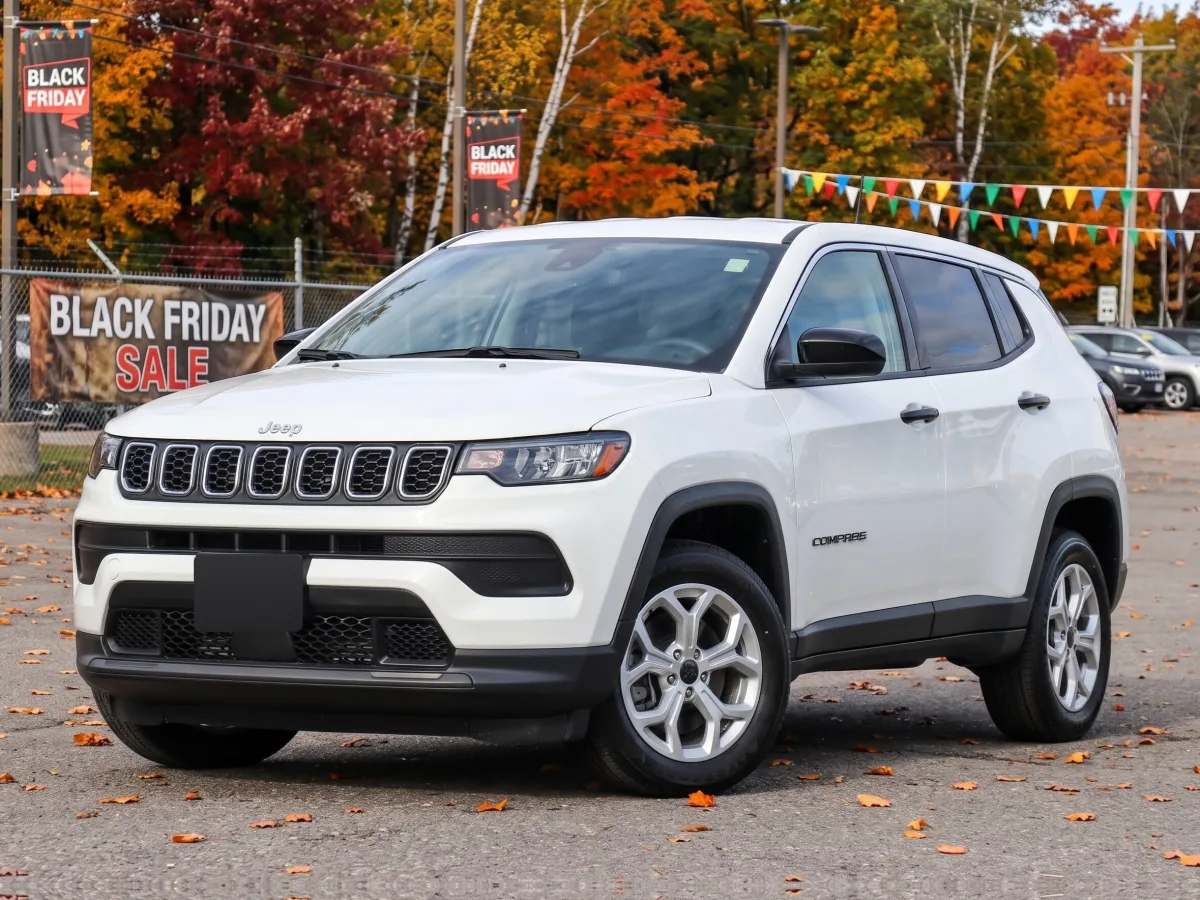
2026 Jeep Compass Sport 4x4 DEMO
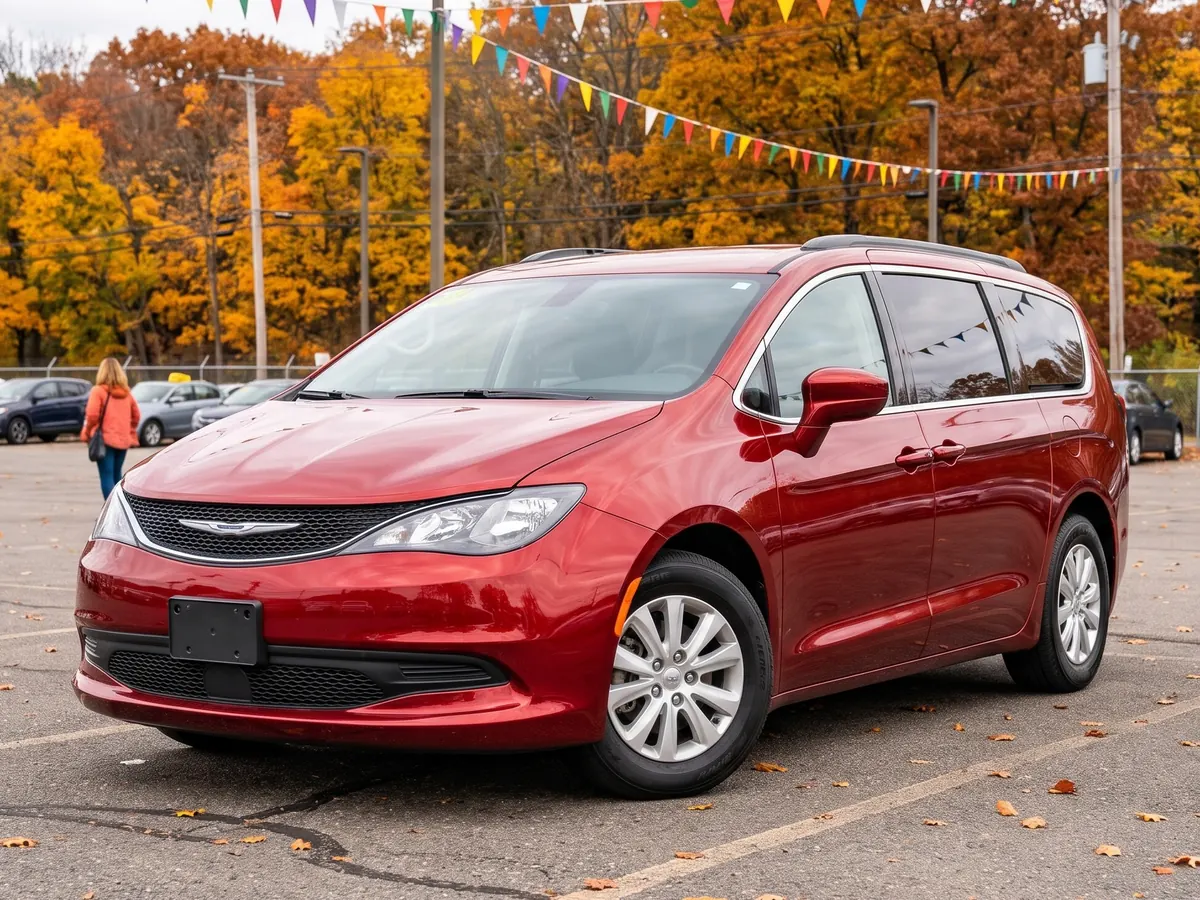
2026 Chrysler Grand Caravan SXT DEMO
A note on this month's offers. The CDD6 program is running finance offers only for November 2026 — there are no advertised lease specials in this cycle. Leasing remains available on everything Golden Mile Chrysler stocks; the terms are simply quoted directly rather than advertised as a special. Call 437-524-1747 and we will price it either way so you can compare.
Advertised weekly prices are all-in (freight, PDI, admin & OMVIC fees included); only HST and licensing are extra. On approved credit (OAC). Not all lessees or buyers will qualify — see dealer for eligibility. Vehicles subject to prior sale; see each deal page for full disclosure. E.&O.E. Call 437-524-1747.
See all of this month's deals Black Friday Used Car Sale: on until November 30, 2026 →
Talk to the Car Doctor
Straight answers, no games, no runaround. The line is open.
437-524-1747